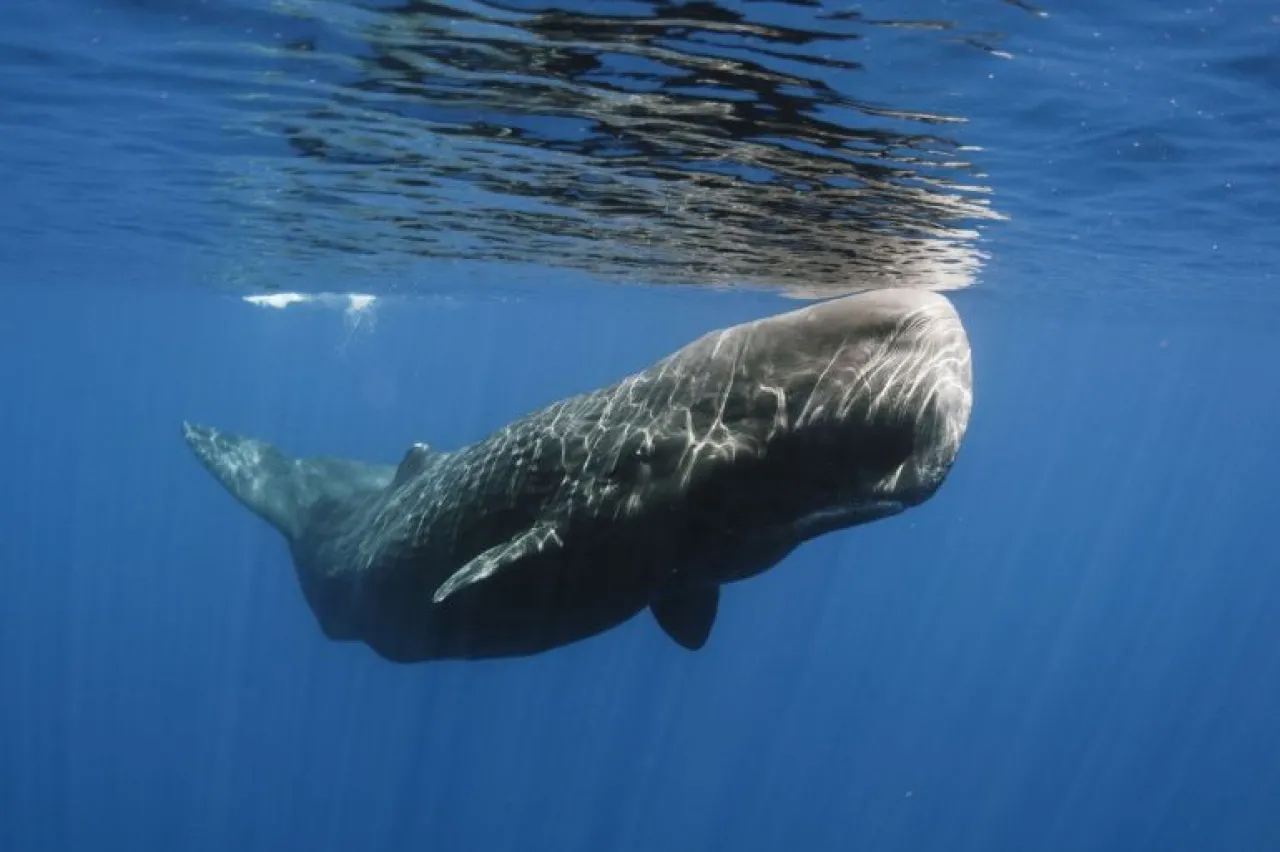
Khaberni - A US research team has discovered that sperm whales do not emit random clicks as was believed, but instead organize their sounds according to complex patterns that strikingly resemble the rules of human speech.
These strong clicks are known as "Coda," and are the primary means of communication for sperm whales. Although they appear to the human ear as mere repetitive knocks, a research team from the Whale Language Translation Initiative project discovered a new dimension to these sounds, which showed waveforms and frequencies resembling human language vowels acoustically.
According to the study published in the journal "Proceedings of the Royal Society B," prepared by a research team from several US universities, the researchers analyzed about 4,000 sound patterns recorded from whales living off the coast of Dominica in the Caribbean Sea. The study focused on female whales and their calves, as adult males generally live solitarily.
The scientists based their analysis on examining the shapes of the sound waves, identifying peak frequencies, and measuring the precise time intervals between each click, aiming to understand the rules of this communication.
Rules Similar to Human Language
The results showed that sperm whale clicks include five main features that intersect with human phonology (phonetics). The researchers classified the clicks into two main types, "Coda-A," with a single peak, and "Coda-I," with two peaks, and they noticed differences in length and rhythm between them, just as occurs in the pronunciation of letters and words.
It was also found that each whale has its unique "soundprint" in terms of click speed, which reflects individual differences similar to the differences in tone and speed of human speech.
Another notable similarity is that some clicks overlap with each other, whereby the first sound in the new pattern is affected by what comes before or after it, a phenomenon known in human languages when sounds overlap during pronunciation.
According to the researchers, combining these five properties allows sperm whales to produce thousands of different sound combinations, indicating a rich and complex communication system that may be one of the closest animal systems to human language.
Despite this similarity, the scientists affirm that these properties evolved independently in whales and humans, in a striking example of parallel evolution in nature.
The researchers believe that this discovery could pave the way for a deeper understanding of the meanings of these clicks, and perhaps someday their translation, opening an unprecedented window onto the world of these giant marine creatures. The closer scientists get to understanding the language of sperm whales, the greater the chances of answering a question that has long puzzled humans: What do these creatures say to each other in the depths of the ocean?