Khaberni - The Egyptian Ministry of Tourism and Antiquities announced on Saturday that the Spanish archaeological mission from the University of Barcelona and the Institute of the Ancient Near East has discovered a tomb dating back to the Roman era in the Bahnsa area of Minya governorate, during excavation work at the site.
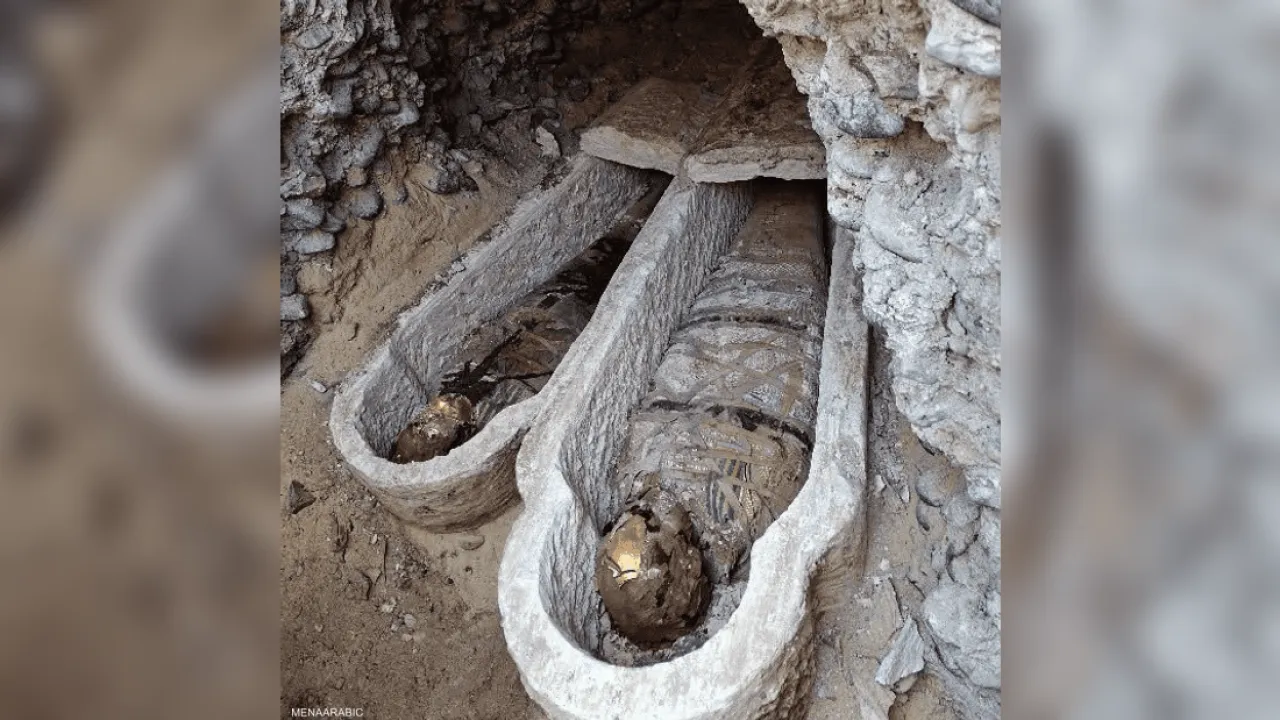
The ministry said in a statement that excavation work revealed several mummies from the Roman era, some wrapped in decorated wrappings with geometric designs, alongside wooden coffins, three golden tongues, and one of copper, as well as evidence of the use of gold leaf on some of the mummies.
The Egyptian Minister of Tourism and Antiquities, Sherif Fathy, confirmed that this discovery adds to the series of important archaeological discoveries recently witnessed in Minya governorate and reflects the richness and diversity of Egyptian civilization through the ages.
The Secretary-General of the Supreme Council of Antiquities, Hisham El-Leithy, explained that this discovery provides new insights on funeral practices in the city of Bahnsa during the Greek and Roman periods, pointing out the mission’s success in uncovering a rare papyrus inside one of the mummies, containing a text from Book II of Homer's Iliad, which describes the participants in the Greek campaign against Troy, known as "the Catalogue of Ships," noting that this discovery adds an important literary and historical dimension to the site.
Details of the Archaeological Discovery
Mohamed Abdel Badea, head of the Egyptian Antiquities Sector at the Supreme Council of Antiquities, added that excavations east of the Ptolemaic tomb number (67), discovered during the 2024 season, resulted in the opening of a trench containing 3 rooms built of limestone, of which only limited parts remain.
He explained that in the first room, a stone slab and a large jar containing burnt human remains of an adult were found, along with bones of an infant and the head of a feline animal, all wrapped in pieces of fabric.
The second room contained a similar jar housing the remains of two burned individuals, in addition to bones of an animal from the same species.
Small terracotta and bronze statues, including statues representing the deity Harpocrates in the form of a knight, and a small statue of Cupid, were also found south of the site.