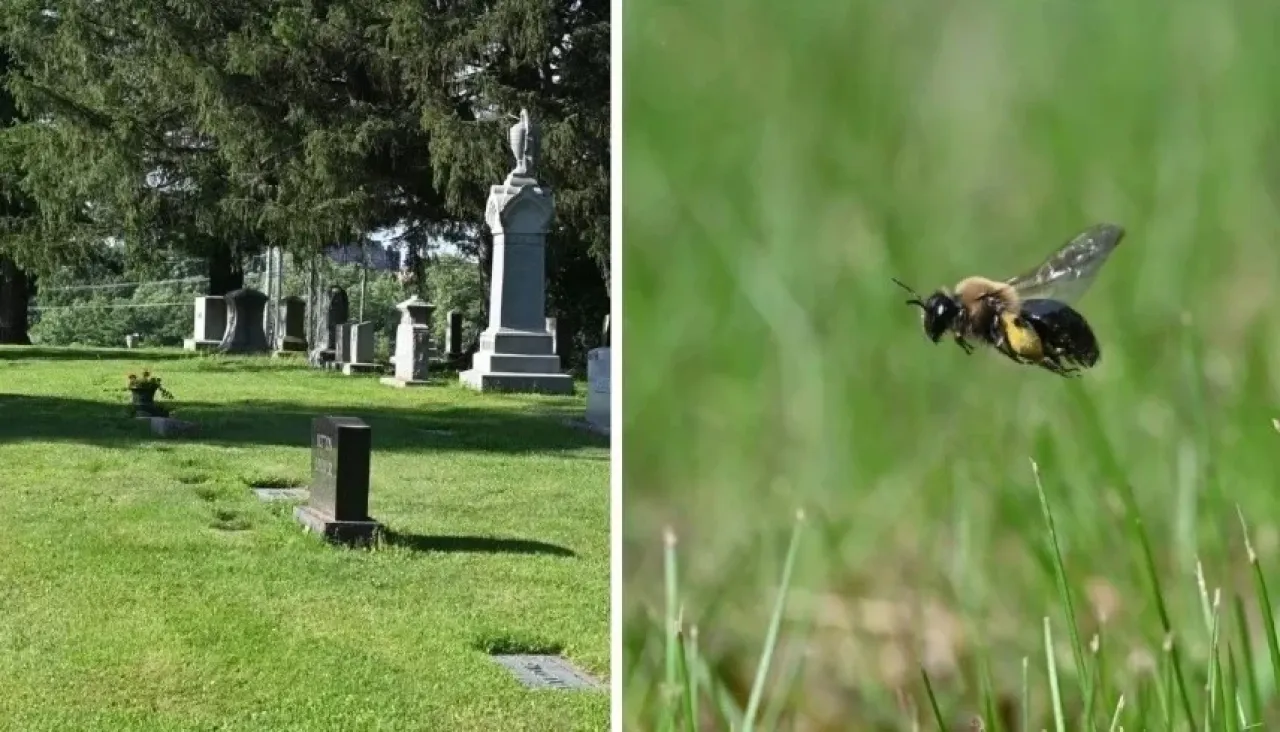
Khaberni - Insect scientists at Cornell University revealed an amazing environmental phenomenon that resides beneath the quiet soil of the "East Lawn" cemetery in Ithaca, where one of the world’s largest residential gatherings of bees was found, including an estimated 5.5 million bees living in secret underground tunnels.
This exciting discovery happened purely by chance when Rachel Forde, a technician at the Cornell Entomology Lab, stumbled upon a parking spot near the cemetery. As she walked, she noticed a vigorous bee activity emanating from the ground, prompting her to collect samples and show them to her colleagues, thus beginning the journey to explore this "environmental puzzle."
Unlike bumblebees that live in collective hives, this bee type belongs to the "ordinary mining bees," which prefer solitary living in ground burrows.
Scientific estimates indicate that every square meter of the cemetery’s sandy soil contains about 853 bees, making this aggregation the largest of its kind recorded in scientific literature to date.
The scientists believe that the quietness, absence of insecticides, and undisturbed or un-tilled soil makes cemeteries ideal environments and safe havens for these sensitive insects, which represent 75% of bee species globally.
The researchers relied on a precise field methodology that involved using exit traps to measure bee density during the spring season. The results showed hundreds of bees per square meter of sandy soil, with more than 3,000 insects identified across 16 different species, allowing for an estimation of the total population in the millions.
This discovery is not just a scientific curiosity, but it reveals a "natural economic engine"; these bees are among the most important pollinators for apple and blueberry crops in New York, yet they also face environmental threats including natural parasites like Nomada imbricata, known for its parasitic behavior on ground bee nests.
Researchers warned that such massive gatherings might be more widespread than currently known, but are threatened by urban expansion or land use changes, affirming that cemeteries and undisturbed areas are ideal environments for the survival of this type of bee.
The study, published in the journal Apidologie, concluded by emphasizing the importance of enhancing global awareness of ground bees and launching research initiatives involving the public, so non-specialists could assist scientists in monitoring bee gathering sites, recording them, and protecting them, which contributes to preserving these ecosystems before they are irrevocably lost.