




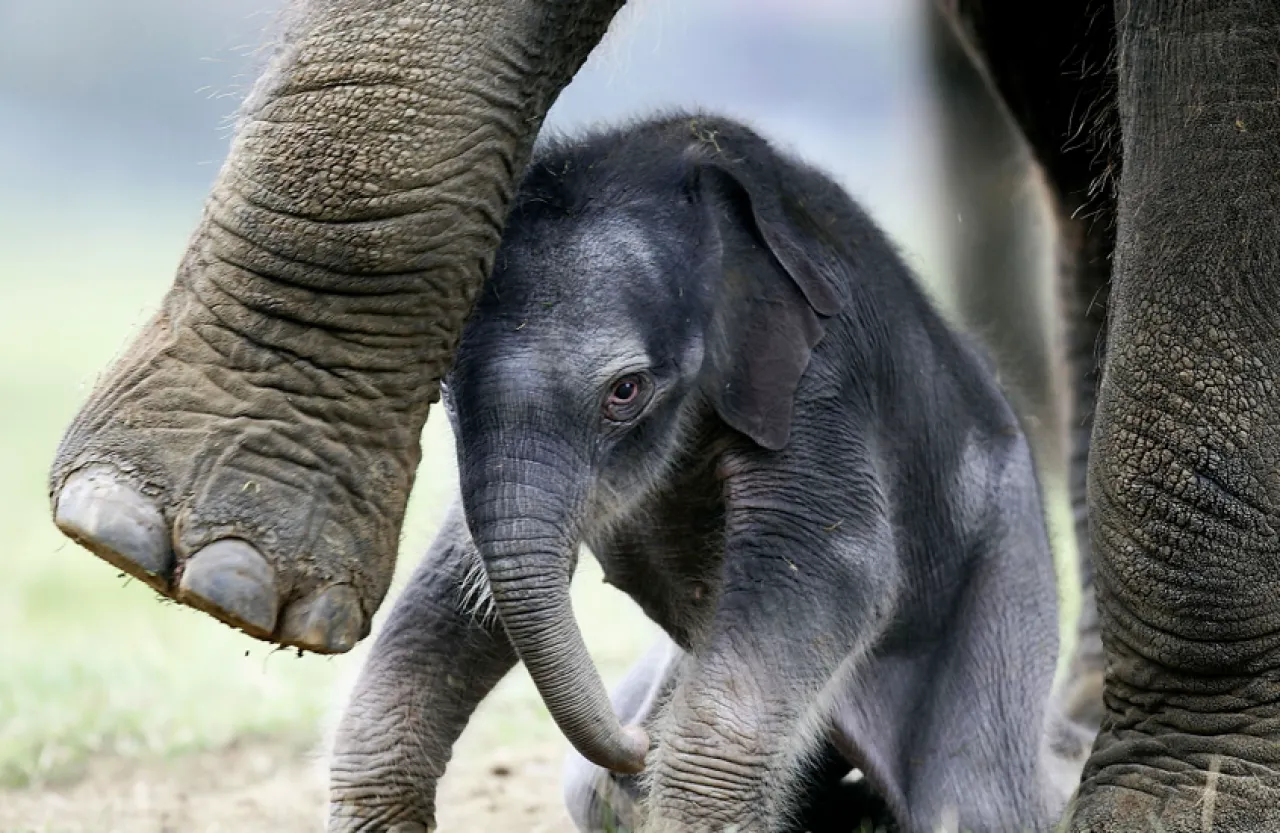
Khaberni - The story of a young Asian female elephant garners wide interest after she shifted from being rejected by her mother to becoming a notable model of care and compassion, attracting considerable attention on social media.
The Asian female elephant "Lin May" was born at the Smithsonian's National Zoo in Washington on February 2nd. However, her mother "Ni Lin" exhibited aggressive behavior towards her in her early days, leading to their separation with the reason for this rejection still unknown to date.
On the other hand, the elephant "Swarna" stepped in to take care of her. Although she had never given birth before, the zoo management confirms that she has shown a remarkable innate ability to care for "Lin May", successfully balancing providing protection for her and granting her a suitable degree of independence.
In the early days, "Lin May" primarily relied on caregivers who fed her using bottles. But over time, she began to bond with "Swarna", and started to mimic her movements, after initially being more impulsive and distant from her.
The zoo management describes this relationship as significantly evolving, noting that monitoring the interaction between the two elephants reveals a growing bond that reflects increasing harmony and understanding.
Despite being separated from her mother, "Lin May" appears to be full of vitality and energy, according to the care team, who also mentioned that taking care of the young elephant, especially with the need for around-the-clock feeding, is a challenging task, but very rewarding.
On the other hand, the story of "Lin May" has sparked widespread interaction on social media, with many expressing sympathy and amazement at her situation, and some comparing her story to that of the monkey "Punch" who previously garnered significant attention under similar circumstances.
In a notable comment, one follower questioned why the mother rejected her young, while others expressed mixed feelings of sadness and empathy, and there were also humorous comments where some expressed being deeply moved by the story.