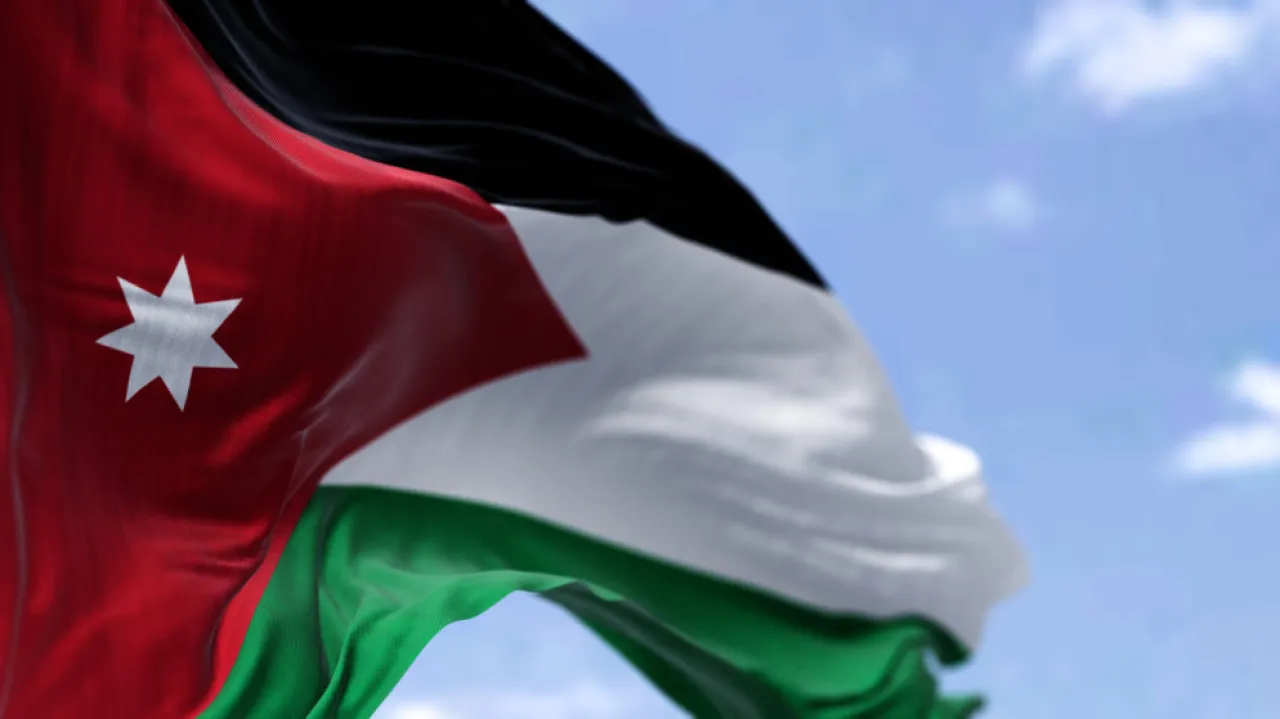
Khaberni - The Constitution of Jordan specifies the flag, where Article 4 states: "The flag shall be in the following form and dimensions: its length shall be twice its width, and it shall be divided horizontally into three equal parallel parts: the upper part black, the middle part white, and the lower part green. A red right-angled triangle, with a base equal to the width of the flag and a height equal to half its length, shall be placed next to the hoist. Inside this triangle, a seven-pointed white star with an area that can be filled by a circle with a diameter of one-fourteenth of the flag's length is positioned, with its center at the intersection point of the lines between the angles of the triangle, and with an axis passing through one of the vertices parallel to the base of this triangle".
The flag is seen as an indivisible part of the nation-building process, and it reflects the growing sense of patriotism among the people, intensifying their feeling with a collection of symbols, signs, and colors, and endowing them with meanings and significances that accumulate over the days, preserving their national memory. It records unforgettable events where the flag was flown during the first Jordanian National Congress on July 25, 1928, attended by over one hundred and fifty national figures, emphasizing the people as the source of powers and preserving the interests of the nation.
The flag itself was raised by Jordanians during the declaration of the independence of the Hashemite Kingdom of Jordan on May 25, 1946, which established their sovereignty over the land, marked the end of the British Mandate that lasted about twenty-five years, and included the swearing-in of the late King Abdullah bin Hussein. This day is written as a historical day in the page of Jordan, meeting the challenges of modernization and development, and dignity.
The current design of the Jordanian flag was adopted in 1922, derived in its form and colors from the flag of the Great Arab Revolt, which started in 1916 in Makkah. Its colors, black, white, and green, represent the Umayyad, Abbasid, and Fatimid Islamic Arab civilizations, respectively, while the red triangle joining the parts of the flag represents the Hashemite family, and the seven-pointed star at the center of the red triangle symbolizes the seven verses of Al-Fatiha in the Holy Qur’an.
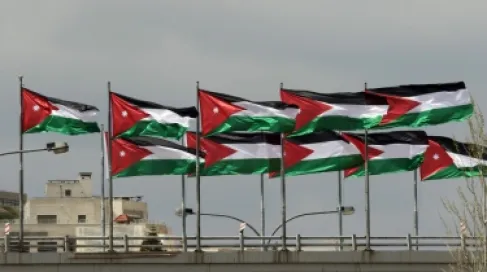
On Thursdays, Jordanians hold public and official events, celebrating Flag Day across all provinces, according to a national plan coordinated among all ministries and national institutions to carry out field and media events and programs that reflect and affirm the meanings of pride and loyalty, and ingrained the flag in the visual landscape and societal behavior across the provinces of the kingdom.