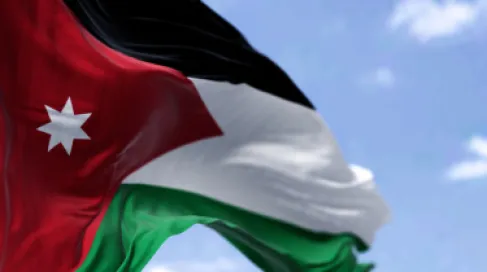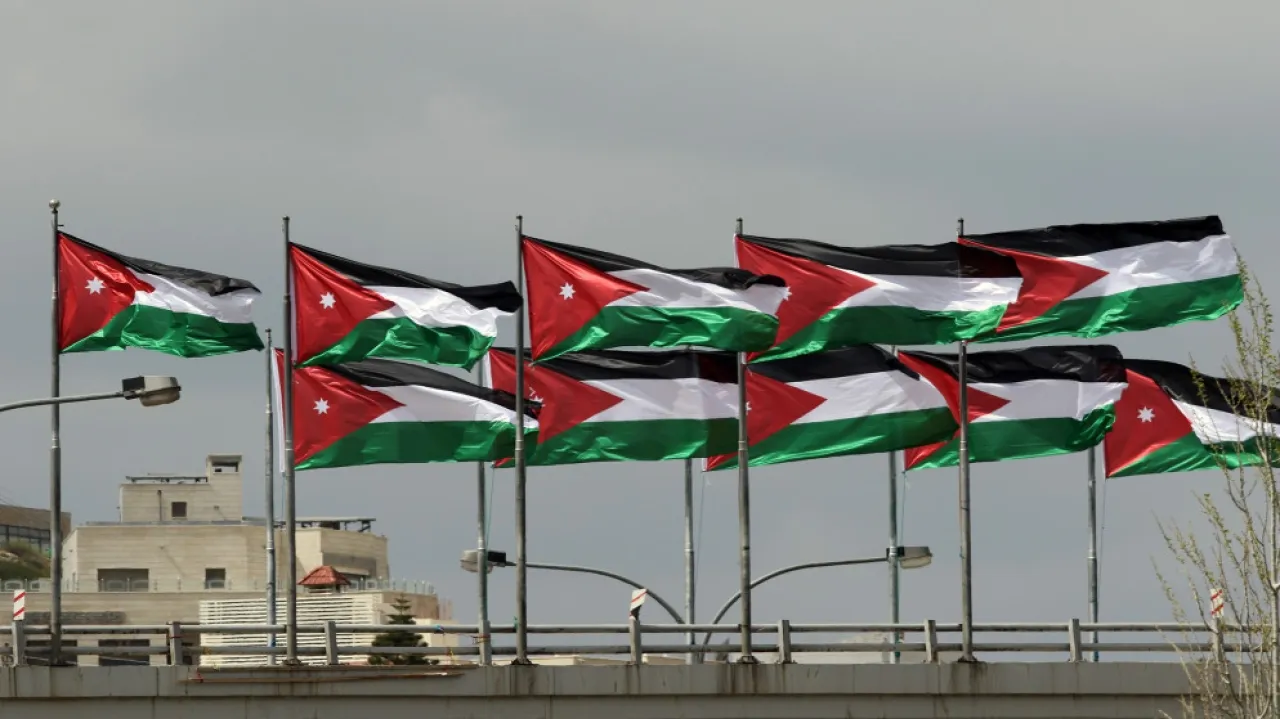
Khaberni - Jordanians observe on Thursday the sixth anniversary of Flag Day, which falls on April 16 of each year, remembering on this day that it was first raised 104 years ago, and since then Jordan has been moving forward with stable strides, inclusive of all, where humanity and the values of justice and law prevail under a balanced Hashemite leadership, safeguarded by the arms of the brave Jordanian Armed Forces – the Arab Army and security institutions, ensuring its safety and prosperity, with its flags high and waving.
On March 31, 2021, Jordan decided to make this day each year "Flag Day," given its significance and importance in reinforcing belonging and national values, as it represents a Jordanian identity that extends over more than a century. On this day, Jordanians nationwide and extending from their national soil to the global stage and international forums raise the flag, which is held by the hands of children, youth, the elderly, and women across Jordan's geography.
Official documented information from Jordan’s archives and heritage indicate that the use of the flag in its current form began in the year 1922, and it was officially adopted with the issuance of the Basic Law of the Emirate of Transjordan in 1928. Its design and colors are derived from the flag of the Great Arab Revolt that began in 1916.
The Royal Jordanian Documentation Center indicates in its archives that the newspaper "Al-Qibla" published in its issue No. 82 on June 8, 1917, an official statement proclaiming the adoption of the Arab flag beginning from Shawwal 9, 1335 AH, coinciding with the first anniversary of the start of the Great Arab Revolt. The statement outlined that the flag consists of three parallel colors "black, green, and white linked to a red equilateral triangle".
The newspaper clarified, according to the archives of the center, that the black color is a symbol of the "Black Banner" which Prophet Muhammad "peace be upon him" used to raise in his battles, and it is the same color used by the Abbasids for their banners. The green and white colors are emblems historically raised by the Arabs, while the red aniline color is the color of the banner that the Sharifs have been raising since the time of Sharif Abu Numay.
The center explained that on March 13, 1922, an official bulletin was issued in issue No. 568 of “Al-Qibla” newspaper stating, "Given that the white color was initially placed at the bottom of the Arab Hashemite flag in a way that it was not properly visible, it was decided by the council of ministers and a royal decree was issued to amend it to the following: positioning the white in the middle, and the green in the place of white and black in its original place as before."
It adds that, in 1928, the Basic Law was issued which detailed the design and dimensions of the flag of Transjordan. On May 25, 1946, Prince Abdullah bin Hussein signed the independence resolution which included the proclamation of Jordan as an independent nation in full sovereignty, endorsing Prince Abdullah as king over Jordan. This was followed by the issuance of the Constitution of the Hashemite Kingdom of Jordan in 1946, published in issue No. 886 of the Official Gazette on February 1, 1947, which detailed in Article 4 the design and dimensions of the Jordanian flag, along with the 1952 Constitution issued under King Talal bin Abdullah, detailing its design and dimensions.
The center points out that the significances of the flag of the Hashemite Kingdom of Jordan include: "The black color: the Eagle Banner, which is a banner of the Prophet Muhammad "peace be upon him", and was adopted by the Abbasids as their emblem. The white color represents the Umayyad dynasty, the green color denotes the Fatimid state, the banner of the Ahl al-Bayt, while the red equilateral triangle is the banner of the Hashemites since the era of their grandfather Sharif Abu Numay. The seven-pointed star symbolizes the Al-Fatiha of the Holy Quran consisting of 7 verses."
The historian Bakr Khazer Al-Majali stated that the Jordanian flag, with its current colors and design, represents the depth in authentic Arab history, and Jordan always focuses on this value to make this history have goals, reasons, and forms of deepening nationalism and loyalty to the land and belonging to it, as well as loyalty to the Hashemite leadership.
He added that in every occasion and event, you find the Jordanian flag showing our original identity, and this value has risen among Jordanian generations over time and with every crisis Jordan overcomes. The sight of the flag in the finals of the Asian Cup and the Arab Cup, raised and carried and decorating the screens, instills pride in having a Jordanian identity with this flag.
He mentioned that the year 1922 witnessed a modification to the arrangement of the flag's colors to position the white in the middle for better visibility between the black above and the green below, while keeping the red triangle and the seven-pointed star, which carry several meanings including reaching desires and goals, the nobility of the human soul, humility, and social justice. These significances indicate the dimensions of the Jordanian state, with the first significance in the seven-pointed star being faith in God.
He affirmed that the Jordanian flag holds a high national value and various meanings and significances, and since April 16 of each year became a day of celebration in the flag, attention to it has increased, reminding generations that the flag is both identity and history.
On his part, Dr. Muhammad Rabab'ah, Professor of Political Science, said that flags historically represented empires and kingdoms, and even armies had their specific flags, especially used in wars to guide soldiers. Thus, the flag embodies the history of the state and has symbolism indicating historical significations that color the state and establish national identity...
Maysa Al-Rawashdeh, Professor of Sociology at the University of Jordan, said that the Jordanian flag carries a deep national symbolism that we remember throughout the year and remember even more on April 16 of each year, as it represents the nation and reflects the identity of its people, who regard it as an embodiment of their history and belonging, with respecting and appreciating it being a respect for the national identity, and a celebration of everyone who carries this identity and embodies it in actions.
She added that this respect is evident in raising the flag during national occasions, keeping it neatly and beautifully on top of institutions and homes, and in markets; in our joys, we raise it and decorate our homes with it, while in moments of sorrow, we lower it as an expression of solidarity and grief, thus the flag becomes a living symbol expressing community emotions in various states, and embodies the history and authenticity of the state, reflecting the identity of its people.
She affirmed that celebrating Flag Day signifies the importance of its symbolism, and strengthens the values of unity, resilience, and belonging, as the flag remains a symbol of the homeland to which the individual belongs, from which they derive their identity and existence, with celebrating it being a national opportunity to renew belonging and loyalty, and to enhance awareness of the collective national symbols.
Also, she pointed out that in light of successive crises and misleading campaigns that Jordan faces, it is necessary to enhance social cohesion and unity, where the flag becomes a unifying symbol that transcends differences, and in times of crises, rallying around the flag reflects a state of national solidarity and adherence to stability and faith in society's ability to overcome challenges, indicating the presence of a strong national identity, forming a common reference for individuals in difficult circumstances.