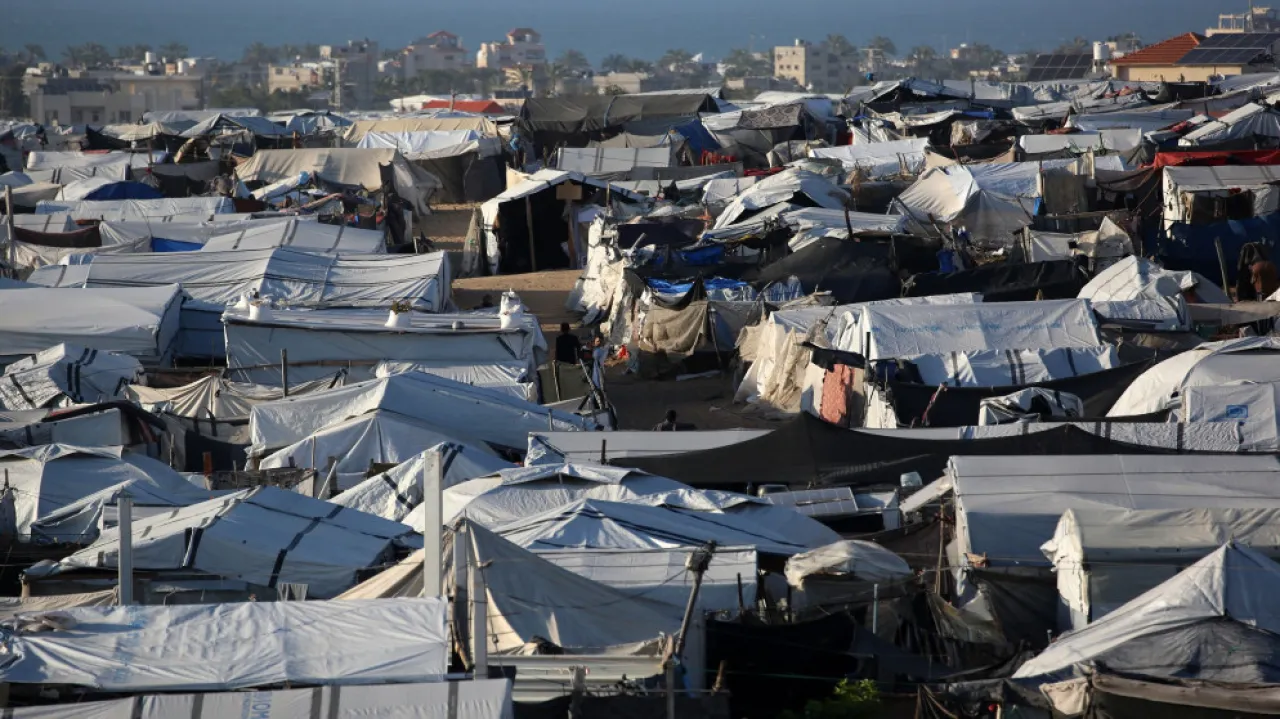
Khaberni - Mohammed Aldayah did not expect to lose his expected newborn due to displacement conditions, not by bullets or Israeli occupation bombings, but because of a tent he had sought refuge in for about a year, which collapsed on him and his pregnant wife under the weight of fierce winds.
Aldayah (36 years old), a displaced person at the "Qatari Al Atta Camp" on Salahuddin Road at the entrance of Al Bureij Camp in central Gaza, is waiting in Nasser Hospital in Khan Younis for news about his wife Marleen Imad (30 years old), who is in a coma in the intensive care unit, unaware that her fetus in its seventh month has passed away.
Aldayah details the events, saying that the strong winds during the last storm caused the tent to collapse, and one of its iron poles fell on his pregnant wife's abdomen, causing her injuries.
He adds that he initially took her to Al Awda Hospital in the middle of the sector, where he was informed that her condition was stable, but it quickly deteriorated after returning to the tent, as she lost consciousness and was transported with difficulty to Nasser Hospital in Khan Younis, where tests showed that the fetus had died, and that she was suffering from severe bleeding threatening her life.
He continues that his wife is still in a coma inside the intensive care unit, in a critical health condition, at a time when doctors are unable to perform a delivery for her until her condition stabilizes.
Aldayah says that the loss of his fetus was a result of living in tents, expressing his fear of losing his wife also at any moment, given the dangerous state of her health.
Aldayah had been displaced 7 times, before settling in the Al Atta camp, after his house was destroyed in eastern Al Bureij Camp.
This case reflects the suffering of a large segment of displaced persons in the Gaza Strip, where about one and a half million displaced people live in dilapidated tents or temporary shelters. Reports indicate that about 125,000 tents out of 135,000 have collapsed, making most of them unfit for residence and exposing their inhabitants to increasing risks, especially during the winter season.