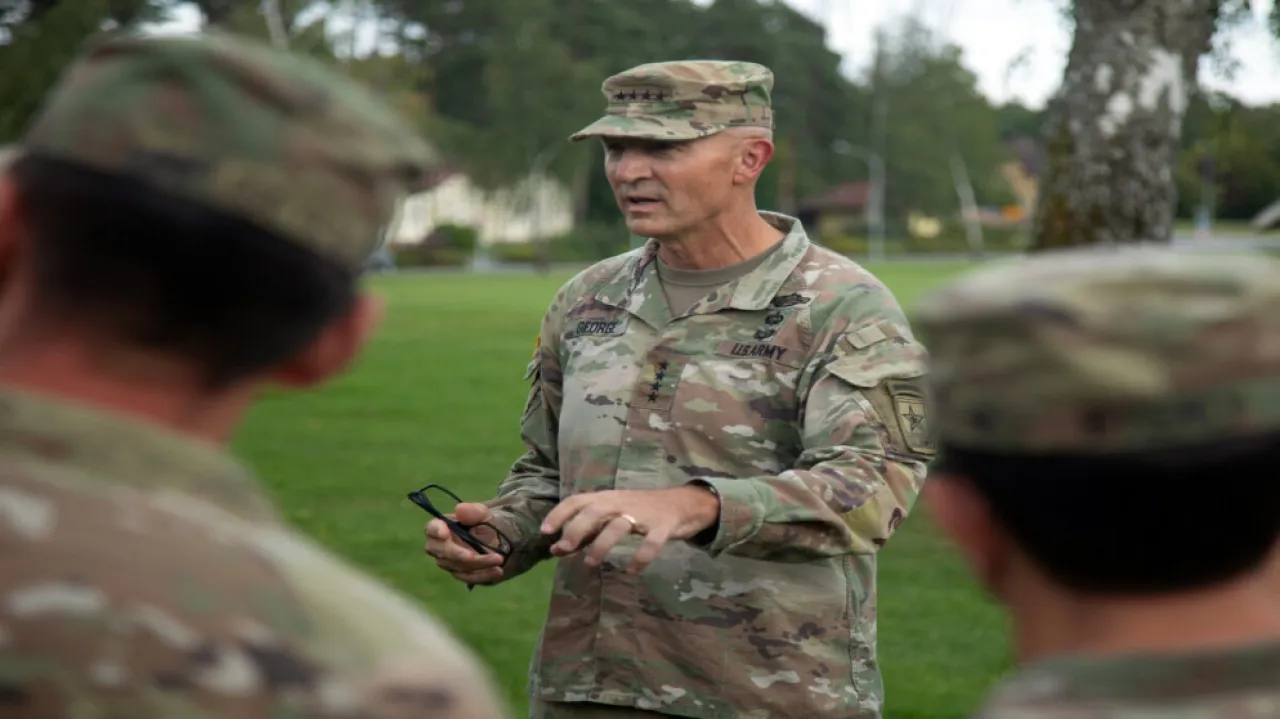
Khaberni - Four decades of stringent military service, and a seat at the highest peak of the leadership pyramid of the American army, all evaporated within 24 hours. Yesterday morning, Thursday, General Randy George, like his daily routine, entered the Pentagon gates only to be met with an immediate and decisive dismissal decision awaiting him on his desk, signed by Defense Secretary Pete Heigseth; a dismissal devoid of any prior notice, devoid of traditional military farewell ceremonies or even accountability sessions, amidst the height of the Iran war.
This abrupt shift goes beyond the usual administrative changes accustomed to with the change of successive administrations, putting Washington before a silent quake undermining the military institution's roots.
The ousting of the officer, who is one of the most prominent military leadership figures in the era of President Joe Biden, opens the door wide to decoding the new phase within the American Defense Department, raising urgent questions about the newly introduced criteria determining the generals' continuance in their positions, and the nature of the muted clash between the Pentagon’s accumulated institutional legacy and the incoming political doctrine aiming to reengineer the American army from top to bottom.
To understand the weight of what transpired, it is essential to know who the dismissed man is. Randy George graduated from West Point military academy in 1988, and built a field career spanning four decades. He also participated in "Desert Shield" and "Desert Storm" with the 101st Airborne Division, then got deployed several times in Iraq as part of "Operation Iraqi Freedom," where he commanded a battalion then a full brigade.
In Afghanistan, he led the 4th Infantry Division as part of "Operation Enduring Freedom". Before taking over as Chief of Staff, he held the position of Commander of the First Corps at Joint Base Lewis-McChord, followed by Vice Chief of Staff.
Therefore, the question of why he was dismissed is very logical at such a time, as someone with such a rich field record is not typically dismissed for incompetence, but rather for an entirely different reason. And this different reason is what annoyed Heigseth.
George previously held the position of senior military assistant to former Defense Secretary Lloyd Austin, the most prominent face of defense policy under Biden. This closeness to the previous administration was, in the eyes of Heigseth and his circle, considered a "stigma" that made George incompatible with the new vision of the Pentagon, regardless of decades of field service. For the War Secretary in Trump's administration, loyalty takes precedence over competence.
Chief of Staff between "warrior spirit" and "institutional mind"
To understand what happened, one must delve into Heigseth's philosophy that he never concealed. Since assuming his position, the War Secretary in Trump's administration explicitly announced that his mission was to "restore the warrior spirit" in an army he saw as "deteriorated for decades" due to what he described as political agendas and policies of diversity and inclusion.
In this vision, there is no place for officers whose leaderships were shaped under previous administrations, nor for those who prioritize institutional considerations over loyalty to the new direction. And George exemplifies perfectly the model Heigseth wants to dispose of: a professional officer, politically neutral, raised under a different military doctrine.
The dismissal of George is not an isolated incident, but is the apex of a systematic pattern that began since the first months of Heigseth’s tenure.
In just one day, February 21, 2025, Heigseth dismissed an entire batch of the country’s top military leaders: General Charles "CQ" Brown, Chief of the Joint Chiefs of Staff; Admiral Lisa Franchetti, Commander of Naval Operations; and General James Slyfe, Vice Chief of Staff of the Air Force.
The wave did not stop there; in August 2025, Lieutenant General Jeffrey Cruz, Director of the Defense Intelligence Agency (DIA), was dismissed, and in October, Lieutenant General Dan Cain was removed after accumulated tensions. Culminating with George in April 2026, thereby completing a scene of purification that the American military institution has not witnessed in its modern history.
When the law was also silenced
There is a dimension that almost escapes ordinary news coverage, but it illuminates the complete picture of what's happening inside the American military leadership: on the same day that Brown, Franchetti, and Slyfe were dismissed, Heigseth's firing extended to the heads of the military legal offices in the Army, Navy, and Air Force all at once.
Lieutenant General Stewart Reisch, the head of military lawyers in the Army, and Admiral Christopher French, the head of lawyers in the Navy, were dismissed. In March 2026, Heigseth issued orders for a “comprehensive and merciless review” of the entire military lawyers' offices.
Kori Schake from the American Enterprise Institute (AEI) believes this step is not incidental, but a necessary complement to the dismissal of generals: silencing military lawyers aims to “remove legal obstacles” before orders that might violate international rules of engagement or the law of war, in a scene where institutional guarantees erode from the top of the pyramid to its base.
What do the experts say?
This dismissal did not pass without sparking a wave of sharp analyses among American think tanks specializing in military and national security matters.
Peter Feaver, a professor at Duke University specializing in civil-military relations, describes what's happening as a "purge" targeting personal loyalty rather than professional competence, asserting that targeting the generals in this manner "breaks democratic norms and creates a deep confidence crisis" within the military institution.
Mara Carlin from the Brookings Institute, former Assistant Secretary of Defense, argues that what's happening is a "serious philosophical shift" in the nature of the relationship between political leadership and the military institution, criticizing the administration's justifications that she describes as a "scattered menu" of contradictory reasons that do not align with any consistent strategic rationale.
Michael O'Hanlon, a senior fellow at Brookings, adds an operational dimension that cannot be ignored: dismissing leadership during an active military conflict with Iran is "reckless" by all measures, as it undermines the stability of military planning and deprives the institution of its "strategic memory" in its darkest moments.
Jim Golby, specializing in civil-military relations, points out that this approach essentially undermines the principle of "objective civil control" over the army, where personal loyalty to the president and minister becomes the primary criterion for promotion and retention in position, instead of professional competence and institutional neutrality.
Succession.. Who will fill Randy George’s vacancy?
Reports indicate that Brigadier General Christopher Laney, who held the position of Heigseth’s personal military assistant, is the foremost candidate to succeed George. The potential implications of this choice are clear to everyone: not necessarily the most competent, but the closest to the minister and most aligned with his vision. This cements fears that the Pentagon is moving towards a leadership model that prioritizes loyalty over competence at the apex of its military hierarchy.
What does this mean for the American army?
The repercussions of this dismissal extend beyond the Pentagon to affect the entire American security infrastructure. On an institutional level, consecutive dismissals during wartime lead to the loss of what's known as "institutional memory"; that accumulated strategic expertise built only through decades of field service and planning in the most complex crises.
When this expertise is replaced by new faces owing their allegiance to the current political leadership rather than to the institution, the ability to make independent military decisions based on objective data erodes.
On the morale side, this approach discourages officers from offering honest military advice, fearing it may be interpreted as political opposition. This produces a dangerous phenomenon researchers call "institutional silence"; where officers prefer silence or acquiescence to what is asked of them, rather than risking their professional futures by presenting a dissenting opinion, even if that opinion is the most strategically correct.
On the international stage, allies watch these transformations with escalating concern. When allies see that the Chief of Staff of the American army can be dismissed overnight without declared justifications, it raises fundamental questions about the reliability of American commitments in defense alliances, casting shadows over the entire Western defense cooperation system, from NATO to bilateral partnerships in the Indo-Pacific region.
Randy George quietly left the Pentagon, as befits an officer who spent four decades serving his country, from the deserts of Kuwait to the mountains of Afghanistan. But the questions he leaves behind are anything but quiet. Is Heigseth building a stronger and more decisive army, or an army that is more obedient and less independent? The difference between the two is not just a matter of administrative philosophy but is the line dividing a military institution that protects the Constitution, and an institution serving power. And this line, as experts warn, is thinner than ever before.