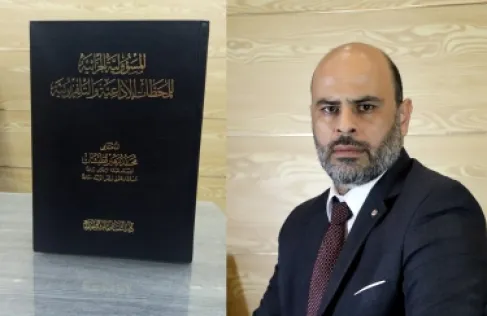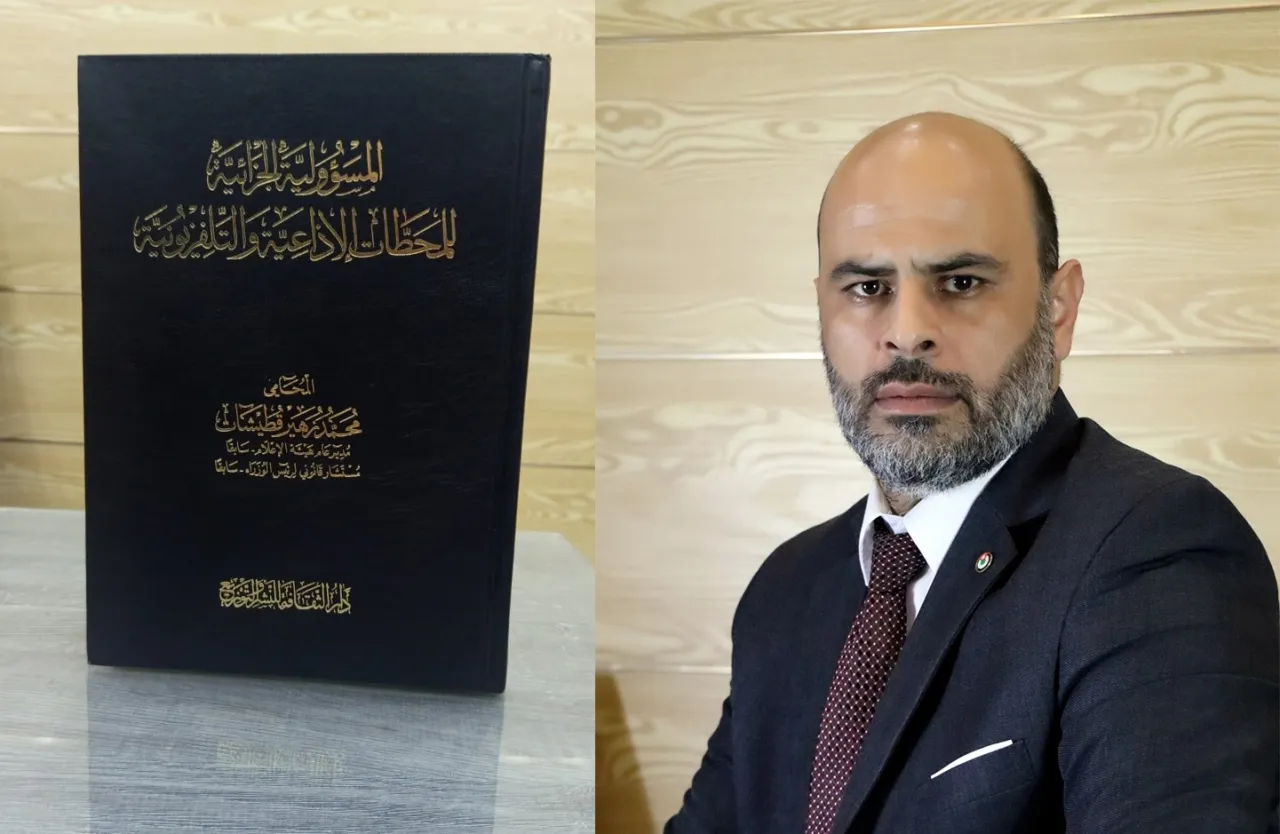
Khaberni - Often, the fourth estate is seen as a wide space for freedom of expression and criticism, which might create a false impression of absolute immunity that distances media institutions from the realm of criminal accountability. A deep reading of the legal regulation of the media sector, however, reveals a legislative reality that is clearly manifested in the quality work of Lawyer Mohammed Qutaishat, the former director of the Audio-Visual Commission, titled: "Criminal Responsibility of Radio and Television Stations". This book represents a forward-looking critical review that regulates the relationship between media freedom and criminal responsibility in light of contemporary technological developments.
.
Qutaishat has succeeded in dismantling textual isolation to prove that media work is governed by a tri-dimensional legal convergence: the law of visual and auditory media, the law of press and publication, and the Jordanian Penal Code, which serves as the general law in criminalization and punishment; this intersection confirms that a specific law does not cancel the general one, but rather complements it to ensure that no media transgression escapes accountability, especially in cases of defamation, slander, or threats to national security.
.
The study concluded with key results that establish this responsibility, most notably:
The unity of the punitive path: criminal responsibility increases with the number of applicable penal laws, which necessitates a comprehensive understanding of the limits of all laws.
.
The legal root of responsibility: Qutaishat anchored the criminal responsibility of the stations as legal entities based on Article (74/2) of the Penal Code, although the legislator in Article (29) of the Audio-Visual Media Law has established station responsibility in all cases.
.
This book establishes the principle of dual subjection to criminal responsibility, which is consistent with the title of the work and the significance of its subject:
Corporate entity responsibility: Stations are criminally liable for crimes committed in their name, facing penalties ranging from major financial fines to broadcasting suspension or license cancellation; here, the author makes a subtle distinction: Stations are accountable for recorded programs as they possess the time for review, but are exempt in live broadcasting (such as conferences and seminars) unless the event is unlawful or against public order.
.
Individual liability (staff): Applying the principle of personal penalty, the staff's responsibility (presenters, producers, directors, guests, and station manager) remains; however, Qutaishat sees the station exempted from their actions if it proves to be beyond its control and will despite obeying all regulatory body instructions.
.
The author not only deconstructed and analyzed legal texts but also presented reform recommendations to bridge the gaps resulting from the disparity between the old text and the technical reality, summarized as follows:
Modernization of definitions: The author calls for amending the second article to define the station comprehensively, including internet and application broadcasting, to ensure that no criminal accountability escapes under the pretext that the medium used does not fall under the traditional concept of a station.
.
Adjusting vague texts: The researcher criticized Article (20/l) of the Media Law for its lack of discipline in drafting, warning that it violates the principle of legality of crimes and penalties.
.
Addressing feedback: He recommended adding provisions that handle the station's responsibility for the public's interactive comments and opinions, asserting that traditional accomplice laws are no longer sufficient to cover digital space crimes.
.
Updating the licensing system: He emphasized the need to cancel or amend the fees and licenses system of 2003, as it does not keep up with technological development, causing chaos with unlicensed stations broadcasting online.
.
The added value of Qutaishat’s book lies in its precise balancing; while it acknowledges the rights of stations to critique and cover crimes, it safeguards this right with controls that protect others' rights and the course of justice. Adopting these recommendations would mean moving Jordanian legislation to a stage of responsible digitization, where the rule of law is entrenched without restricting media creativity with vague texts, ensuring professional, objective, and judicially and socially responsible media presentation—an increasing necessity amid practices on digital spaces and social media platforms.