Khaberni - The Israeli Knesset approved, on Monday evening, by a majority of 62 deputies against the opposition of 48 deputies and one abstention, the law on executing Palestinian prisoners.
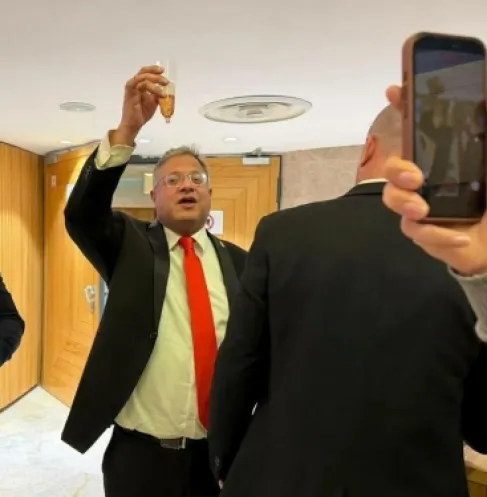
National Security Minister Itamar Ben-Gvir was seen distributing "champagne" to right-wing deputies, describing the passing of the law as a "historic day." After the vote, he wrote on the X platform, "We made history!!! We promised. We delivered."; he had made the death penalty for Palestinian prisoners one of the main pledges in his 2022 election campaign.
The bill stipulates that any person "who deliberately causes the death (of another person) intending to harm an Israeli citizen or resident, and with the intention of ending the existence of the state of Israel, shall be punished by death or life imprisonment", according to the text.
According to the law's draft, Israel can impose the death penalty on any Palestinian citizen who kills an Israeli citizen, but under no circumstances can it be applied to an Israeli who kills a Palestinian.
The two Arab Knesset members from the Druze community, Akram Hasson and Afeef Abdul, voted in favor of the law.
The following are the names of those who voted for and against the law:
The voters for the law
– Likud Party (right): all its 32 deputies, including: Benjamin Netanyahu (Prime Minister), Amir Ohana, Dan Iluz, Amit Halevi, Zeev Elkin, Avichay Boron, David Bitan, Boaz Bismuth, Nir Barkat, Tali Gotliv, Mai Golan, Gila Gamliel, Avi Dichter, and Gilat Distel Atbaryan.
In addition: Eliyahu Dalal, Shalom Danino, Amit Halevi, Nissim Vaturi, Ofer Katz, Yisrael Katz (Minister of Defense), Yariv Levin, Hanoch Milwidsky, Tziga Malako, Moshe Saada, Afeef Abdul (Druze), Ity Hafa Atia, Moshe Basal, Ariel Kalner, Shlomo Karei, Eliyahu Revivo, Cathy Sheetrit, and Osher Shikalim.
– Shas Party (religious right): all its ten deputies, including: Moshe Abutbul, Yinnon Azulay, Moshe Arbel, Uriel Busso, Yoav Ben-Tzur, Aryeh Deri, Yossi Taieb, Jonathan Meshraki, Michal Malkieli, and Yaakov Margi.
– New Hope - The National Right (right): 3 deputies, namely: Michelle Boscila, Sharren Haskel, and Akram Hasson (Druze).
– Jewish Power Party (extreme right): all its five deputies, including: Itamar Ben-Gvir (party leader and Minister of National Security), Isaac Wasserlauf, Limor Son-Har Melech, Tzvika Fogel, and Isaac Kreuzer.
– Religious Zionism Party (extreme right): all its eight deputies, including: Bezalel Smotrich (party leader and Finance Minister), Michal Waldiger, Ohad Tal, Tzvi Sukot, Moshe Solomon, Ofer Sofer, Orit Struck, and Simcha Rothman.
– Yisrael Beiteinu Party (secular right): 4 deputies, including: Avigdor Lieberman (party leader), Yulia Malinovsky, Evgeny Sova, and Oded Forer.
Voters against the law
– Yesh Atid Party (center-left): 23 deputies, including: Yair Lapid (party leader and opposition leader), Karine Elharrar, Debora Biton, Vladimir Beliak, Meirav Ben Ari, Ram Ben Barak, Simon Davidson, Boaz Toporovsky, Moshe Tur-Paz, and Meir Cohen.
In addition: Meirav Cohen, Ron Katz, Yorai Lahav-Hertzano, Miki Levi, Tanya Mazarsky, Shelly Miron, Yoav Segalovich, Idit Azouz, Yasmine Friedman, Mati Herkevi, Elazar Stern, Michal Shir, and Naor Shiri.
– Blue and White Party (center): 7 deputies, including: Benny Gantz (party leader), Michael Biton, Eitan Ginzburg, Hili Tropper, Orit Farkash Hacohen, Yael Ron Ben Moshe, and Alon Schuster.
– The Democrats (left): 4 deputies, including: Naama Lazimi, Meirav Michaeli, Gilad Kariv, and Efrat Rayten.
– Judaism of the Torah Party (moderate religious right): 4 deputies, including: Moshe Gafni, Yaakov Asher, Uri Maklev, Isaac Pindrus.
– The Arab parties: all their ten deputies, including: Mansour Abbas, Walid Taha, Yasser Hajjirat, Iman Khatib Yassine, and Walid Al-Hawashla (United Arab List), Ahmad Tibi, Samir Bin Said (Arab Movement for Renewal), Ayman Odeh, Ofer Cassif, and Aida Touma-Sliman (Democratic Front for Peace and Equality).
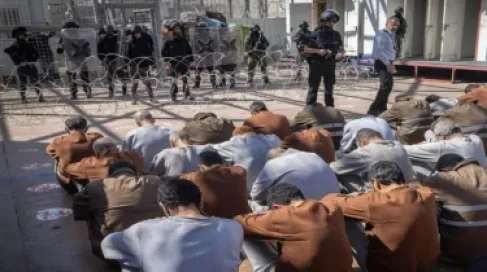
Currently, over 9,300 Palestinian prisoners are held in Israeli jails, including 350 children and 66 women. Palestinian and Israeli human rights organizations accuse Israel of practicing torture, starvation, and medical neglect against them, which has led to the death of dozens.
Israel has occupied the West Bank since 1967, where Palestinians who commit offenses are subject to Israeli military courts, while Israeli settlers are tried before civil courts.
"Retaliatory" legislation
The "Association for Civil Rights" in Israel confirmed that the law is retaliatory legislation "designed with legal engineering aimed at applying the punishment selectively and categorically, as the death penalty will apply only to Palestinians in the occupied territories and to Palestinian citizens and residents of the state."
After the project was approved, the non-governmental organization "Association for Civil Rights in Israel" announced that it had filed a petition before the Supreme Court against the law.
The organization explained that there are two reasons to invalidate the law: "First, the Knesset does not have the authority to legislate for the West Bank. Israel does not have sovereignty there.", and "Second, the law is unconstitutional" as it conflicts with the basic laws in Israel which prohibit any arbitrary discrimination.
Israel abolished the death penalty in murder cases in 1954. Adolf Eichmann, one of the architects of the Nazi Holocaust (Holocaust), was the only person executed in Israel after a civil trial in 1962.