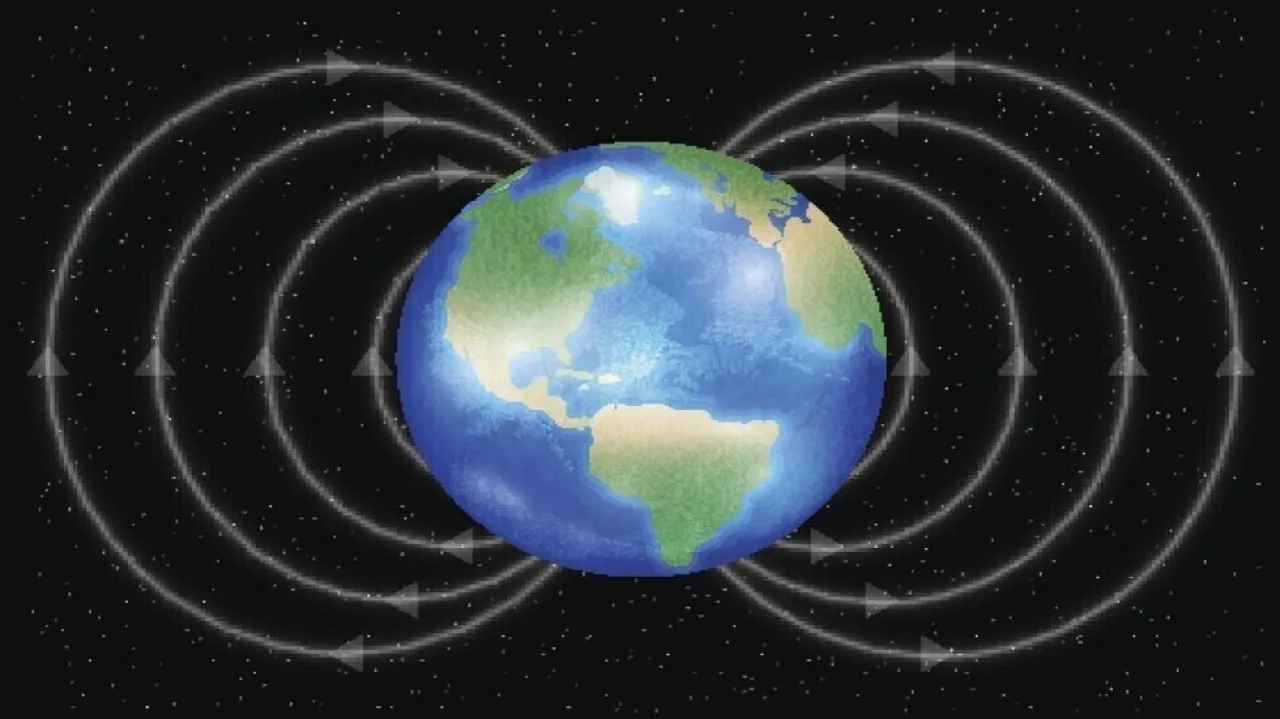
Khaberni - Astronomers have revealed that the magnetic field of our planet is not limited to protecting Earth alone but extends to include the Moon with additional protection that was not expected, even when the Moon is outside the range of this field.
Earth has a strong magnetic field that acts as a protective shield safeguarding the planet and its inhabitants from solar storms and dangerous cosmic rays. This protection also extends to the Moon, which enters and exits this field during its 27-day orbit.
Until recently, scientists believed that radiation on the Moon's surface remained constant when the Moon was outside Earth's magnetic field’s protective range. However, new data analysis from the Chinese mission "Chang'e-4" on the Moon's surface, in collaboration with observations from NASA's lunar reconnaissance orbiter, revealed an unexpected surprise.
In a research paper recently published in Science Advances, scientists say they found strong evidence that a “cavity” of active particles formed by Earth’s magnetic field protects the Moon from harmful cosmic rays, even when the Moon's orbit is outside the magnetic field.
The data showed a 20% reduction in radiation on the Moon's surface during a specific period of its orbit, when it is in the opposite direction of Earth’s magnetic field. This means that the influence of the magnetic field extends further than previously thought, forming a "cavity" of active particles that protects the Moon even in areas assumed to be outside the protective range.
Cosmic galactic rays, which originate from supernova explosions and violent cosmic events, pose the greatest radiation hazard to astronauts. These tiny particles move at speeds close to the speed of light and carry immense energy enabling them to penetrate deep into the solar system and even Earth's magnetic field itself.
To investigate this, the team conducted statistical tests on radioactive particles in the space between Earth and the Moon over 31 lunar cycles, adjusting for any fluctuations in solar weather.
Most importantly, the 20% reduction in radiation observed by the team pertains to low-energy ions, which are the primary source of radiation doses that astronauts' skin is exposed to. Since the skin is the largest organ in the human body, this discovery is highly significant for the safety of astronauts in future missions.
These results open the door to the possibility of using these additional protection zones to reduce astronauts' exposure to radiation during future lunar missions, such as NASA's planned "Artemis" mission intended to return humans to the Moon.
However, scientists caution that space weather is complex and cannot be simplified. Towards the end of the "Chang'e-4" mission, the spacecraft detected several solar storms that increased the radiation levels by more than tenfold, underscoring the need for a deeper understanding of these phenomena.