Khaberni - Professor Mohammed Wahib, a professor of archaeology at Queen Rania’s Faculty for Tourism and Heritage at the Hashemite University, announced a groundbreaking discovery representing the oldest evidence of human settlement outside Africa, in southern Bilad ash-Sham, within the Zarqa River basin and the Jordan Valley, placing Jordan on the global human history map as a key station after humanity’s cradle in Africa, according to a recently published study.
Dr. Wahib, in an exclusive statement to the Jordanian News Agency (Petra), confirmed that the area of Khirbet as-Samra in the Zarqa river basin witnessed the discovery of stone tools (flint axes) dating back to the Lower Paleolithic era, estimated to be about 2.5 million years old, making Jordan one of the oldest human presence stations after the first migration out of Africa, surpassing many global sites.
He pointed out that the Ubeidiya site in the Jordan Valley provided tools and remains dating back to 1.5 million years, confirming that the stone tools found in Jordan lead globally in terms of age, while the human skeletal remains, like those found at the "Dmanisi" site in Georgia, have a record of the oldest human remains reaching back to 1.8 million years, indicating that the early humans who made their tools in Zarqa migrated north hundreds of thousands of years later, leaving a clear structural trace in places like Dmanisi.
Dr. Wahib explained that this discovery requires a comprehensive reevaluation of the "Out of Africa" theory, as it was previously believed that humans left the continent 1.8 million years ago, while Jordanian evidence suggests that this journey began about 700,000 years earlier.
Dr. Wahib mentioned that the recently published study relied on extensive scientific research, notably the work of Italian scientist Fabio Parenti, and was published in prestigious journals such as Quaternary Science Reviews and L’Anthropologie, pointing out that the stone tools were not the result of being transported by water, but were embedded in original geological layers, confirming their authenticity and age.
He also reported that the discovered tools belong to the Oldowan industry, which are the oldest known human tool-making techniques, including choppers, which are trimmed flint stones used to create sharp cutting edges, and flakes, which are stone pieces used as primitive knives for cutting meat and scraping hides.
He added that the discovered animal remains, including ancient horses and elephants, bear marks of butchery, confirming that early humans relied on hunting and direct foraging.
Dr. Wahib clarified that the dating was done using two precise methods, the first being stratigraphic magnetic dating that determined the age of the tools between 1.9 and 2.5 million years during the “reversal” of the Earth's magnetic polarity in the Matuyama epoch, and the second being potassium-argon dating, which confirmed that the volcanic rocks covering the layers prove that the tools are older than the solidified volcanic lava above them.
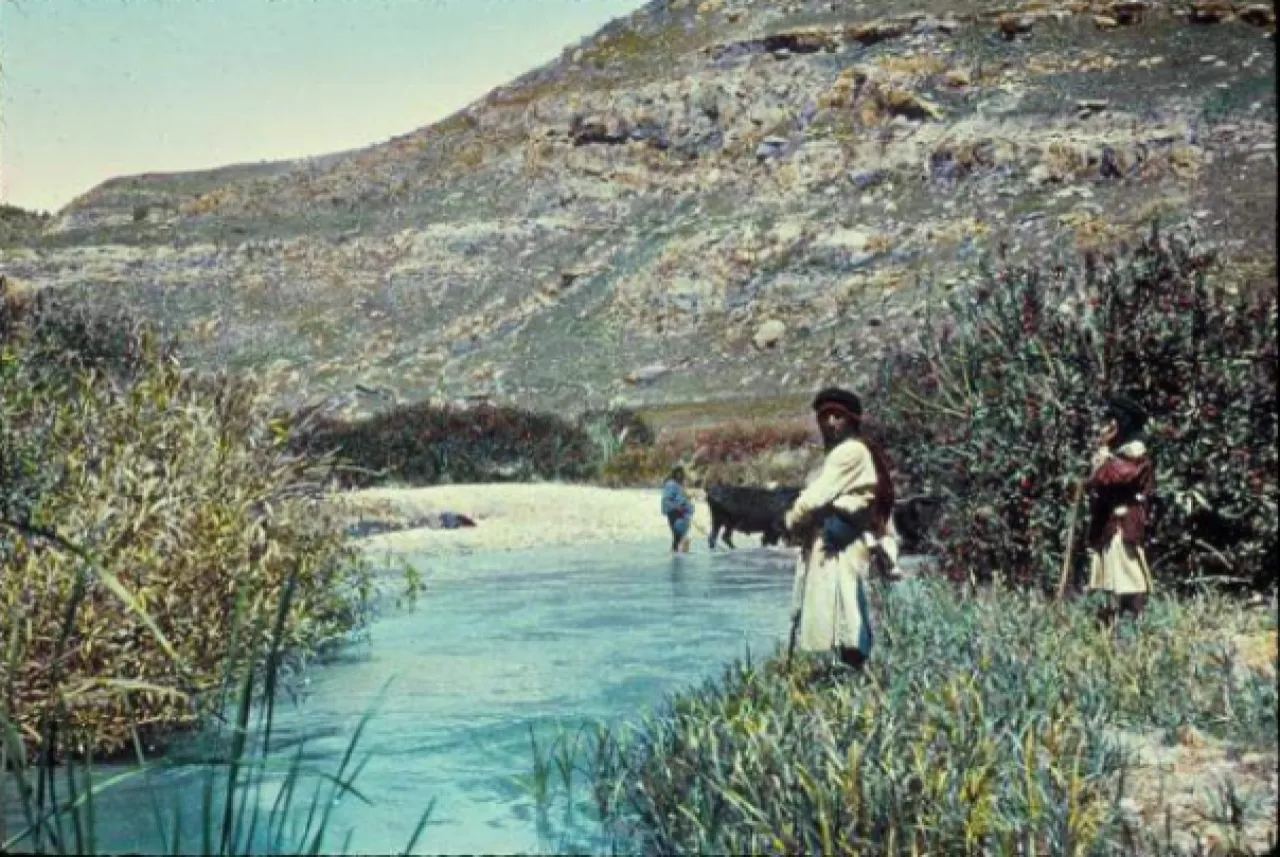
Dr. Wahib indicated that the Zarqa Valley was a center of permanent settlement thanks to the abundance of water and prey during the Pleistocene era, as these discoveries place Jordan at the heart of early human history, as one of the first stations after humanity's cradle in Africa.
Dr. Wahib confirmed that the Hashemite University, in collaboration with the Department of Antiquities, conducted research and documentary studies in the Zarqa Valley over the past twenty years, involving postgraduate students, resulting in dozens of scientific theses and publishing hundreds of globally peer-reviewed articles, noting that these rigorous scientific efforts contribute to documenting the national historical narrative of Jordan and enhancing its scientific standing in global archaeology.