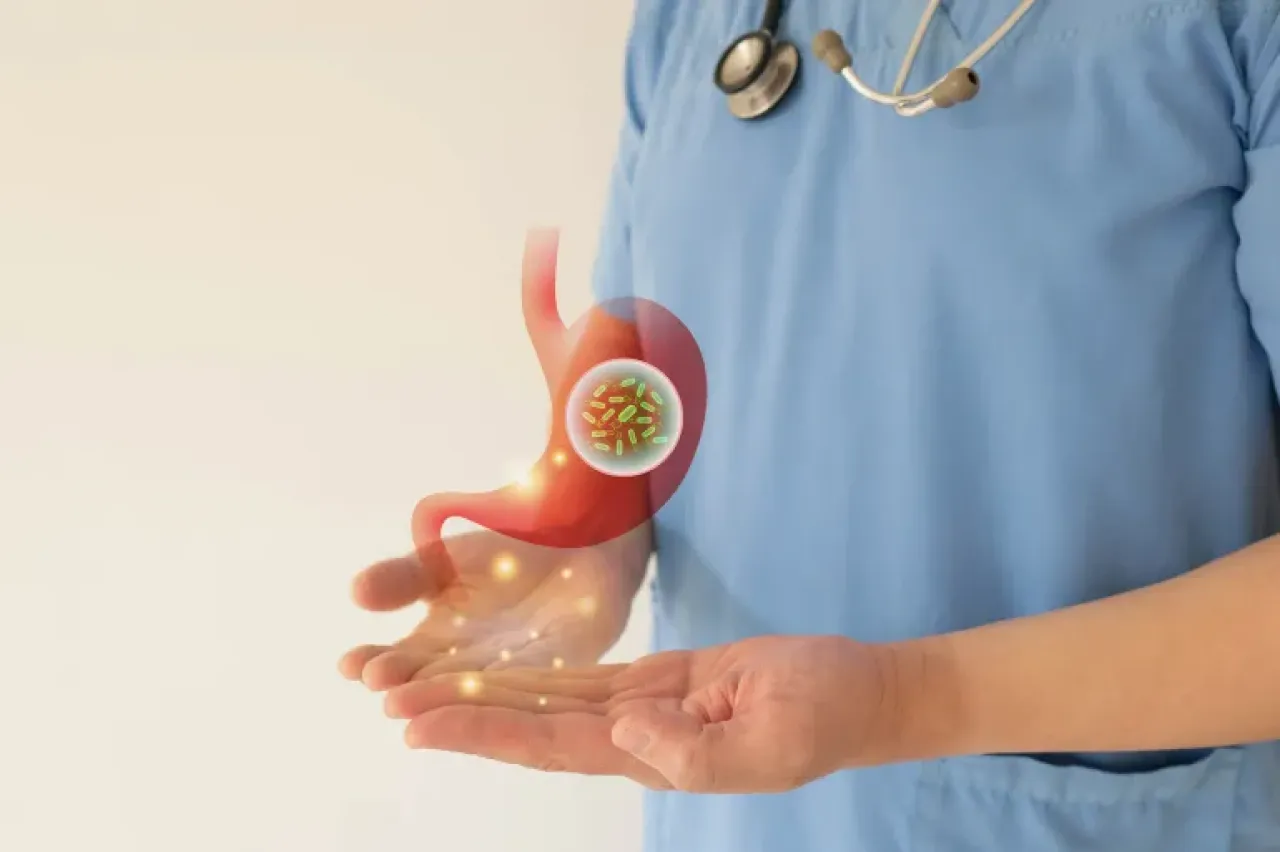
Khaberni - Imagine a hidden world inside your stomach that you cannot see, where microscopic organisms live that may affect your health without you realizing it. This system, thought to be protected by its strong acid, is not completely isolated but may be a habitat for resilient and surviving organisms.
Among these organisms, a unique bacteria has managed to challenge the harsh stomach environment and plays a significant role in many digestive disorders.
Stomach germ is not just a passing microbe, but a hidden message that calls us to listen more deeply to a body that never ceases to communicate. Yes, when we understand the body, we elevate our health and our lives.
The Helicobacter pylori may seem a small organism, but it reveals how even the slightest imbalance can disrupt a remarkably designed balance. We do not triumph over it by treatment alone, but by understanding, listening, and living consciously.
The Helicobacter pylori
For a long time, doctors believed that the stomach, with its strong acids, was an unsuitable environment for bacterial life. However, in 1982, the Australian doctors Barry Marshall and Robin Warren discovered and isolated a type of bacteria that lives in the stomach lining, radically transforming our understanding of its diseases.
This bacteria is known as Helicobacter pylori, a microscopic organism invisible to the naked eye, living covertly inside the body, benefiting from any imbalance in the internal environment. When natural protective mechanisms weaken, these bacteria find an opportunity to settle and proliferate.
Its spiral shape helps it penetrate the mucosal layer that protects the stomach wall, granting it a high survival capability in the highly acidic environment.
Medical estimates worldwide, including data from the Centers for Disease Control and Prevention in the United States, suggest that about 50% of the world's population might be infected with this bacteria, with varying rates of prevalence depending on the geographical location and health and environmental conditions.
The stomach under microscopic examination
If the stomach can digest meat, why doesn’t it digest itself?
A question that puzzled many people until recent research unveiled an amazing protection system:
A protective mucous layer covers the stomach wall—a thick alkaline mucus layer that protects the tissue from erosion
Rapid cell regeneration
A precise system for acid secretion
A vascular network that nourishes and protects
Clinical signs and symptoms
Most infected individuals feel nothing; the germ is often silent. However, when symptoms appear, they vary between:
Pain or burning in the stomach, especially after eating or at night.
Frequent bloating and gas.
Nausea and sometimes vomiting.
Loss of appetite and unexplained weight loss.
Blood in vomit or stool in advanced cases.
Biological testing and diagnosis
Diagnosis of Helicobacter pylori depends on a set of precise tools:
Breath tests (Urea Breath Test)
Blood tests: to detect antibodies, but they may not distinguish between current and past infections.
Stool examination: to detect bacterial antigens.
Gastrointestinal endoscopy with biopsy
Each test has its specificity, and doctors often use more than one method to ensure accurate diagnosis.
Helicobacter pylori and Nutrition
Nutrition plays a dual role: it can either alleviate or worsen symptoms.
Beneficial foods: fresh vegetables, especially cruciferous ones like broccoli, and fruits rich in antioxidants and fibers that help soothe the stomach.
Harmful foods: salty and processed foods, excessive fats, sugars, and smoked meats, which increase inflammation and accelerate stomach irritation.
Dietary habits: eating small, regular meals.
Overeating and the hidden guest
Recent studies have shown that overeating can disturb the gastric environment and weaken the protective mucous barrier, predisposing to stomach inflammation and increasing susceptibility to infection with Helicobacter pylori.
Treatment
Is it possible to recover from the infection? Yes, and the treatment depends on:
Several antibiotics
A medication that reduces stomach acidity called a proton pump inhibitor
Treatment typically lasts 10 to 14 days, and this treatment eliminates the bacteria in 80 to 90% of cases.
However, in 10 to 20% of cases, the treatment may fail due to bacterial resistance to antibiotics or incomplete adherence to the treatment.
In such cases, the doctor suggests a new treatment with different antibiotics.
What are the benefits of eliminating the bacteria?
Disappearance of stomach inflammation
Improvement in digestive symptoms
Prevention of stomach ulcers or their recurrence
Anemia: When anemia becomes a puzzle, the doctor begins to think of a hidden guest disrupting the absorption of iron and vitamin B12 (B12)
Reduction of the risk of stomach cancer among those infected: about 1% may develop stomach cancer.
Are there any contraindications for treatment?
Pregnancy
Breastfeeding
In these cases, treatment can be postponed as it is not an emergency situation.
What are the side effects of the treatment?
The treatment may cause symptoms such as:
Nausea
Diarrhea
Vomiting
Loss of appetite
A change in taste (especially a metallic taste)
Difficulty in digestion
Headache and dizziness
These symptoms can be inconvenient, so it is preferable to start the treatment at a suitable time to allow completion to the end.
Testing to confirm treatment success
Given the possibility of treatment failure in about 10 to 20% of cases, a test post-treatment is necessary to confirm the eradication of the bacteria
The best test is the breath test, which must be conducted on an empty stomach for 12 hours with acid-reducing medications stopped for two weeks before the test and for at least four weeks after the end of antibiotic therapy.
If the treatment fails, a new treatment is prescribed and then the test is repeated after one month.
Is there a treatment other than antibiotics?
These bacteria can only be eliminated by antibiotics, which must be taken according to a strict regimen. If the patient does not fully adhere to the treatment, it may not completely eradicate the bacteria, which could become resistant to antibiotics. In this case, another treatment with different antibiotics is required.
Is it possible to get reinfected after treatment?
If the eradication of the bacteria is confirmed (by testing after stopping acid-reducing medications and antibiotics), recurrence of the germ is possible but it is not common, and generally related to environmental factors or infection from close contacts.
Is it possible to treat the infection by changing the diet?
The bacteria cannot be eradicated by diet changes alone.
However, dietary modifications may help reduce stomach irritation and alleviate symptoms.
Is it possible to transmit the infection to others?
The infection can be transmitted from one person to another through saliva, or contaminated food and water with the feces of the infected person, or by sharing eating utensils. Although it is not highly contagious like the flu and generally requires direct contact or inadequate hygiene conditions, it is medically proven to be a communicable disease.
Therefore, prevention through handwashing and avoiding sharing personal utensils is essential to limit its spread.