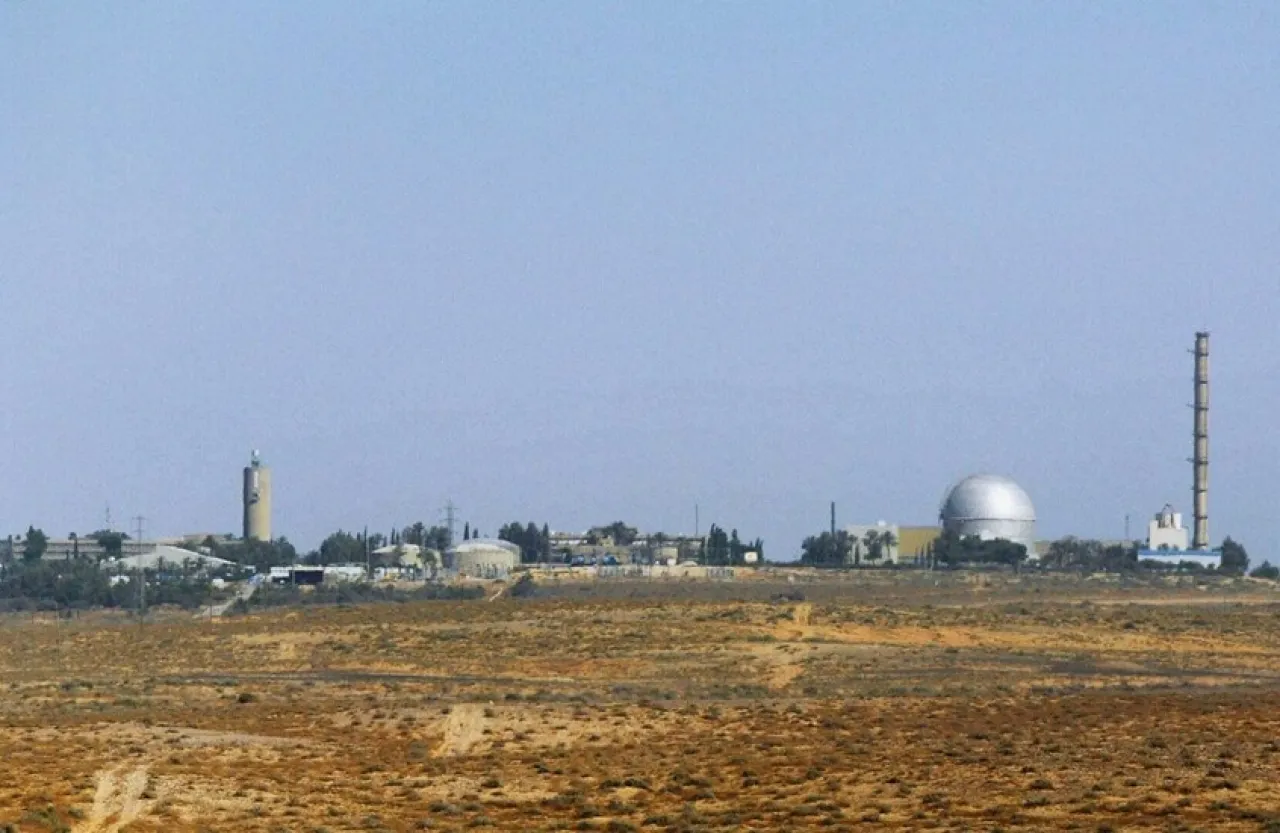
Khaberni - The Israeli newspaper "Yedioth Ahronoth" reported that Egypt, Saudi Arabia, Jordan, and Iraq are monitoring with concern the military escalation in the region, especially regarding the risks of targeting nuclear reactors in Dimona.
The Hebrew newspaper pointed out that nuclear power plant and atomic energy experts are providing reassuring data to those worried about a radiation leak, confirming that it "can technically be contained".
The newspaper added that the debate began on Arab networks since the outbreak of the war between Israel and the United States against Iran, about the inherent risks in attacking nuclear reactors, noting that this debate escalated significantly after Iranian reports of an attack targeting the uranium enrichment facility in Natanz, despite assurances of no leakage of radioactive materials.
It also mentioned that the Iranian response targeting Dimona on Saturday also had a strong impact on the course of the debate, as it was reported in Arab media that the military escalation in the region increased questions concerning the repercussions of events around the nuclear reactor in Dimona and the risks associated with any potential damage to nuclear facilities.
The Hebrew newspaper mentioned that Arabic media reports clarified that, according to experts, developments should be dealt with through precise scientific analysis without exaggeration, but also without underestimating the threats, quoting a statement posted at the beginning of the week by Amjad El-Wakeel, the former head of the Nuclear Power Plant Authority in Egypt, who emphasized that in the face of an attack on the area surrounding the Dimona reactor, he felt the need to share the most significant scientific and technical points to understand the situation accurately and objectively.
The newspaper added that the Egyptian expert explained on his own Facebook account that there is a fundamental difference between an "explosion" and a "leak", explaining that damage to nuclear reactors does not necessarily lead to a nuclear explosion as with atomic bombs. Instead, the risk lies in a radiation leak that may result from damage to the reactor vessels or cooling systems, which he said can be technically contained.
It noted that El-Wakeel continued in his post to discuss additional factors that influence the level of danger, including wind direction, explaining that the winds in the Eastern Mediterranean region predominantly come from the northwest most days of the year, a geographical factor that directs the natural path of any potential radioactive cloud away from central Egypt towards desert or open areas eastward or southeastward, necessitating vigilance on the part of Jordan.
The newspaper stated that the Egyptian expert added that the Dimona reactor is located 70 to 80 kilometers from the Sinai borders, and more than 400 kilometers from Cairo and the Nile Delta, and considering that radioactive materials naturally disperse with distance, the potential impact on these Nile regions is almost negligible, pointing out that Egypt has a national radiation-monitoring network operating around the clock and in real-time, capable of instantly detecting the slightest changes in radiation levels.
It further added that the Egyptian nuclear expert confirmed that the "seriousness" of any radiation event is linked to other factors such as weather conditions and terrain, and that concern is legitimate, but it is also necessary to consider the science and reality.
It referred to a report published on the Jordanian channel "Ro'ya" website during the second week of the war, focusing on the risk of leakage from nuclear sites in Iran, under the headline: "Nuclear Leakage Scenario - Existential Threats to the Marine Environment in the Gulf and Geographically Limited Repercussions on Jordan", emphasizing that any damage to sensitive Iranian nuclear facilities would not be confined to Iran but would extend to form a direct radiation threat to neighboring countries.
The newspaper stated that in the last hours, it was reported in Arab media that the chairman of the Jordanian Atomic Energy Commission, Khaled Toukan, assured his country's readiness to monitor any environmental changes, explaining that there are 26 radiation monitoring stations spread from north to south Jordan, operating with high efficiency around the clock to ensure the safety of citizens, and that there are no indications of radiation risks so far, despite recent military developments targeting nuclear facilities inside Iran.
It added that Toukan further explained that the attacks focused on surface facilities, while part of the nuclear facilities is located tens of meters underground, making them difficult to reach.
It indicated that in Iraq, Iran's neighboring country, it has been mentioned since the first days of the war that the National Emergency Center to monitor any increase in nuclear radiation levels has been activated, and that the National Authority for Nuclear, Radiation, Chemical, and Biological Control has not registered any increase within the Iraqi borders or from Iran.
The newspaper mentioned that this is not the first time that some Arab countries have expressed concerns in the nuclear field, as the same happened during the operation "Me Kabee" in June last year, where some exploited the panic during the previous war to sell iodine and potassium iodide to the public in Arab countries, claiming that these substances can be used as a "preventative treatment", which is of course exploitative, as the use of potassium iodide is intended only for emergency situations related to radiation, and is administered under specific conditions and precise guidelines.
It added that despite the increased discussion on Arab social networks, no radiation contamination has been reported yet in the territories of the warring countries in the current battle, as the International Atomic Energy Agency reported after the Iranian attack targeting the Dimona area that it had not received "any indication" of damage to the nuclear research center in the Negev.