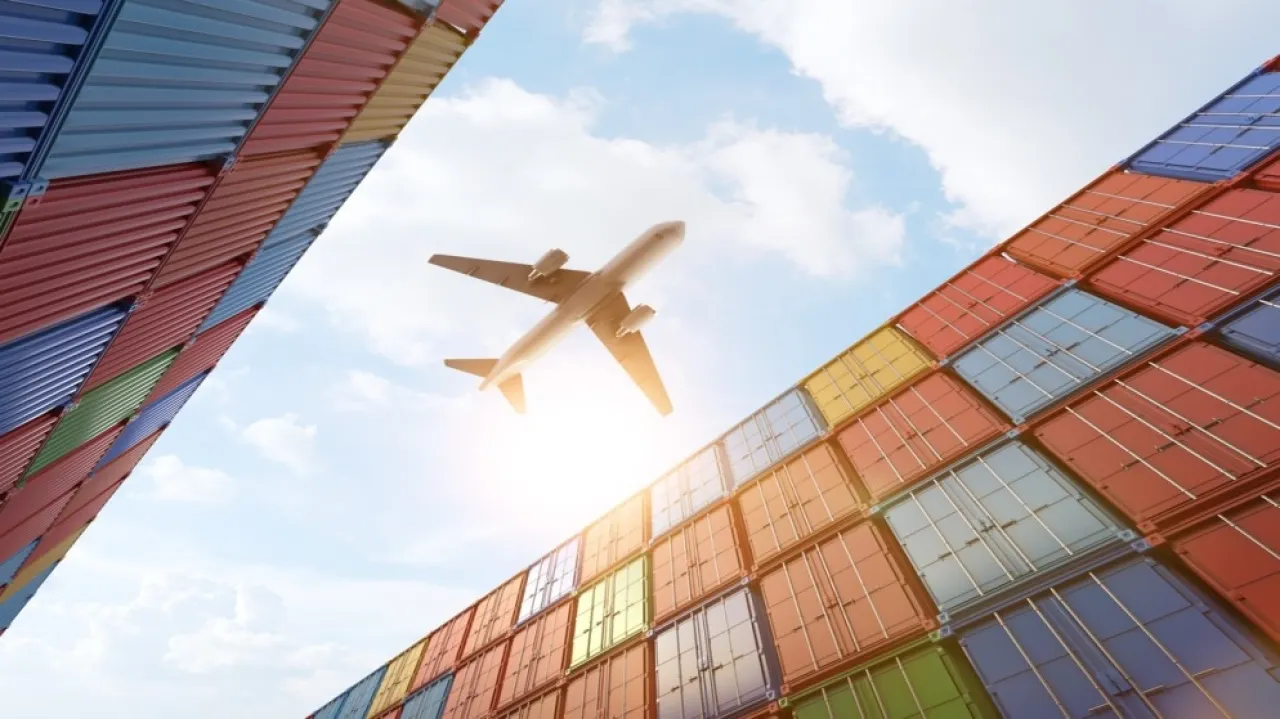
Khaberni - Data from Friday showed that air freight prices have risen by 70 percent on some routes since the outbreak of the US-Israeli war on Iran after the conflict imposed restrictions on flights and hindered the movement of some maritime shipments, leading to an increase in aircraft fuel costs.
Sector experts said that prices on the routes between South Asia and Europe suffered the most due to the airspace closure and security issues in the Middle East, where the conflict stranded more than 100 container ships in the area surrounding the Strait of Hormuz, which is a vital oil export passage.
The Swiss logistics services group Kuehne+Nagel announced today that global transport companies are prioritizing shipments of healthcare and perishables such as food to the Middle East.
Prashant Yadav, a pharmaceutical supply chain expert, said that some inexpensive, unpatented drugs and pharmaceutical ingredients from India are being shipped on container ships through the strait to eventually be exported to Europe, Africa, and some Arab countries.
Yadav, a fellow at the Council on Foreign Relations, stated, "A major shift I've heard about relates to companies shifting unpatented medicines from maritime to air freight".
The shift to air freight is significant because it handles about one-third of global trade by value, making the rising prices a potential source for increased inflation, from fresh food to medicines and electronics.
Steve Blue, a senior strategic supply chain expert at logistics software company Envios, said "Clients are shifting shipping from sea to air, but this is very costly. It's typically five to ten times higher. These costs increase as capacity shrinks... In most cases, shipping officials move a limited amount by air to bridge the gap."
Doubling of Jet Fuel Prices
The price of jet fuel has doubled since the start of the conflict, and this week, Denmark's shipping giant Maersk announced that its air cargo service is now applying additional charges for fuel and war risks. Maersk expanded the range of extra charges on some maritime shipments from the region.
Analysts expect oil prices to remain high in the near term before stabilizing later in the year.
The closure of airspace has also reduced the capacity of cargo and passenger planes, forcing airlines to operate on longer routes to avoid the conflict zone, thereby increasing price pressures.
Dubai and Doha are usually among the busiest air cargo hubs in the world, but the conflict in the Middle East has severely reduced operations at these two airports.
Ronald Lam, CEO of Cathay Pacific in Hong Kong, said that many of the company's air cargo flights to Europe usually stop in Dubai for refueling and loading more goods.
He added in a conference call about profits on Wednesday, "But due to the situation in Dubai, we are now bypassing that stop and heading directly from Hong Kong to Europe, with some load restrictions, because we are no longer able to refuel on the way."
The airfreight index issued by the booking and payment platform Freightos shows that spot prices from South Asia to Europe have increased 70 percent to $4.37 per kilogram from $2.57 prior to the start of the war.
Freight prices from South Asia to North America have risen 58 percent to $6.41 per kilogram, and from Europe to the Middle East by 55 percent to $2.79.