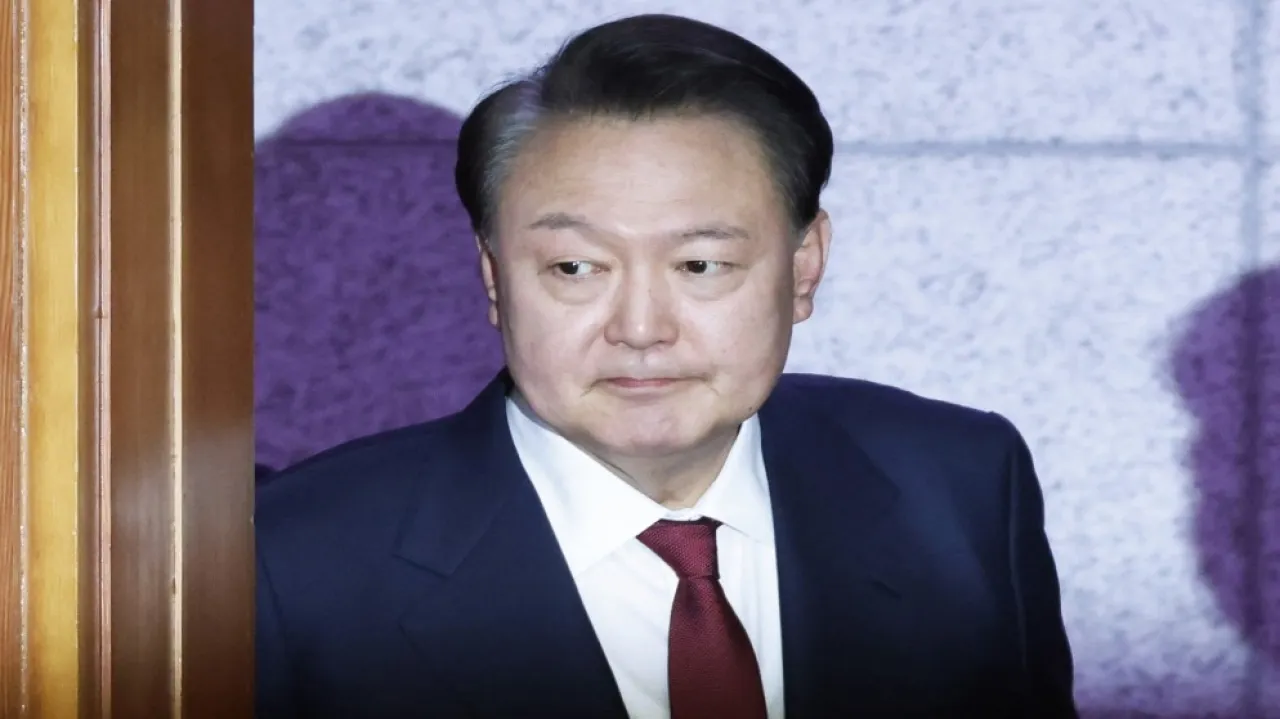
Khaberni - A court in South Korea ruled on Thursday to imprison the former president Yoon Suk Yeol for life after convicting him of leading a rebellion by declaring martial law in 2024.
Yoon suddenly announced martial law in a televised speech in December 2024, citing the need for drastic measures to eradicate "anti-state forces" in South Korea's National Assembly.
The 65-year-old conservative governor was later removed from office, then detained and faced a series of charges ranging from rebellion to obstructing justice.
Judge Ji Gui-Yeon said that Yoon sent troops to the headquarters of the National Assembly in an attempt to silence his political opponents who thwarted his attempts to monopolize power.
He added in the Seoul Central District Court, "The court concluded that the intention was to paralyze the operation of the assembly for a long period."
He continued, "The social costs of declaring martial law were enormous and it is hard to find any indication that the accused showed remorse for that.. Yoon is sentenced to life imprisonment."
The former defense minister, Kim Young-Hyeon, was sentenced to thirty years in prison for his role in the crisis.
The prosecutors called for the most severe penalties for Yoon and urged the court during the hearings held in January to issue a death sentence.
South Korea informally stopped implementing the death penalty, last applied in 1997, meaning that a death sentence would have led to Yoon being imprisoned for life.
- Reminder of the era of coups -
Thousands of Yoon's supporters gathered outside the court building prior to the verdict, holding banners that read "Glory to Yoon again" and "Drop the charges against President Yoon."
The cheers intensified when blue prison buses, believed to be transporting the former president to the court complex, entered.
Police officers in yellow vests gathered in large numbers outside the courtroom in anticipation of any disturbances following the verdict.
They created a temporary barrier using police buses that surrounded the courtroom.
South Korea has long been considered a stable democratic country in Asia, but Yoon's failed attempt to monopolize power recalled the military coups that shook the country between 1960 and 1980.
Yoon was in solitary confinement while facing several criminal trials. He repeatedly denied having made any mistakes, emphasizing that he acted to "protect freedom" and restore constitutional order in the face of what he described as a "legislative dictatorship" led by the opposition.
The prosecutors accused him of leading a "rebellion" driven by "a thirst for power aimed at dictatorship and long-term rule."
- Martial law -
Under South Korean law, the charge of rebellion carries two penalties: life imprisonment or the death penalty.
Yoon had previously been sentenced to five years in prison on less serious charges, while several senior officials also faced harsh prison sentences.
Yoon delivered his sudden speech to the nation on the night of December 3, 2024. During it, he talked about unclear threats from North Korea and "anti-state forces," announcing the suspension of civilian government functions and the commencement of military rule.
Martial law was lifted after six hours as legislators rushed to the National Assembly for an emergency voting session. Officials fortified the doors with furniture to prevent the soldiers from entering.
The announcement of martial law triggered sudden protests, disrupted the stock market, and surprised major military allies like the United States.
Yoon’s wife, Kim Kyun Hee, was sentenced in January to 20 months in prison in a separate case involving bribes received when she was the first lady.