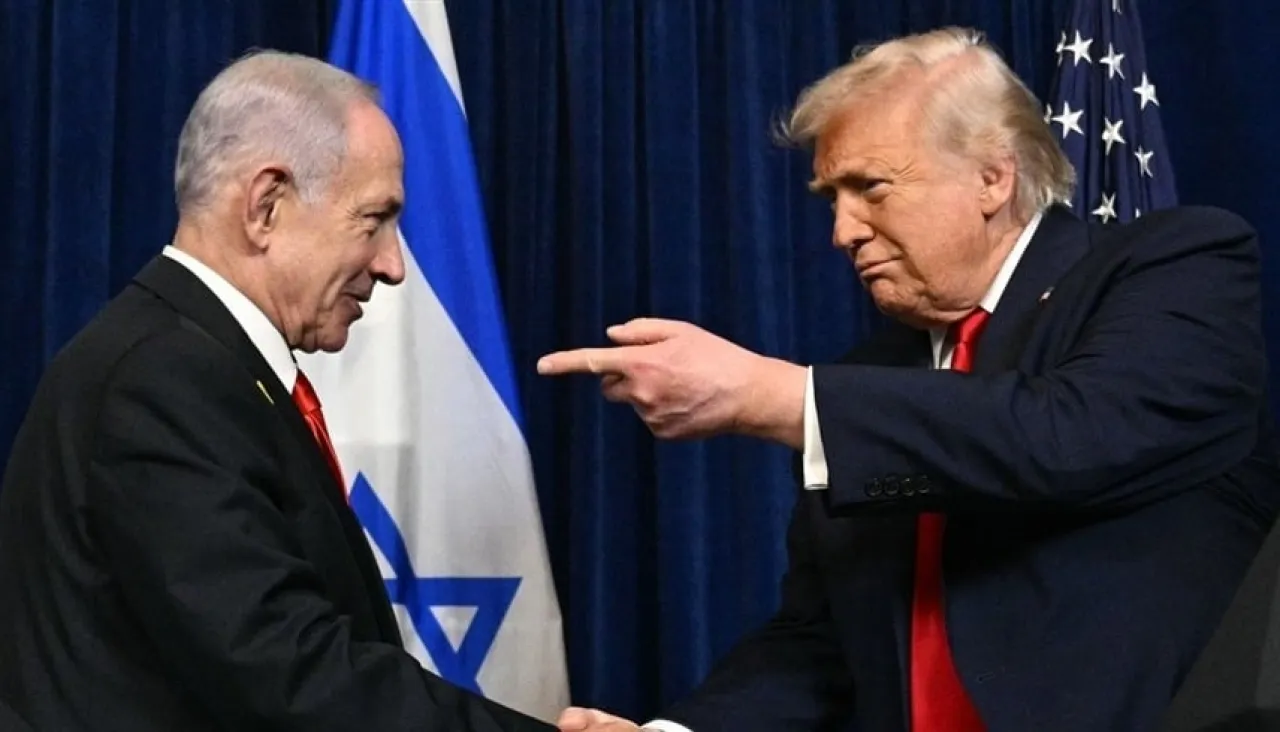
Khaberni - The American President Donald Trump and the Israeli Prime Minister Benjamin Netanyahu agreed during their meeting at the White House last Wednesday, to increase economic pressure on Iran, especially concerning its oil exports to China.
Well-informed U.S. officials explained to the news site "Axios" that more than 80% of Iranian oil exports go to China, meaning that reducing Beijing's purchases could double the economic pressures on Tehran and affect its calculations, pushing it to make concessions regarding its nuclear program.
The officials pointed out that the "maximum pressure" campaign will coincide with the ongoing nuclear negotiations with Iran, along with the American military reinforcement in the Middle East, in anticipation of possible strikes if the diplomacy fails.
Full Force
A high-ranking U.S. official told the site that both sides agreed to proceed with full force in pressuring Iran, including targeting its oil sales to China.
An executive order signed by Trump ten days ago allows for increased economic pressure, granting the Secretaries of State and Commerce the authority to recommend imposing tariffs of up to 25% on any country that trades with Iran.
Imposing tariffs on China due to its purchase of Iranian oil could complicate the already tense relations between Washington and Beijing, especially as the United States seeks to preserve the flow of essential rare minerals and protect an upcoming summit in Beijing in April.
Although Iran is a major oil producer, markets are showing greater concern about potential regional disruptions if Tehran moves to disrupt oil flows from other countries.
No Nuclear Weapons
Also, the officials noted that Trump and Netanyahu agree on the ultimate goal, which is an Iran without the capability to possess nuclear weapons, but they differ on the means to achieve it.
Netanyahu affirmed to Trump that reaching a good agreement with Iran is impossible and that Tehran would not adhere to it even if signed, whereas Trump saw an opportunity to strike a deal, saying, "We'll see if it's possible, let's try."
In recent days, Trump asked his advisers Steve Witkoff and Jared Kushner about the chances of reaching an agreement.
A U.S. official reported that they informed the president that past experiences show the difficulty, if not impossibility, of reaching a good agreement with Iran, but they also noted that so far, the Iranians seem to show positive signs in the negotiations.
The Ball is in Iran's Court
Witkoff and Kushner are scheduled to meet the Iranian delegation in Geneva next Tuesday for a second round of talks.
Earlier this week, Witkoff conveyed messages to the Iranians through Oman’s Foreign Minister, and Washington awaits Tehran’s response during the meeting in Geneva.
A U.S. official confirmed that his country deals realistically with Iran, adding, "The ball is in their court, and if the deal isn't real, we won't accept it." Conversely, another U.S. official said he sees the chances of Iran accepting American proposals, or vice versa, as "zero."
Iranian journalist Ali Goolhaki mentioned that the American messages included a proposal for Iran to suspend uranium enrichment for a period ranging from 3 to 5 years, with the transfer of 450 kilograms of highly enriched uranium out of the country, which he said Tehran rejected, although a U.S. official denied such a proposal was made.