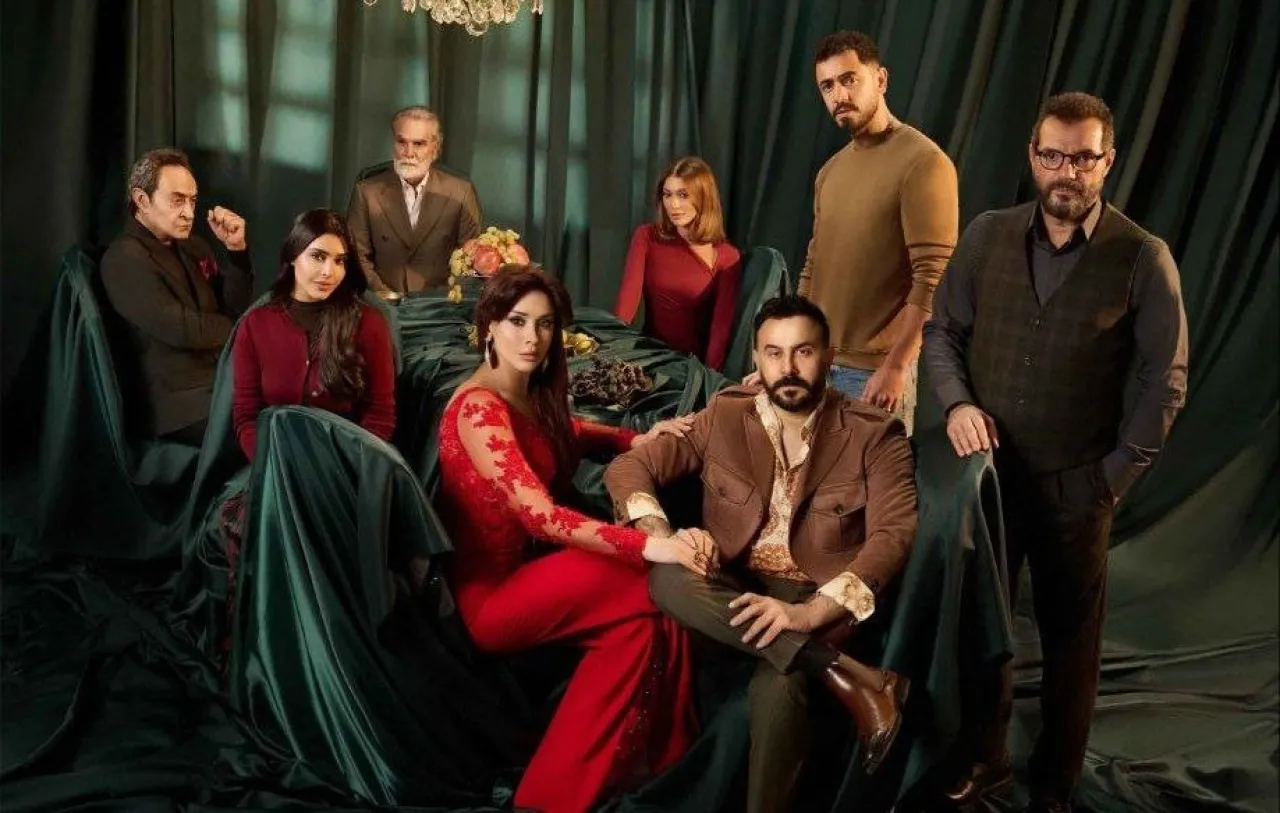
Khaberni - Only a few days separate us from the holy month of Ramadan, which has become akin to a special drama season where Syrian and Arabic dramas are showcased. In the blessed month of Ramadan, platforms, television stations, and production companies compete in showing their annual dramatic products. Syrian and Arab audiences look forward to watching all the Arabic dramatic works produced for the Ramadan drama season of 2026, especially since Syrian drama is entering an exceptional phase, the first after the fall of the ousted regime and a year of liberation, tackling issues and themes that were previously taboo, with narratives that touch the Syrian reality as it is, not as it was imposed.
Among the most anticipated Syrian series are: "The Syrian Enemies", "Escape to the Well", "Caesar, No Place No Time", "City Kitchen", "Moulana", "King's Family", "Happiness of the Mad", and others. Meanwhile, the relationship between Turkish drama and the Arab audience has gone through various phases over the year ranging from closeness and alienation. Thus, forms of importing Turkish production have diversified beyond dubbing to include adoptions, co-production, and Arabization, producing Arabized versions of popular Turkish series that have had significant popular success.
Many believe that Arabized versions of series, though celebrated by the media for their rendition, remain captive to boredom and monotony despite including the finest artistic talents in the Arab world, particularly in acting with large budgets. So what is the secret of this relationship? Will Arabized drama continue to dominate the drama scene with the crowded Ramadan drama?
The essential reason is that the Arab viewer has thoroughly understood the rules of the game, which, whether we like it or not, are marketing and financial, without caring for what the follower himself, who longs to see original works inspired by his environment, dealing with his concerns and expressing his issues, desires. Especially since most Arab countries are living in a rhythm of tragedies and wars, how can they care about the fate of the relationship between heroes of an adapted series? It is really unfortunate to see significant acting talents lost in a worn-out story that neither contributes nor takes away, through the stereotyping of the Arab dramatic production in the manner of the Turkish script building and style of filming and directing, to further distance local drama from the street living in problems and instead present it with a drama called “family drama,” based primarily on stories of love, betrayal, and mixed relations, yet still achieving high viewership from the public, thus enhancing the concept of stardom and expanding the fame of its participants.
Artists and critics have described Arabized series as counterfeit material from an original product, negatively impacting authentic Arab drama and causing it to lose elements of creativity and excellence. Particularly since the Arab Ramadan works are distinguished by reflecting our daily lives, discussing our problems, and conveying images of our environments both old and contemporary. We find ourselves before a major debate between fears of a real crisis in writing in the Arab world and the idea of artistic exchange freedom among different drama worlds, which will inevitably cast its shadow on the artistic taste of the public, affecting it and being affected by it in a significant conflict that Ramadan drama lives in its encounter with Arabized drama dominating the drama scene throughout the year.
Who will prevail?
Syrian Revolution Newspaper met “Saeed al-Hannawi,” the writer and screenwriter, who believes that Ramadan drama will triumph over Arabized drama for several reasons, stating: “First is our Eastern society, which is predominantly conservative. During Ramadan, there are special rituals for most Syrian families, and people will not resort to drama that doesn't resemble them at all. In the month of goodness, they need something that touches them, touches their reality, while I reserve that the Syrian and Arab drama seasons are in the month of Ramadan. Unfortunately, it is the production companies and stations that have accustomed people to this season.”
He added: “I return to my talk and confirm that authentic drama is closer in всех its stories and places. Besides, the plots of Arabized dramas are repetitive, nothing new in that. Meanwhile, Syrian drama series are in new versions with new stories, especially this year, which will be different after the fall of the outdated regime, adopting a new style, and the Syrian and Arab public is thirsty for our drama, thus authentic drama will win more viewership and follow-up than Arabized ones.”
“Al-Hannawi” observed that drama, in general, is a vast sea with manyangles and diverse forms, and that Arabized drama is a type of drama, stating: “Viewers have tastes, especially after the spread of ‘social media’ and the ‘trend’ world; the topic is no longer confined to certain types and forms of drama that we were used to before. Viewers now understand what they see on screen and select what they want, especially after wars and crises that occurred in the Arab world.”
The opinions and thoughts clash where viewers now turn to platforms to satisfy their desires and needs for new drama, new stories, and different crews, even a breathtaking kind of décor and modern clothing, and even a new way of life from living and human relationships. The fans of this type of drama didn’t find their desired content until Turkish dramas came along, which are originally stolen from global drama but with cleverness, according to the speaker.
He added: “Because Turkish drama is close to Arab society, it has managed to invade us and dominate many of us. I cannot deny that some of it has been a reason for the ruin of general taste and its distortion, especially among the youth of both genders, where they began to turn to watching this drama as it satisfies their thinking, mentality, and way of life. This is all due to the rapid development of technology in the world, making this drama exist with fans and followers, which makes me wonder... Do we really not have anyone who can write this kind of dramatic work? Are we as an Arab society incapable of producing such series resulting in copying and replication? Especially since no matter the precision worked into them, they will always remain distorted copies if compared between the original and the copy, and no matter the capabilities and resources and budgets, we will not reach a convincing result with these drama works because they are imitations, and they will remain as someone who brought a famous painter’s picture and then painted it again; it has no value like the original, even if it is identical.”]
About his opinion of the Arab actors’ performance in these drama works, Al-Hannawi answered: “I am not the right one to evaluate them. They are artists who have studied, learned, and presented many important drama works, which have become well-known, and they have excelled in roles leaving an important imprint on everyone. A skilled actor is an actor who can perform any role asked of him, and a ‘framed’ actor is a constrained actor who does not present anything new.
He added: “I have a complaint against those who transform these works and replicate them on paper ‘the screenplay’ -I am personally for adaptation- but with developing the idea and making it suitable for the environment we live in. What is my role as a writer or screenwriter if I took a ready-made work and just Arabized its dialogues as they are? Where is my imagination? Where is my ingenuity? Where is my unique way with my plot? And I know that what they did of copying and replication was by the request of those in charge of the work or the producing entity, and this justifies their doing so.”
Actual superiority of authentic drama
Syrian Revolution Newspaper met “Jalal Abu Samir,” the film producer, who saw that authentic drama indeed triumphs over Arabized drama in the Ramadan season, saying: “We notice that Syrian and Arab drama secures about 55%–65% of the total Arab viewer’s interest in Ramadan specifically, compared to 35%–45% for dubbed or Arabized Turkish drama, due to the different culture of seasonal time consumption during this season where the viewer prefers a timely limited work, rich with events and suspense, which achieves daily escalation of the story away from the slowness characterized by Turkish works, not to mention the significant diversity of Arab works compared to the Turkish dramatic ending. Meanwhile, Syrian drama achieves a strong and notable presence due to its cultural and linguistic proximity to the audience, touching on issues experienced by the Arab public in its reality, as we know that a work achieves its niche when it is the son of its environment, which enhances the public attraction factor to it, in addition to that the viewing condition in Ramadan requires a quick daily decision and an intense and changing dramatic plot. while Arabized works that extend to 90 episodes or more do not fit the rhythm of intense viewing, and the work consisting of 30 episodes gives the viewer a clear time commitment and a guaranteed ending within a specific time frame that achieves the viewer’s goal, which aligns with the nature of Ramadan viewing.”
He added: “Identity and its related factors play a decisive and fundamental role, as the Syrian dialect is understood Arabically, and the issues raised belong to the Arab reality and are its daughter and not foreign to it, which is what the public seeks, while Turkish drama - even after being Arabized - still carries values, contexts, and social attributes foreign to our reality. However, if we want to speak realistically and authentically, we find that the superiority achieved by authentic drama is seasonal mostly, as Arabized drama returns to regain its audience after the Ramadan season ends.”
“Abu Samir” saw that diagnosing this crisis boils down to several factors, the first of which is the crisis of innovating and being unique in arab productions, followed by the crisis of the adventurous and experienced producer, for the production journey starts primarily with the script and then moves to the producer who funds the work, and if the script is innovative and whoever evaluates it as a producer does not have the necessary competence and does not possess the experience and adventurous spirit, then he will not appreciate the value of scenario in his hands, and thus the journey of the script will end in a drawer just like many innovative scripts that did not complete their journey to the production and display stages.
About the professional conclusion we derive from the polarization achieved by the Ramadan season, “Abu Samir” said: “I find Ramadan to be the season that rewards work artistically and financially, as it is the most suitable season for displaying work close to the identity, effective quickly, and it is the season that achieves the investment viability of the dramatic work, in terms of its display on platforms and television stations to cover production costs in a short time, which pushes us to focus on the Ramadan season more than others.”
He added: “Out of personal responsibility, I find it necessary for colleagues working in the dramatic and cinematic production field to elevate this industry and not to drag it to the bottom and vulgarity, as our societies are rich with issues that if we shed light on them, we would have fulfilled our duty in raising the level of Arab productions. We need genuine and sincere adoption of strong and content-rich scenarios in terms of artistic value, and we need an honest reading of the current crises that our societies are experiencing. Art is the son of its environment and its true mirror, we must shine light on producing meaningful drama that shapes societal awareness and contributes civilly, culturally, intellectually, and artistically. When we say that art is a message, we mean what we say, as viewers now possess awareness and are highly familiar with various global productions from all cultures, distinguishing good, bad, valuable, or cheap productions, where many viewers possess knowledge in the field and a high critical experience, perhaps surpassing veteran critics.”