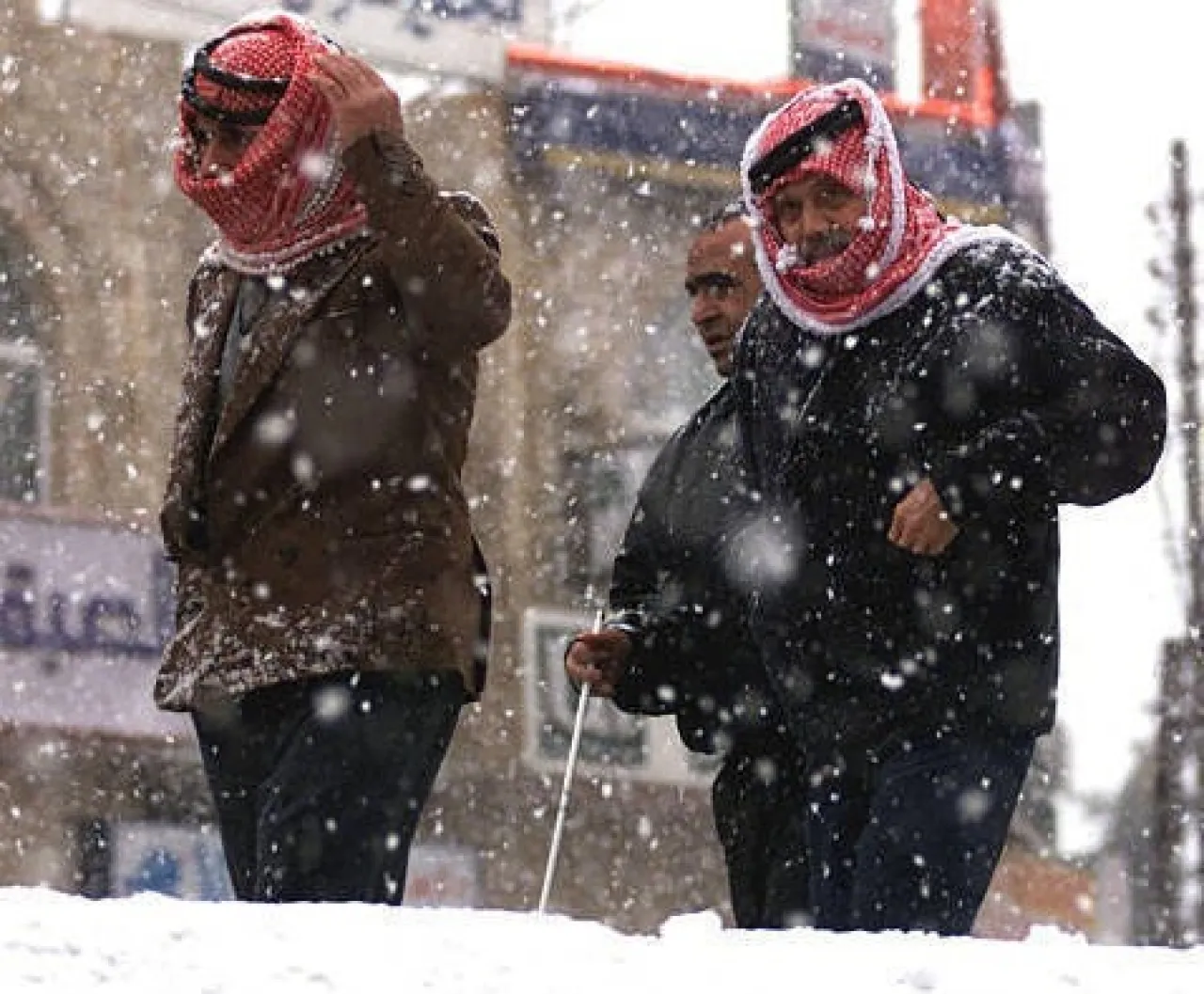
Khaberni - The winter fortieth period that began on the twenty-first of December last year ends on the last day of the current January, followed by the winter fiftieth, which continues until the spring equinox, which falls on the twenty-first of March.
Astronomer Imad Mujahid, a member of the Arab Union for Space and Astronomy Sciences and a fellow of the Royal Astronomical Society, said on Wednesday that the ancient Arabs in the Arabian Peninsula used to determine the seasons, cold and hot days, the planting season, and the harvest season based on the rise and set of stars, and this science was known among the Arabs as the science of weather forecasts, similar to modern meteorology.
He pointed out that, based on the science of forecasts, the end of this month marks the beginning of what is known as the winter fiftieth, which the Arabs divided into four parts called "Al-Saud"; these are Saad al-Dhabih, Saad al-Khabaya, Saad al-Saud, and Saad Bal'a, each lasting approximately 12.5 days.
The fame of this period is due to the story of the shepherd Saad, who decided to travel on a warm and sunny winter day, thinking that winter had ended. His father and the village elders advised him to carry items to keep warm from the cold, either fur or wood, but he ignored the advice and did not listen to them. He took his camel and sheep and began his journey outside the village.
Saad was surprised halfway through the journey, as the weather turned extremely cold, and heavy rain and snow fell, and the severe cold forced him to slaughter his camel to shelter in its fur and entrails from the harsh cold.
This period during which Saad slaughtered his camel was called Saad al-Dhabih, indicating the intensity of the cold, and it is described as the coldest days, and it was said (Saad slaughtered, no dog barked, no farmer succeeded, no shepherd grazed). This period is followed by Saad Bal'a during which Saad ate the meat of the camel he slaughtered, and during this period the rains fell and were quickly absorbed by the earth, hence it was called Saad Bal'a, indicating that the earth quickly absorbs the rainwater while the shepherd Saad ate the camel’s meat.
Then comes the period of "Saad al-Saud" where the sun shines after the storm and Saad rejoices in his survival. When he wanted to cut tree branches to start a fire for warmth, he found water flowing through them, hence it was named after Saad's joy in his survival, because the water flows in the plant's stalk, and it was said (Saad al-Saud the water crawls in the stalk and every chilled one warms up).
As for Saad al-Khabaya, it occurs at the end of the winter fiftieth where snakes and other creatures that were in hibernation during the winter begin to emerge from the ground, and the weather is delightfully moderate during this period, and it was said (Saad al-Khabaya the snakes come out and the girls dazzle).
Mujahid mentioned the borrowed days, where during the fiftieth period what is called "borrowed days" occur, which are 7 days, the last 4 days of February and the first 3 days of March, characterized by extreme cold.
According to folk tradition, their story goes back to an old woman who had six sheep grazing in a valley during the last days of February, when no rain fell and the weather was warm, so she happily repeated "February the destroyer passed and took neither a ewe nor a rope from me, and we beat its back with a mallet"; February heard her words, felt insulted and angered, went to his cousin March, and pleaded "Oh March my cousin, three from you and four from me, let's make the old woman in the valley sing".
During these days heavy rains fell, valleys flowed, and the stream swept away the old woman's sheep, and she cried out sadly "O stream, handle them gently, oh millers, do not harm them with your machinery".
Mujahid said, according to meteorologists, this year's spring equinox coincides with March 20th, celebrated in some countries as "Nowruz", where the day and night are of equal length, and the sun rises for the first time at the North Pole after a night lasting 6 months, and sets for the first time at the South Pole after a day lasting 6 months.