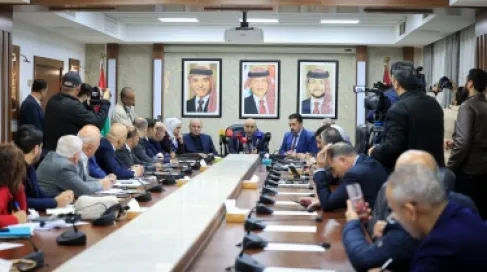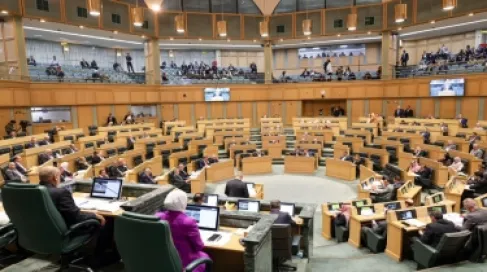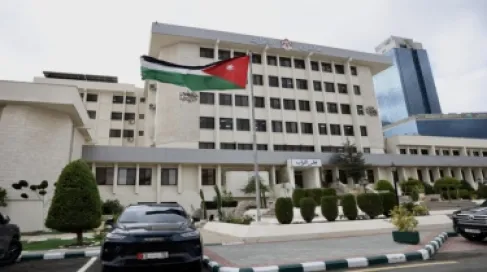
Khaberni - The Parliamentary Economic and Investment Committee, chaired by Representative Khaled Abu Hassan, approved the final report on the legislative impact assessment process for the Investment Environment Law No. (21) for the year 2022, in the presence of committee members, and representatives of the entities that contributed to the preparation of the report from the General Secretariat of the Parliament and the Westminster Foundation for Democracy.
The report reviewed the results of applying the law after its entry into force, showing partial progress in some regulatory aspects, while challenges still persist, most notably the need to enhance institutional governance, clarity of authority, activation of measurement and monitoring tools, linking investment incentives to performance indicators that can be assessed, and enhancing the role of the Investment Council in investment decision-making and its implementation.
The report included a comprehensive package of institutional, procedural, and executional recommendations, notably expanding the powers of the investment window to include dealing with overlapping procedures and granting necessary approvals, adopting clear institutional coordination mechanisms between the Ministry of Investment and the Investment Council, enhancing the General Secretariat of the Council with necessary human and technical resources, and creating specialized units within the council's structure to follow up on decision implementation and issue periodic reports on achievement rates and challenges.
Recommendations also included developing a national system of measurable performance indicators for the investment climate, including licensing duration, compliance costs, investor satisfaction, and geographic distribution of investments, and linking these indicators to standardized periodic reports that allow comparison and measure the actual impact of investment policies, in addition to completing the comprehensive digital transformation and unifying systems to end duplication between paper and electronic processes.
The report contained a suite of legislative and institutional recommendations, most notably enhancing the legal framework governing the Investment Council, introducing performance indicators to measure the implementation of the investment policy, linking incentives to environmental and social standards, and establishing permanent institutional mechanisms for measuring legislative impact before the enactment of laws and after their application.
The report emphasized the importance of enhancing transparency and partnership with investors, through publishing simplified informative information about investor rights and investment procedures, adopting clear mechanisms for receiving and analyzing feedback and complaints, linking them to policy improvement, as well as adopting clear timelines for Investment Council meetings, and publishing summaries of its decisions and periodic reports to enhance oversight and institutional trust.
Abu Hassan stressed the importance of this review as a fundamental milestone in the path to improving the quality of economic legislation, measuring its actual impact on the investment environment, its alignment with the priorities of the economic modernization vision, and enhancing investor confidence and economic growth sustainability.
In the context of follow-up actions, Abu Hassan noted that a press conference will be held at the end of the review process to announce the report's results and its adoption by the illuminating committee. The final review report will then be forwarded to the President of the House of Representatives, who in turn will send it to the economic team at the Prime Minister's Office, ensuring its integration into government follow-up pathways and economic decision-making processes.
Abu Hassan emphasized that the Economic and Investment Committee will carry out its legislative and oversight role fully, based on an institutional approach that relies on impact measurement and accountability enhancement, noting that this report represents the first step in an integrated path of subsequent actions, most notably the preparation of a specialized study on the government's second executive program, in collaboration with relevant entities, aiming to assess its economic impact and role in advancing the national economy and achieving the objectives of the economic modernization vision.
The committee endorsed the final report, confirming that it will follow up on the implementation of the recommendations contained in the report, and how they are translated by the relevant entities into practical steps, contributing to the improvement of the implementation of the Investment Environment Law and maximizing its developmental and economic impact.