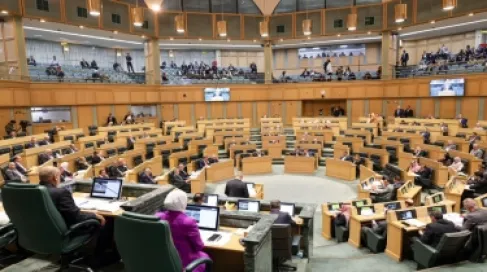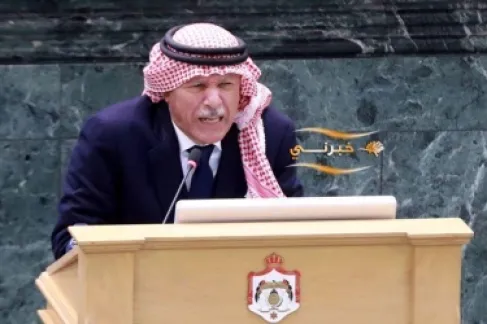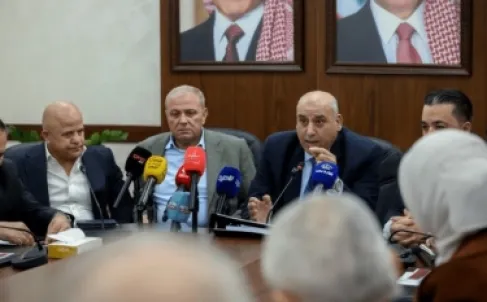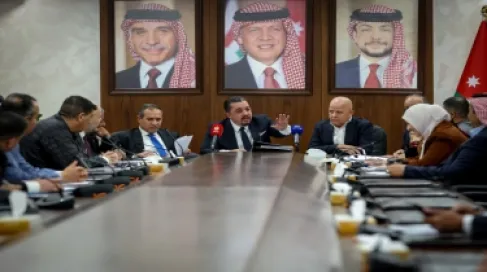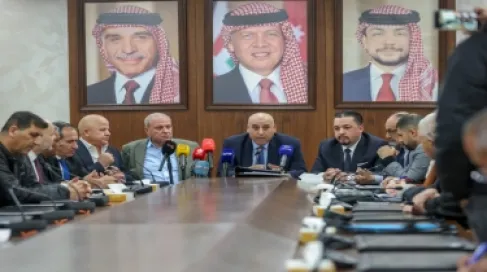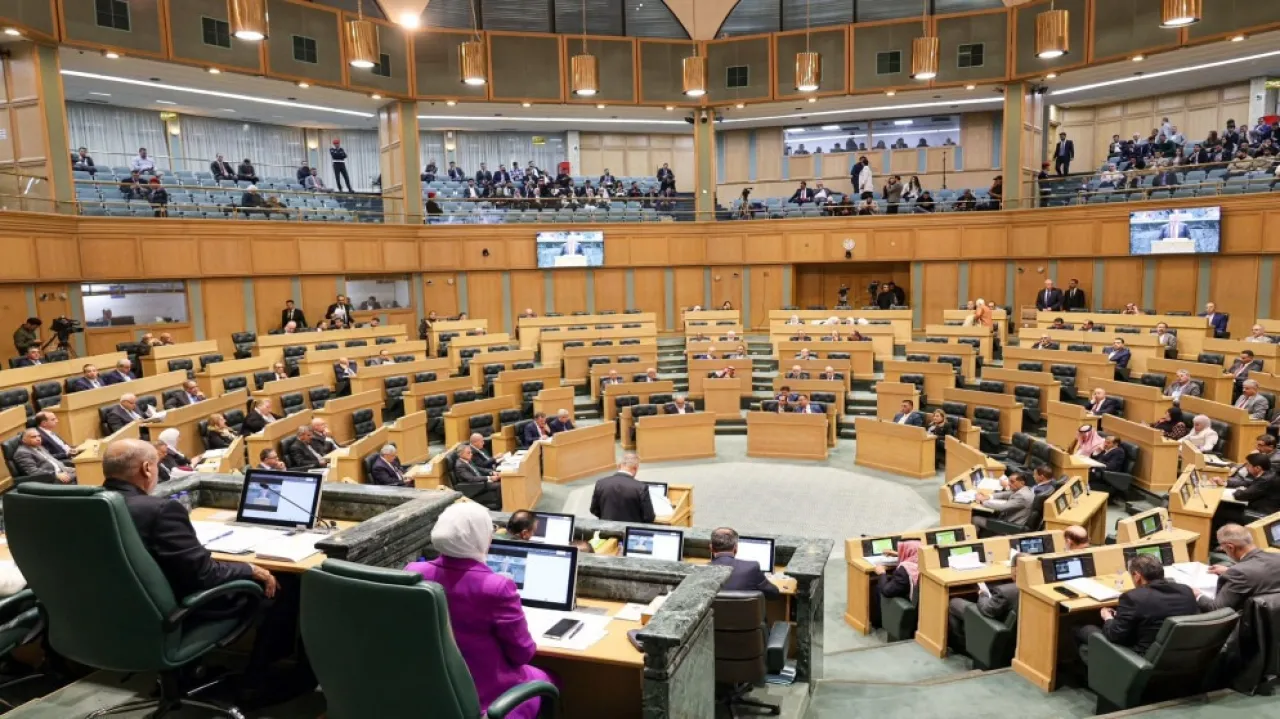
Khaberni - The House of Representatives discussed the recommendations of the Financial Committee on the seventy-third annual report of the Audit Bureau for 2024, during a session held on Wednesday chaired by the Speaker of the Council, Mazen Al-Qadi, and attended by Prime Minister Jafar Hassan and members of the government team.
In the session chaired by the First Deputy of the Speaker, Khamees Atiyah, the Council listened to the report of the Financial Committee on the Audit Bureau report, delivered by its rapporteur, MP Mohammad Bstanji, while the Speaker of the Council granted each deputy three minutes for discussion.
Bstanji read the recommendations issued by the committee after holding 36 meetings, emphasizing the importance of the independence of the Audit Bureau's work and providing it with all the capabilities required to achieve optimal standards, as well as the importance of its role in reducing risks by applying audit standards.
The committee's report included main aspects: analyzing the outputs of the Audit Bureau and its application of subsequent auditing and the impact of the application, the results of evaluating the efficiency of internal audit units for all entities legally subject to its control, its comments on the financial statement for the fiscal year 2024, and the decision of the Financial Committee on the supervisory outputs contained in the Audit Bureau's report for the year 2024.
The analysis results for the final account in terms of revenues and general expenditures showed deviations between the estimated and the actual performance, explaining that the reasons for the deviations in the estimates of general revenues, especially tax revenues, came due to optimism in achieving growth rates higher than their logical levels, along with the effects of the Israeli assault on Gaza Strip and its ongoing violations during 2024.
He continued that the government is now more aligned with the reality of the economic indicators' outcomes, particularly the growth of general consumption and the factors affecting it, and mitigating its effects on the citizens, noting that the government is actively engaged in stimulating and mitigating the severity of conditions on economic sectors or categories of citizens, which is a beginning acknowledged by the committee.
Regarding general expenditures (current), Bstanji stated that the assumptions of general revenues, especially tax revenues, recorded a deviation of 11.6%, which reflected on the percentage of current spending, registering a deviation of 2.6 percent, and impacted the allocations of the civil apparatus amounting to 164.7 million dinars, affecting the filling of vacancies and decreasing the allocations for the use of goods and services, contributing to the delay in payments due and the decrease in medication quantities with measures for good inventory management.
Regarding general expenditures (capital), Bstanji clarified that the capital expenditures recorded an achievement rate of 67.6%.
The committee recommended the Ministry of Finance not to approve any transfers from one project to another unless it is confirmed that the project meets the requirements to be put out to tender.
Bstanji continued that the corrected supervisory outputs reached 60 supervisory outputs, containing 451 items, and constituted 35.3% of the total supervisory outputs, noting that the committee decided to terminate them formally.
In connection with the supervisory outputs which included proof of assault on public funds, referred to the judiciary, Bstanji said they numbered 11 supervisory outputs, constituting 6.5% of the total supervisory outputs.
Regarding the supervisory outputs potentially involving corruption and requiring further investigation and evidence, Bstanji stated that the financial committee decided to refer them to the Integrity and Anti-Corruption Commission, numbering 13 supervisory outputs, making up 7.6% of the total supervisory outputs.
Concerning the supervisory outputs involving payments of bonuses or incentives or allowances for overtime work, exceeding the ceilings set by the regulatory legislations, the committee recommended initiating the recovery processes, which numbered 45 supervisory outputs, constituting 26.5% of the total supervisory outputs, while their value amounted to about 2.463 million dinars.
Regarding the supervisory outputs involving financial amounts due to contracts or financial commitments or receivable accounts on various entities, Bstanji said the committee decided to take collection measures, which numbered 41 supervisory outputs, making up 24% of the total supervisory outputs.
Regarding observations related to the movement or use or traffic violations of government vehicles, although 82% of government cars were linked to the electronic tracking system, Bstanji clarified that the committee noted organizational violations in transport management and vehicle use, recording traffic violations totaling more than 17,000 violations, emphasizing that this requires the activation of administrative and financial penalties, whether in unauthorized allocation or traffic violations or any misuse of vehicles.
Several members stressed that the Audit Bureau is a prestigious supervisory body, serving as a supervisory arm of the House of Representatives in safeguarding public funds, appreciating the work of the Financial Committee and its efforts in preparing its report, and conducting thorough reviews and studies of the report and addressing all supervisory outputs of all departments.
They said that the Audit Bureau is one of the key pillars of the supervisory system in the Jordanian state, playing an important national role in revealing financial and administrative malpractices and anomalies, presenting them transparently before the executive and legislative authorities, so they can be corrected and addressed to safeguard public funds and enhance the citizens' trust in the institutions of the state.
They added that what the Audit Bureau presents through its detailed annual reports should not be seen merely as a supervisory document, but as a real reform tool that helps us all – government and the House of Representatives – to identify and address shortcomings responsibly and nationally.
They continued that the House of Representatives «examines» the Audit Bureau's report, not only in the context of violations, but also in light of the government's actions and policies aimed at improving its administrative performance and general dealings.
They emphasized the need to set up «a clear timeline to address all the violations contained in the report, activate administrative and legal accountability for those responsible for them, and enhance the control and audit systems within government institutions.
They also clarified that the report points to the stalling of some projects due to lack of readiness or absence of medium-term planning, along with deviations in estimating public revenues sometimes based on overly optimistic expectations that do not reflect the actual economic indicators.
Deputies called on the government to make changes to the Audit Bureau law allowing the Bureau to supervise companies in which the government holds less than 50% shares, noting that the current law does not allow the Bureau to audit companies in which the government's share is less than 50%, of which there are 100 companies.
They recommended enhancing the mechanisms for monitoring the implementation of the recommendations of the Audit Bureau through clear corrective plans presented by government agencies, enhancing the system for recovering public funds, enhancing coordination between supervisory and judicial entities to ensure collection of funds due to the treasury, and enhancing the independence and effectiveness of internal audit units in government institutions in accordance with international standards for governance and financial control.