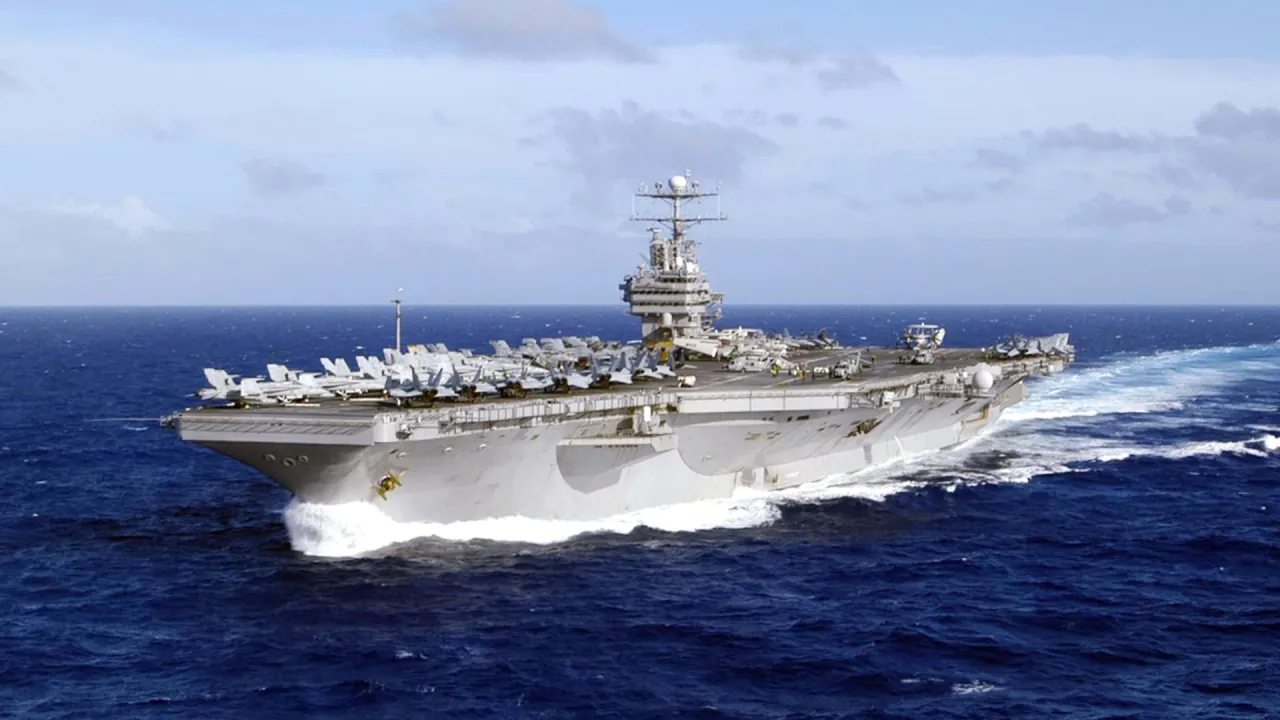
Khaberni - U.S. officials announced that the American aircraft carrier "USS Abraham Lincoln," accompanied by a battle group of warships, has entered the Middle East region.
According to the officials, this deployment provides President Donald Trump with additional offensive and defensive capabilities in case he decides to proceed with any military action against Iran.
The carrier's deployment followed cautious statements by President Trump last week, where he mentioned that the United States has "a fleet heading towards Iran," and at the same time indicated that he is still considering response options, saying: "We have great strength heading towards Iran. I prefer nothing to happen, but we are watching them closely."
U.S. officials reported that Trump had previously backed off from carrying out strikes on Iran earlier this month, but he has not ruled out the option of strikes in response to what reports described as "Tehran's massacre of protesters."
Some estimates issued by human rights organizations suggest that the number of victims exceeds 5,000 people, a claim that the spokesperson for the Iranian Foreign Ministry, Ismail Baqaei, has denied.
This military deployment comes at a time when the region has experienced a gap in the presence of American aircraft carriers, since the "USS Gerald Ford" was redirected to the Caribbean region last fall amidst escalating tensions with Venezuela. Previously, "Lincoln" was stationed in the South China Sea before receiving orders to head to the Middle East.
The "USS Abraham Lincoln" carries aboard advanced fighter jets of type "F-35C" and "F/A-18," in addition to electronic warfare aircraft "EA-18G Growler" capable of jamming defense systems.
A U.S. defense official confirmed that the carrier is accompanied by three navy destroyers equipped with Tomahawk cruise missile launch systems.
In addition to naval power, the United States has recently deployed "F-15E" fighter jets at an airbase in Jordan. It is also transferring advanced air defense systems, types "Patriot" and "THAAD," to the region to bolster the defense of U.S. facilities and allies against any potential counterattacks from Iran, according to flight tracking data and U.S. officials.
One of the officials mentioned that part of this equipment has already been moved, and the deployment of the remaining units is expected to be completed within one to two weeks.