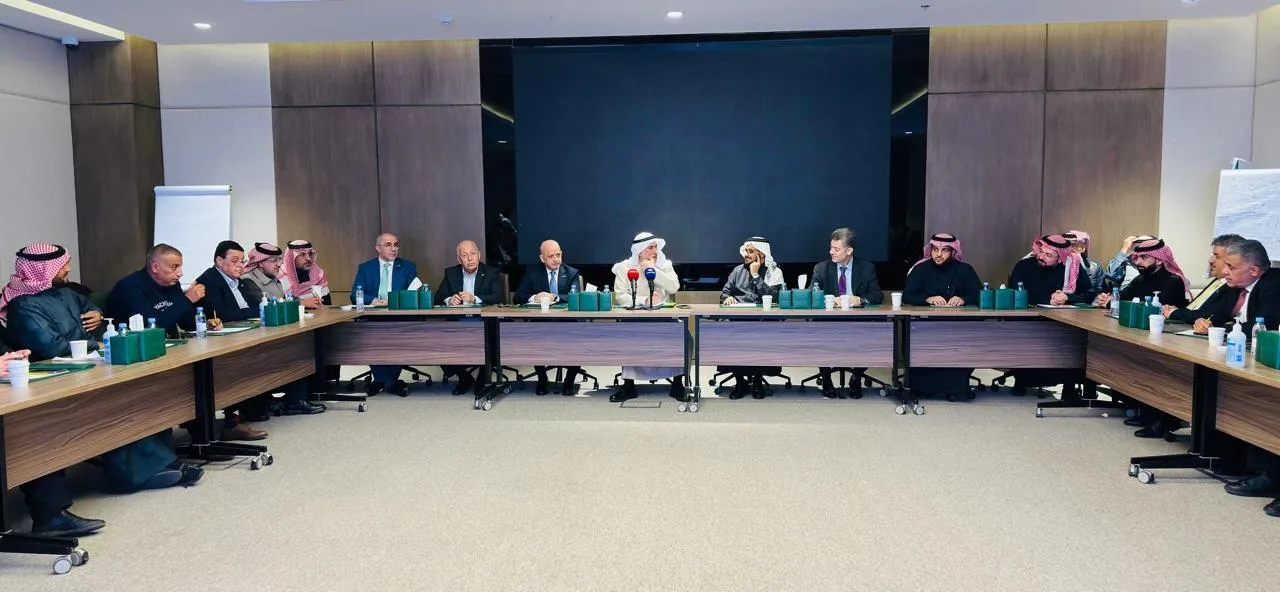
Khaberni - The Jordanian economic delegation participating in the Saudi-Jordanian business forum discussed during their visit to the Saudi Investment Ministry in Riyadh, ways to enhance partnerships, expand cooperation horizons, and attract joint investments between the two brotherly countries.
The head of the Jordan Chamber of Commerce and the head of the Jordanian side in the Jordanian-Saudi Business Council, Senator Khalil Hajj Tawfiq, said that the delegation's visit to the Saudi Investment Ministry comes within the framework of the two countries' keenness to attract investments, confirming that the Jordanian-Saudi relations are special and exceptional, enjoying direct support from the leaderships in both countries.
He added that the holding of business council meetings in the Saudi capital, Riyadh, for the first time since its establishment in 1997, represents a clear indication of the depth of historic relations, love, and kinship and brotherhood bonds that join the Hashemite Kingdom of Jordan and the Kingdom of Saudi Arabia.
Hajj Tawfiq stated that moving from having meetings traditionally in Amman to holding them in Riyadh reflects mutual confidence and a true strategic partnership, indicating that this is an appropriate time for direct action and building upon the mutual interests of the two countries.
He explained that all efforts in the realm of economic cooperation are conducted under the umbrella of the Saudi-Jordanian Business Council, which includes 12 joint sectoral committees carefully formed based on the economic strengths and intersections between the two countries, aiming to achieve real and sustainable success stories.
Hajj Tawfiq clarified that the participating Jordanian delegation includes representatives from various economic sectors, ranging from heads of chambers of commerce in Jordanian provinces, heads of employers' unions, and investors operating in Jordan and Saudi Arabia, in addition to sectors of education, gold, food products, information technology, construction, and others.
Additionally, Hajj Tawfiq emphasized that Syria’s stability represents a national interest for Jordan, Saudi Arabia, and the Arab world, confirming that Jordan, as a bordering country, has paid the price for the events in Syria since 2011 and still faces challenges related to drug and weapon smuggling, adding that Jordan stands, under the directions from His Majesty King Abdullah II, alongside the brothers in Syria, believing that its stability serves everyone.
He pointed out that there are significant opportunities for Jordanian-Saudi cooperation on the Syrian file, especially in logistical areas and reconstruction, where Jordan can act as a logistical platform for Saudi companies looking to enter the Syrian market, benefiting from the presence of Jordanian banks operating in Syria and Jordan's advanced experience in the banking sector, digital transformation, and electronic payments.
Hajj Tawfiq revealed plans for a tripartite Jordanian-Saudi-Syrian meeting with the Syrian Chambers of Commerce, aiming to discuss mechanisms for joint economic integration.
He confirmed the importance of coordinating the Saudi Vision 2030 and the Jordanian Economic Modernization Vision overseen by His Majesty the King, pointing out the potential for developing joint projects, such as connecting “Neom” with Aqaba, and enhancing cooperation in various fields and brands between the two sides.
Meanwhile, Saudi Assistant Minister of Investment Dr. Abdullah Al-Dubaikhi affirmed that the Saudi-Jordanian economic relations possess great untapped opportunities, despite their notable development, indicating that the current volume of trade and investments does not reflect the depth of the fraternal relations and natural integration between the two brotherly countries.
Al-Dubaikhi mentioned that approximately 2448 Jordanian companies are licensed in Saudi Arabia, while the volume of trade between the two countries is about five billion dollars according to the latest statistics, describing these figures as “modest” compared to the significant potentials and historical, geographical, and economic ties that join the countries.
He added: “These numbers should be much bigger between two neighboring brotherly countries that share countless traits and mutual interests,” stressing that there is a shared responsibility on the Ministry of Investment and businessmen in both countries to intensify efforts and maximize trade and investment cooperation.
He noted that Saudi Arabia is opening its doors to Jordanian investors, working to facilitate their entry into the Saudi market, pointing to introductory and investment programs, including the “Invest in Saudi” program, offering a quick and comprehensive overview of the current opportunities available in various sectors.
Al-Dubaikhi clarified that Jordan has high human competencies and advanced skills in many fields, making it an important partner for the Kingdom, stating that there are promising opportunities for cooperation in the mining sector, especially in phosphate and potash, revealing significant interest from the Saudi Mining Company in enhancing cooperation with the Jordanian side in this sector.
Al-Dubaikhi also mentioned cooperation opportunities with major Saudi companies, including SABIC, especially in the fields of feedstocks and related industries, as well as cooperation in advanced information technology, affirming that the Kingdom aims to be a global hub for data centers, and that projects will soon be announced in this field.
He added that Jordan is among the advanced countries in the information technology sector, opening up opportunities for unique partnerships that serve the interests of both countries, calling for an enhancement of Jordanian investments in Saudi Arabia, and Saudi investments in Jordan, and reaching the highest levels of economic integration.
Al-Dubaikhi emphasized the importance of joint cooperation in supporting the renaissance of Syria, assuring that Syria’s prosperity represents a priority and a collective responsibility, especially for Jordan due to geographical proximity.
He stated that there is increasing activity of Saudi companies in Syria, with some companies already operating, while others are preparing to enter various sectors including health, education, housing, infrastructure, and financial services, confirming that Syria “needs everything,” and that joint work between Saudi Arabia and Jordan will contribute to its revival and stabilization.
On his part, the head of the Saudi side in the Saudi-Jordanian Business Council, Engineer Abdul Rahman Al-Theebeti, emphasized the private sector’s keenness in both countries to enhance cooperation with the Ministry of Investment, indicating that 12 joint committees were carefully formed with a strategic vision focusing on the knowledge economy, particularly in areas of phosphates and their derivatives, and university education in border regions, to stimulate investment in north Saudi Arabia and Jordan.
He explained that railway connection projects represent an important investment and economic lever for both countries, in addition to joint work on economic models for reconstruction, starting from Syria, which could later be generalized to other regions.
He stressed the importance of directives from the Ministry of Investment to organize the participation of Jordanian companies in major Saudi projects, especially in the construction sector and projects related to Vision, Expo, and the World Cup, asserting that developing mechanisms for classifying and qualifying contractors will enable Jordanian companies to enter the Saudi market, achieving mutual benefits.
The Saudi Investment Ministry presented an overview of the targets of Saudi Vision 2030 regarding investment opportunities and ambitious projects, highlighting the most exceptional opportunities in priority sectors and major projects, as well as showcasing the “Invest in Saudi” platform and the quality of services and opportunities provided to investors as a national branding for marketing opportunities and enablers for investors, in sectors of entrepreneurship and innovation, communications and information technology, research and development, education, as well as sports and real estate.