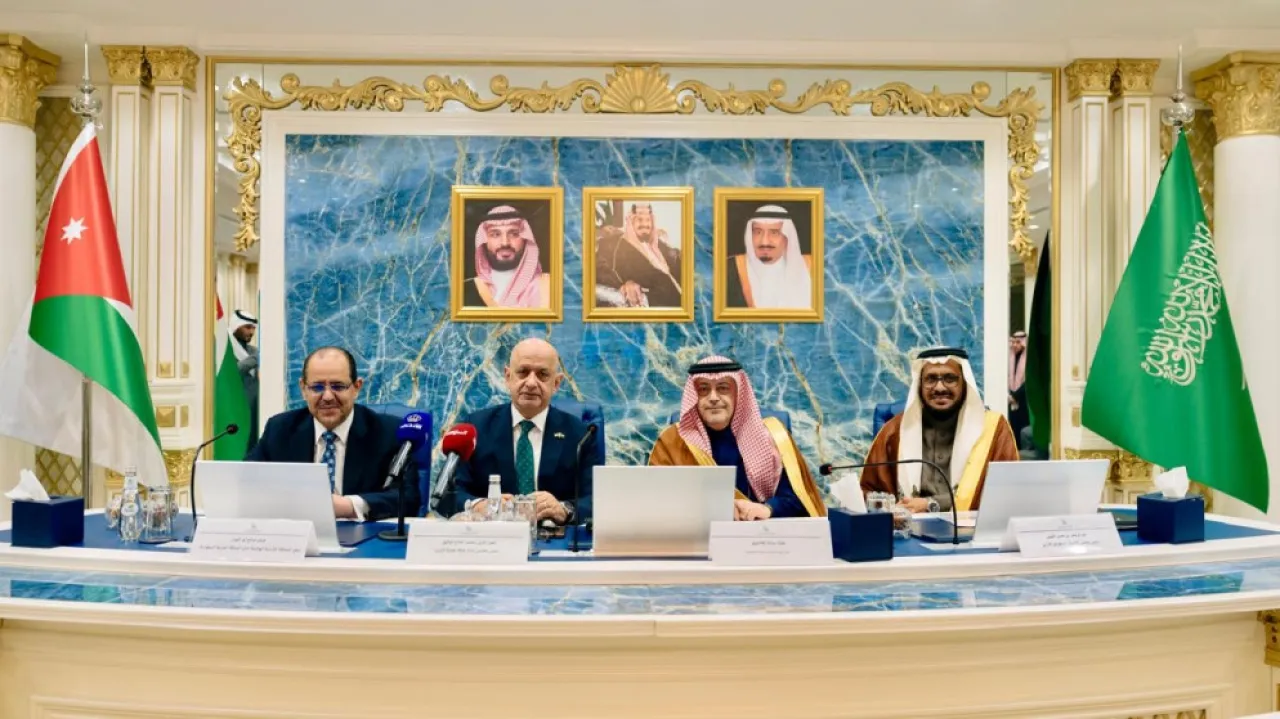
Khaberni - The Jordanian-Saudi Business Forum commenced this Wednesday in the Saudi capital, Riyadh, organized by the Jordan Chamber of Commerce in cooperation with the Federation of Saudi Chambers.
This forum aims to enhance economic and investment cooperation between the two countries, and open new horizons for strategic partnerships between the private sectors in the Hashemite Kingdom of Jordan and the Kingdom of Saudi Arabia.
The president of the Jordan and Amman Chambers of Commerce, and the Jordanian head of the Saudi-Jordanian Business Council, Khalil Haj Tawfiq, emphasized that Jordanian-Saudi relations are a solid model of brotherhood and integration, stressing that the current phase requires translating this robust political legacy into practical economic partnerships led by the private sector and achieving tangible results on the ground.
He stated that the Kingdom of Saudi Arabia is undergoing an unprecedented qualitative economic transformation under the Saudi Vision 2030 led by HRH Crown Prince Mohammed bin Salman, noting that this transformation is a source of pride for all Arabs, especially Jordanians and the Jordanian private sector.
He highlighted that Jordan now possesses a comprehensive economic modernization vision led by His Majesty King Abdullah II. Recently, its second executive program for the years 2026–2029 was launched in the presence of His Majesty King Abdullah II, HRH Prince Hussein bin Abdullah II, the Crown Prince, including specific projects supported by feasibility studies and performance indicators.
He clarified that these projects will be provided to our brethren in the Federation of Saudi Chambers and the Saudi-Jordanian Business Council, while also inviting the Saudi side to share available investment opportunities, as this is a shared responsibility between the private sector institutions in both countries.
He mentioned that the Jordanian delegation participating in the forum is the largest in terms of the number of businessmen and investors visiting the Kingdom, reflecting the seriousness and significant interest in enhancing economic cooperation, appreciating the pivotal role of the Federation of Saudi Chambers in facilitating bilateral meetings and organizing the activities of the joint committees.
He confirmed that the sectoral committee meetings held on the sidelines of the forum were productive and resulted in practical recommendations, explaining that their work is not limited to addressing immediate challenges but extends to formulating visions and long-term strategic initiatives that contribute to reshaping paths of economic cooperation, including enhancing logistical connectivity, transportation, and commerce, and exploring future opportunities for railway connectivity, given its direct impact on facilitating trade movement, reducing costs, and enhancing the efficiency of regional supply chains.
Haj Tawfiq addressed the importance of industrial integration between the two countries, calling for strengthening mutual reliance on production inputs, which contributes to reducing the trade balance gap and enhancing the competitiveness of national industries, pointing out that Jordan owns strong industries capable of entering into integrative partnerships with their Saudi counterparts.
In terms of food security, Haj Tawfiq affirmed that Jordanian-Saudi cooperation demonstrated its strength during crises, particularly during the COVID-19 pandemic, where Saudi Arabia contributed to ensuring a safe food stock for Jordan, which embodies the depth of the strategic partnership between the two countries.
He affirmed that the relationship between Jordan and Saudi Arabia extends beyond trade exchange to broader horizons of economic integration, leading to a true Arab economic unity, emphasizing that all ingredients are available, with only implementation and hard work by the private sector in both countries remaining, which will leave a positive impact for future generations.
Meanwhile, the Vice President of the Federation of Saudi Chambers, Imad Al-Fakhri, confirmed the Federation's commitment to enhancing economic cooperation between the Kingdom of Saudi Arabia and the Hashemite Kingdom of Jordan, and supporting the efforts of the private sector in both countries to capitalize on available investment and commercial opportunities, contributing to building sustainable strategic partnerships serving the shared interests.
He noted that the forum serves as an important platform for exchanging information about investment opportunities, enabling business owners to formulate a clear future vision for the system of promising partnerships, and working to double their size and expand their fields, especially in priority sectors such as industry, food security, transportation and logistics, healthcare and educational services, renewable energy, real estate development, and tourism and leisure.
He explained that the Federation of Saudi Chambers is keen to provide various forms of support and empowerment to the Saudi-Jordanian Business Council to achieve its main objectives, and work to overcome any challenges or obstacles that may face investors, through continuous coordination with the relevant authorities in both countries, contributing to improving the business environment and enhancing investment attractiveness.
He stated that the economic relations between Saudi Arabia and Jordan have seen significant growth in recent years, supported by the exchange of trade delegations and high-level official visits, which has contributed to expanding cooperation horizons and developing partnerships in various economic sectors.
He highlighted that the Kingdom of Saudi Arabia remains the leading trade partner for the Hashemite Kingdom of Jordan among Arab countries, and holds a high position globally, with the volume of trade exchange between the two countries exceeding five billion dollars according to the latest statistics, while Saudi investments in Jordan amount to about 16 billion dollars, compared to Jordanian investments in the Kingdom approaching 8 billion dollars until 2024.
He affirmed that these positive indicators directly reflect the outcomes of the pathways of Vision 2030 of the Kingdom, which contributed to building an integrated system to support the private sector and develop trade and investment, providing a competitive business environment attractive to local and international investors, and enhancing exports, offering investment incentives in various sectors, particularly quality sectors.
He added that the vision has opened new broad fields for investment in sectors such as renewable energy, mining, tourism, and other promising sectors, providing real opportunities for Saudi and Jordanian companies to expand their businesses and engage in joint projects with high added value.
He emphasized the importance of the forum resulting in practical recommendations and actionable implementation mechanisms, contributing to satisfying the aspirations of business owners in both countries, and enhancing the role of the private sector as a crucial partner in achieving sustainable economic development.
On his part, the ambassador of the Hashemite Kingdom of Jordan to Riyadh, Dr. Haitham Abu Al-Foul, confirmed that the joint Saudi-Jordanian Business Council represents one of the most important institutional frameworks for enhancing economic, trade, and investment cooperation between the two brotherly countries, and translating the depth of brotherly relations into effective and sustainable economic partnerships serving the shared interests.
He said that Jordanian-Saudi relations are rooted and based on solid foundations of brotherhood and mutual respect, and are steadily moving towards more cooperation and integration under the guidance and direction of the leadership of both countries, noting that recent years have seen noticeable growth in economic cooperation and the exchange of delegations and official visits, which has contributed to expanding partnership areas between the two sides.
He clarified that the Kingdom of Saudi Arabia remains the leading trade partner for Jordan among Arab countries, with the volume of trade exchange between the two countries exceeding 5 billion dollars, while Saudi investments in Jordan amount to about 16 billion dollars, compared to Jordanian investments in the Kingdom approaching 8 billion dollars until 2024, reflecting the robustness of economic relations and opportunities for future development.
He mentioned that Saudi Vision 2030 has opened wide prospects for investment in major quality sectors, while Jordan provides an attractive investment environment supported by trade agreements, a strategic location, and qualified human talents, emphasizing the importance of moving to the practical implementation phase of the joint projects, and ensuring that the business forum concludes with clear recommendations and a roadmap that enhances sustainable economic cooperation between the two countries.
On his behalf, the president of the Saudi side in the Saudi-Jordanian Business Council, Engineer Abdulrahman Al-Thubaiti, stated that the Jordanian-Saudi Business Forum represents an important milestone in enhancing the strategic economic partnership between the Kingdom of Saudi Arabia and the Hashemite Kingdom of Jordan, noting that the relations between the two countries are based on solid foundations of brotherhood, mutual trust, and a shared vision that believes in the importance of long-term integration and cooperation.
Al-Thubaiti commented that the current phase requires moving from the framework of traditional opportunities to more comprehensive and effective integrative pathways, pointing out that the Saudi-Jordanian Business Council operates within an institutional frame relying on specialized committees concerned with studying priority sectors, analyzing investment and regulatory challenges, and formulating practical initiatives for implementation in coordination with the relevant government authorities in both countries.
He clarified that the role of these committees is not limited to addressing immediate challenges but extends to devising long-term strategic initiatives that contribute to reshaping economic cooperation pathways, including enhancing logistical connectivity, transportation, and commerce, and exploring future opportunities for railway connectivity, which impacts the facilitation of trade movement, cost reduction, and efficiency improvement of regional supply chains.
He highlighted the importance of developing the knowledge economy linked to the phosphate sector as a shared wealth between the two countries, by moving from exporting raw materials to advanced industrial models based on research and development, processing industries, knowledge transfer, and building sustainable industrial and technological partnerships serving both the Saudi and Jordanian economies.
Al-Thubaiti pointed out that the integrative connection between the Aqaba ports and King Abdullah Economic City forms a strategic pathway to enhance maritime and logistical integration and connect trade routes, supporting the movement of exports and imports, enhancing the competitiveness of both countries, and keeping pace with the rapid transformations in regional and international trade.
He added that the forum serves as an interactive platform that brings together visions, ideas, and practical experiences, and contributes to transforming strategic pathways into actionable initiatives that ensure continuity of work after the forum's conclusion, emphasizing the importance of integration between governmental efforts and the work of the specialized committees in the council to achieve tangible results, improve the business environment, and stimulate joint investments.
He stressed that the forum represents a pivotal point in the course of economic cooperation between the two countries, and it is expected to result in quality partnerships and strategic initiatives that reflect the scale of shared potentials and ambitions, contributing to achieving real added value for the Saudi and Jordanian economies.
On the sidelines of the forum, 5 memorandums of understanding were signed, reflecting a strong commitment to effective cooperation and embodying the concrete results of this meeting, and enhancing the course of economic partnership between the two countries. Presentations were also made about the role of the Saudi Ministry of Investment, in addition to a presentation about the Saudi Standards, Metrology and Quality Organization.
Additionally, bilateral direct (B2B) meetings between Jordanian and Saudi companies were held on the sidelines of the forum, aiming to build actual commercial and investment partnerships, and sign agreements and memorandums of understanding in various sectors.
The delegation included representatives from commercial, service, industrial, and agricultural sectors, along with presidents of chambers of commerce from various provinces of the kingdom, in addition to representatives of economic sectors, heads of guilds, and a number of Jordanian businessmen and investors.
It is noted that this visit comes as part of the efforts made by the Jordan Chamber of Commerce and private sector institutions to enhance the presence of Jordanian companies in the Saudi market and benefit from the opportunities provided by major projects and rapid economic transformations in the Kingdom of Saudi Arabia, in line with Saudi Vision 2030, and in harmony with Jordan’s economic modernization vision and its goals in stimulating investment, increasing exports, and creating job opportunities.
The visit represents an important step toward deepening economic integration between the two countries, transforming traditional trade relations into long-term strategic partnerships that contribute to supporting economic growth, creating job opportunities, and enhancing the competitiveness of the private sector in both countries.