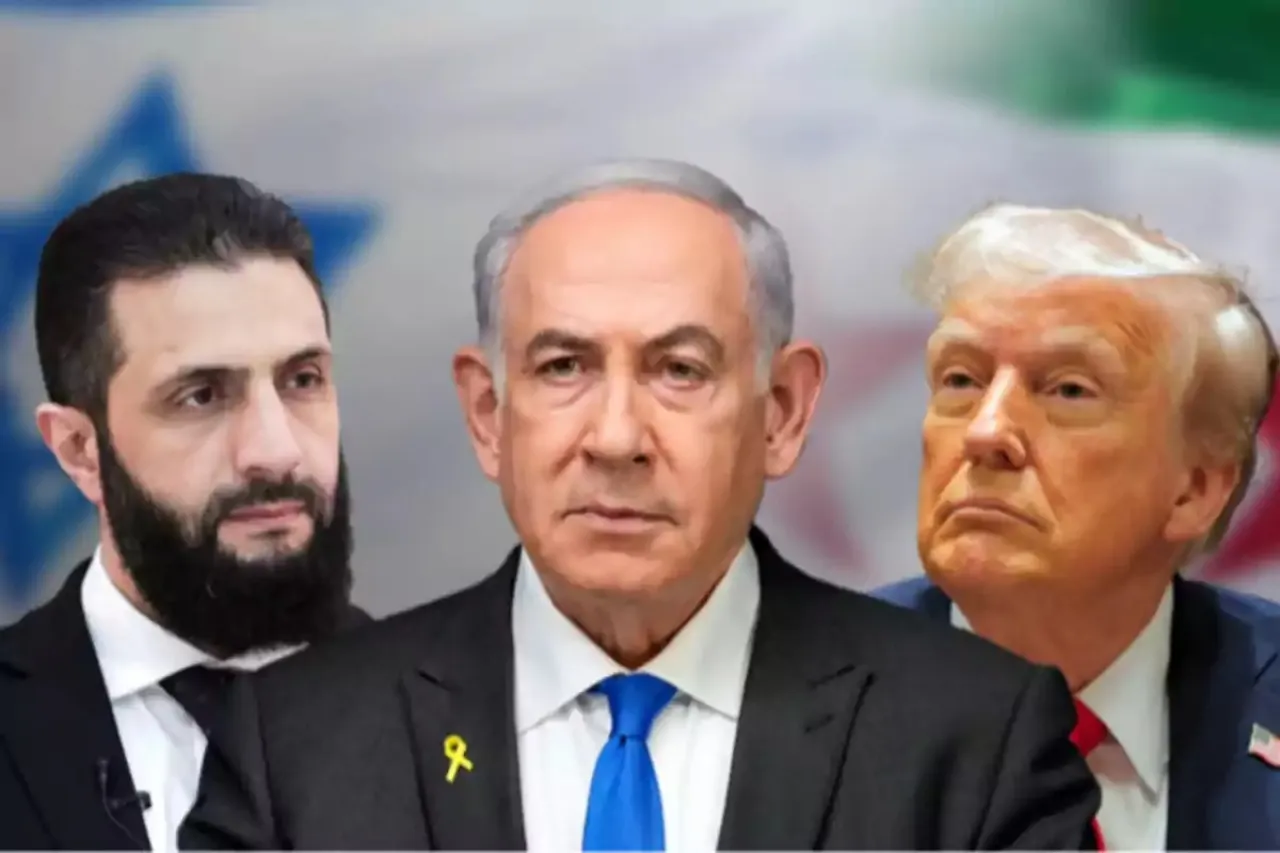
Khaberni - The Israeli Broadcasting Corporation revealed on Saturday that Israel tried to convince the administration of US President Donald Trump not to lift all sanctions imposed on Syria, in order to retain some of them as a future bargaining tool, but their efforts were met with rejection, amidst American promises of "compensation" for Tel Aviv.
Two Israeli sources said that Israel requested the Trump administration not to lift all sanctions imposed on Syria, but the American administration refused.
The sources mentioned that officials from the government of Israeli Prime Minister Benjamin Netanyahu approached officials from the Trump administration and tried to influence them to not lift the sanctions on Syria, claiming that leaving some in place would tie their lifting to future negotiations between Syria and Israel.
They mentioned that the Trump team refused the Israeli request, however, they added that the administration of the American President promised to compensate Israel for that, without specifying the nature of this compensation.
Caesar Sanctions
This comes following Trump’s signing on Thursday of the National Defense Authorization Act for Fiscal Year 2026 (NDAA) with a value of approximately 900 billion dollars, which includes a provision to cancel the "Caesar sanctions" that had been imposed on Syria since 2019.
The law includes ending the broad sanctions imposed on Syria, a step that lawmakers say aims to support Damascus' economic recovery after more than a decade of war.
The law requires the President of the United States or his delegate to provide a report to Congress every six months over the next four years, assessing the performance of the Syrian government and its taking "concrete actions," concerning several issues, among them the elimination of the threat of "terrorist groups".
The "Caesar Act" is one of the strictest laws imposed on Damascus, as it forbids any country or entity from dealing with the Syrian government or financially or economically supporting it.
Syrian-Israeli Negotiations
The enactment of this law came days after the American President spoke about the importance of maintaining a "strong and genuine dialogue" with Damascus, at a time when his administration is seeking to reach an agreement to prevent hostilities between Syria and Israel, which continues to carry out military operations within Syrian territories.
The United States mediates between Syria and Israel to reduce tension and reach a security agreement that Damascus hopes will lead to a scaling back of the control operations Israel has carried out on its territory recently.
On December 15th, the Israeli Prime Minister received the American special envoy to Syria, Tom Barrack, in the presence of several Israeli officials, while reports at the time spoke about the United States setting "red lines" concerning Israeli activities in Syria.
At the beginning of December, Trump wrote in a post on his social media platform "Truth Social": "It is very important for Israel to maintain a strong and genuine dialogue with Syria, and that nothing should happen that could hinder Syria's development into a prosperous state."
The positions announced by Damascus and Tel Aviv confirm that any progress in the negotiation track remains conditional on security and sovereignty considerations. Israel, in previous official statements, emphasized that its movements within Syria are linked to what it claims are "security threats," pointing to its efforts to establish a demilitarized zone extending from Damascus to Mount Hermon and other areas.
In contrast, Syria, on multiple occasions, has stated that any future understandings must be based on respecting sovereignty and the withdrawal of Israeli forces from its territories.
Syria does not officially recognize Israel, which has occupied more Syrian territory since December 2024. Israel had occupied the Syrian Golan Heights during the 1967 war and later annexed it, a step recognized by the United States, but not by most other countries.