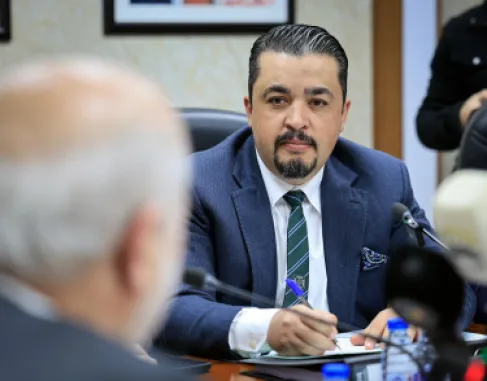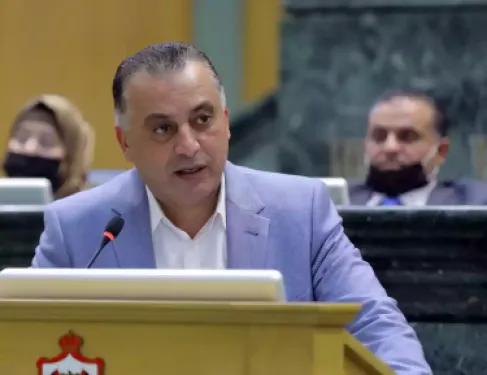
The Speaker of the House of Representatives, Mazen Al-Qadi, stated that keeping up with the developments of artificial intelligence is one of the national files that have received the attention of His Majesty King Abdullah II, noting His Majesty's direction to form a "National Council for Future Technology" with follow-up from His Royal Highness Crown Prince Al Hussein bin Abdullah II, and chaired by the Prime Minister.
Al-Qadi added during his sponsorship of the conference "Legal Responsibility for the Use of Artificial Intelligence Technologies in Healthcare: Problems and Regulatory Prospects" organized by Amman Arab University, attended by the Head of the Medical Association, and a group of academics and specialists from inside and outside the kingdom, that "Our priority today goes towards adopting legislations that keep pace with the artificial intelligence revolution, to ensure its use in a manner that serves the public interest and preserves citizens' rights, and unifying efforts to draft legal and regulatory frameworks that ensure the safe and effective use of its technologies."
He referred to our anticipation of scientific papers from this conference about the proposed legislative regulation for artificial intelligence tools in the health sector, taking into account the balance between technological advancement and the protection of citizens' rights.
On his part, the President of the Board of Trustees of Amman Arab University, Dr. Omar Al-Jazi, said that the conference is convened at a crucial time amidst the global acceleration in technological and medical progress, and the accompanying expansion in the use of artificial intelligence and smart applications in the healthcare sector.
Al-Jazi highlighted that the gap between technological development and the pace of legislation necessitates an effective legislative intervention to address the legal void, and to build a legislative system capable of dealing with emerging medical challenges, and in a way that ensures patient protection and clarification of legal responsibilities of healthcare providers.
Dr. Mohammad Al-Widian, President of Amman Arab University, said that the conference will discuss issues affecting one of the most vital sectors in the state, the medical sector, due to its direct impact on human health and national economic development, noting that the rapid development in medical technologies and artificial intelligence requires a review of the regulating legislations, and building effective partnerships between legislative bodies and the medical sector to uphold human dignity and protect the body.
In turn, the Head of the Medical Association, Issa Al-Khashashneh, said that artificial intelligence has become an integral part of modern medical practice, which necessitates the need to establish clear legal frameworks that regulate its use and preserve patients' rights, and at the same time provide a safe environment for doctors and healthcare providers.
He highlighted the importance of integration between the medical sector and legislative and academic bodies to come up with practical recommendations that balance technological progress and ethical and professional considerations, contributing to the improvement of healthcare services and the protection of the medical system in the kingdom.
Dean of the Faculty of Law at Amman Arab University, Dr. Mohammad Al-Dhneibat said that the conference addresses legal, technical, and medical dimensions integrated together, aiming to provide a comprehensive vision for the use of artificial intelligence in healthcare within clear legal and ethical frameworks.
Al-Dhneibat emphasized the importance of students benefiting from the conference outputs, and enhancing their academic knowledge by participating in the specialized scientific sessions.
The head of the conference's preparatory committee, Dr. Sultan Al-Attiyat confirmed that the conference is held at a pivotal moment in which the world is witnessing a radical transformation in the role of artificial intelligence in the healthcare sector, which places significant responsibilities on the shoulders of law and legislation, noting that (121) researchers from inside and outside the kingdom, presented sixty-eight scientific researches that were peer-reviewed according to precise academic standards, reflecting the scientific confidence in this platform, and affirming its role in producing robust knowledge that is legislatively and institutionally buildable.
Al-Attiyat pointed out that the volume of scientific participation and the quality of the presented research reflect the importance of the conference as a scientific and legislative station capable of producing knowledge that can be built upon in the future, pointing out that each stage has its major questions, and our era's question is "How do we improve the employment of technology while preserving human dignity, and here begins the responsibility of the law".