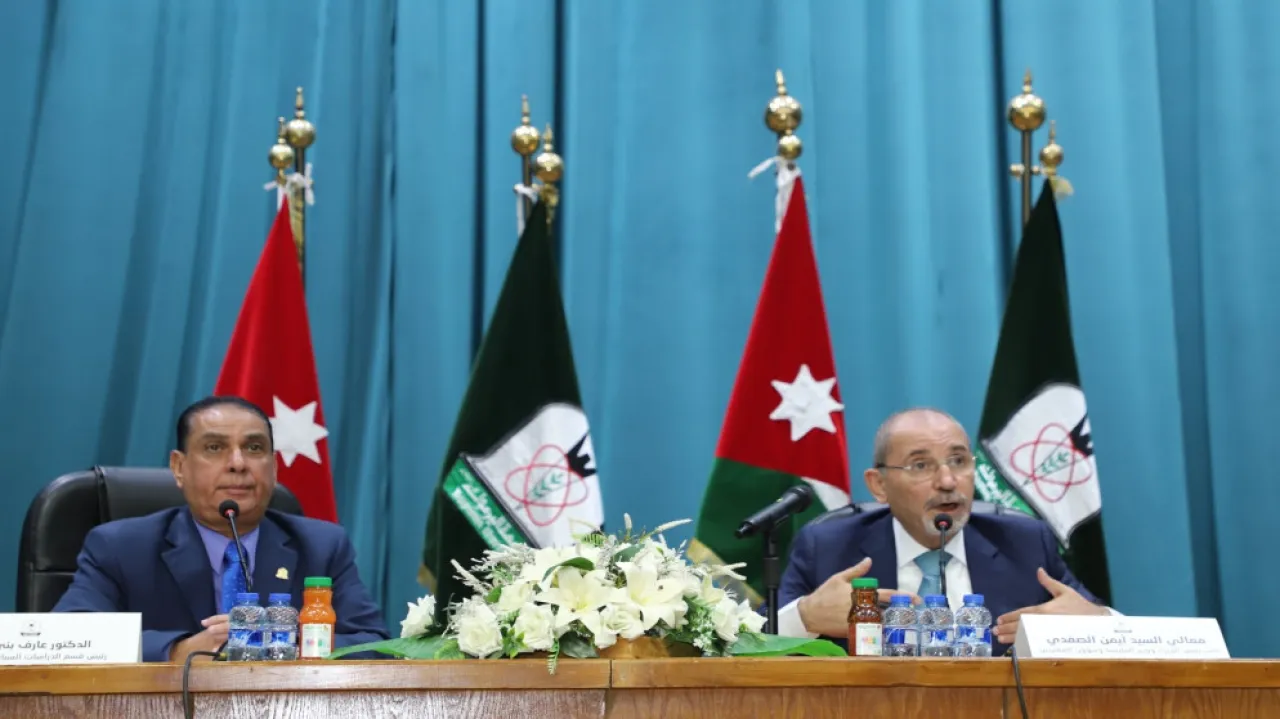
Khaberni - Deputy Prime Minister and Minister of Foreign Affairs and Expatriate Affairs, Ayman Al-Safadi, delivered a lecture on Thursday to the students of Yarmouk University in the presence of the University President Malik Al-Sharairi, titled "Jordanian Foreign Policy: The Jordanian Diplomatic Role in Confronting Regional Crises", during which he reviewed the role and efforts of Jordanian diplomacy towards various regional issues.
Al-Safadi affirmed during the lecture that Jordanian diplomacy, led by His Majesty King Abdullah II, is based on constants, principles, firm positions, and a clear vision to serve the interests of Jordan and its citizens, protect its security and stability, defend justice and just causes, and contribute to enhancing security and stability in the region, which positively reflects on Jordan's interests.
Al-Safadi also confirmed that the Kingdom's efforts, under the leadership of His Majesty King Abdullah II, are steadfast in supporting the legitimate rights of the Palestinian people to end the occupation, freedom, and establishing an independent sovereign Palestinian state based on the borders of June 4, 1967, with East Jerusalem as its capital, based on a two-state solution, pointing out that His Majesty's efforts have been continuous to stop the aggression on Gaza, stop the bloodshed, bring aid into the sector, and prevent conditions leading to displacement.
Al-Safadi pointed out that Jordan continues its efforts, in coordination with brothers and partners, to work on stopping the dangerous escalation and unilateral Israeli measures in the occupied West Bank, and affirmed Jordan's continued role in protecting and caring for the Islamic and Christian holy sites in Jerusalem, and preserving the Arab Islamic and Christian identity of the holy sites, based on the historical Hashemite custodianship over them.
Al-Safadi added that Jordan continues to work on enhancing the established fraternal relations with the brothers and establishing partnerships with friendly countries, serving Jordanian political, economic, investment, trade, educational, and other sectors and areas.
Furthermore, an open dialogue took place at the end of the lecture, during which Al-Safadi answered students' questions and inquiries focusing on Jordanian policies and standings towards regional and international issues.