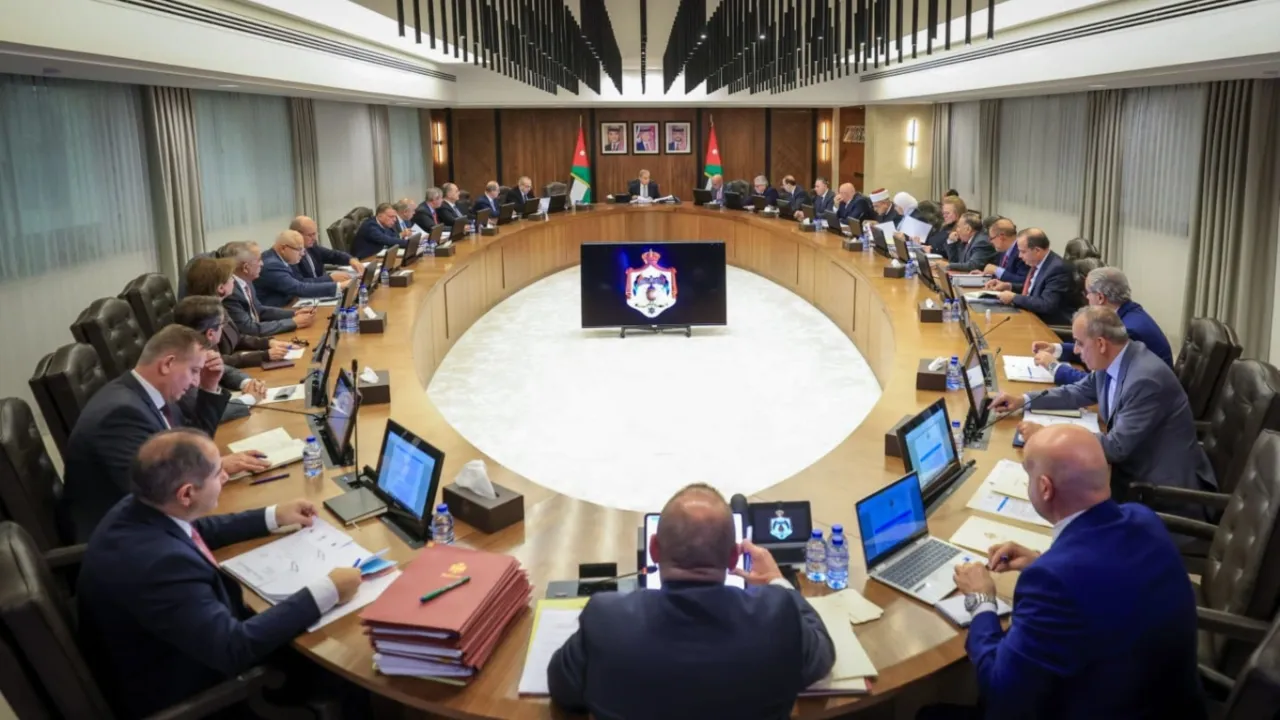
Khaberni - The Cabinet decided in its session held today, Sunday, chaired by Prime Minister Dr. Jaafar Hassan, to assign the Ministry of Public Works and Housing to proceed with the procedures for tendering the preparation of studies and engineering designs and the tender documents for some projects that will be established in Umrah City project, which includes project tenders: race tracks and Olympic halls in King Abdullah II Sports City, and tenders for the International Center for Exhibitions and Conferences, and the streets and infrastructure of Umrah City project.
The decision comes in the context of the necessary procedures to start implementing the projects that will form the core of Umrah City project, which will be managed, monitored, and facilitated by the Jordanian Company for the Development of Cities and Government Facilities, with the work starting at the beginning of next year and extending until 2029.
The Prime Minister had launched Umrah City project at the end of last November, which represents a new model in urban development and long-term population growth management, where he had then reviewed the project plans that will be established during the first phase, which will be established on an area of 40,000 dunums out of a total half a million dunums.
The Cabinet also decided to grant incentives, exemptions, and necessary facilitations for the National Water Carrier project, as it is an important strategic national project, which includes subjecting all project supplies in all its forms to the general and special sales tax at the rate or by the amount (zero).
The decision comes in light of the intensive procedures adopted by the government in preparation for the actual implementation of the project during the next year; as it is one of the most important strategic national projects, and a fundamental pillar for achieving national water security, targeting the desalination of 300 million cubic meters annually of Red Sea water, with an estimated benefit for about 4 million citizens.
Under the decision, the government will also bear the income tax, withholding tax, and the national contribution arising, as well as all materials (involved in the project) from customs duties and service charges, and the temporary admission of vehicles, machinery, and necessary equipment, similarly to similar national projects previously established, most notably the Disi Water Conveyance Project.
In the context of facilitating citizens and investors, the Cabinet approved an amended system for building and urban and village regulation for the year 2025.
Under the amendments, the restrictions and conditions related to licensing investment projects regarding the required street capacity will be reduced, allowing these projects to be established on streets with less capacity than previously required, which was not less than 12 meters, if the plot is serviced by more than one road; aiming to encourage investment.
The amendments also include the exemption of judicial partition transactions and the removal of commonality from the condition of availability of occupancy permits for buildings; for the purpose of facilitating the procedures of this type of partition and not hindering it, given that the number of judicial commonality removal transactions has become very numerous in light of the facilitation of procedures contained in the real estate ownership law.
The amendments also reduce the fees for the required parking spaces for plots with small areas, lowering them to 2000 Jordanian dinars instead of 3000 dinars for residential, and 4000 dinars instead of 6000 dinars for commercial, in the case the land area is less than 400 meters.
Also, the building area percentage allowed in plots located outside the regulation will be increased from 10% to 15%; for the purpose of allowing owners of lands located outside the regulation to build with a larger percentage for residence.
Also, an extension of the grace period for licensing existing violating buildings will be implemented; aiming to provide the opportunity for the largest number of citizens to benefit from the decision to reduce the fines and fees for unlicensed buildings, especially for buildings with violations; including the inclusion of unpaid fees for buildings that had obtained a previous license in the rate of reductions, in pursuit of achieving justice between citizens, especially those who obtained a building license decision and did not complete the payment of licensing fees and fines properly.
In addition, the Cabinet approved a leasing and ownership system for real estate outside the Petra Archaeological Reserve or other archaeological sites in the Petra Development and Tourism Region for the year 2025.
The system comes as a fundamental step for the purposes of revitalizing development in the Petra district, by enabling citizens to invest their properties in a regulated legal manner after they had been frozen over the past years, and as it enhances their ability to establish partnerships within licensed institutions capable of implementing service, tourist, and development projects that serve the local community and tourists alike.
The system provides a legislative framework and clear regulatory controls that stimulate disciplined local investment and preserve rights, while fully conserving the Petra Reserve and other archaeological sites, and not including them in any form of leasing or ownership.
The system is expected to contribute to achieving local and economic development; through attracting institutional investments and providing new opportunities for citizens within a clear legal environment, without compromising the historical identity or national specificity of the Petra region.
Under the system, the process of leasing and owning real estate outside the reserve or archaeological sites in Petra will be institutionalized through the establishment of a specialized committee composed of various relevant entities, including the Land and Survey Department; for the purposes of auditing and reviewing various transactions, and no lease or ownership contract is effective without its approval, within clear control mechanisms.
The system allows only Jordanian legal persons to own lands outside Petra Reserve and other archaeological sites; provided that the percentage of Jordanian partners in the legal entity is more than 51% of the shares, with the principle of reciprocal treatment for all non-Jordanian partners being considered, and in the case of multiple nationalities for any partner, the principle of reciprocal treatment applies to all nationalities, under penalty of invalidating the ownership in case of non-compliance with the legal and system requirements.
It is also required for ownership purposes that the approval of the Council of Ministers based on the recommendation of the Board of Commissioners of Petra Development and Tourism Region Authority and the approval of the Ministry of Interior, and according to the comprehensive plan of Petra Region.
In the case of leasing, it is allowed to lease real estate outside Petra Reserve and archaeological sites to non-Jordanians and legal persons, provided they comply with the principle of reciprocal treatment, and the lease is invalid in the event of non-compliance.
In the context of periodic tax issue settlements, the Cabinet also approved the settlement of 905 pending issues between taxpayers and the Income and Sales Tax Department, according to the recommendations of the committee specialized in studying these settlements according to the regulating legislations.
This decision continues the procedures undertaken by the government; to enable economic activity owners, taxpayers, and investors to rectify their tax situations in case they have any violations, within the framework of easing their burden and providing the opportunity for the continuity of their economic activities and businesses.
In the context of social care, the Cabinet approved the reasons for the draft system for aftercare for graduates of shelters for the year 2025, in preparation for referring it to the Legislation and Opinion Bureau to proceed with the procedures for its enactment according to proper regulations.
The draft system represents a qualitative shift in protecting and empowering orphans and those without family support, and a pivotal step in the social protection system; as it is the first integrated legislative framework that regulates the stage after orphans and those without family support leave the protection and care homes after the age of sixteen, and establishes a clear and secure pathway for social integration.
Proceeding with the procedures for issuing the system is within the framework of the strategy of protection and care homes, which reflects the state's commitment to developing sustainable policies based on the rights approach and human rights standards, and is not limited to care within the homes, but extends to include the stage beyond them as the most sensitive stage in the lives of this group, and in a manner that enshrines the principle that care and attention are an inherent right.
The preparation of the draft system is the fruit of extensive collaborative effort, as a specialized committee was formed including representatives from ministries and official institutions related to welfare, and with active participation from civil society institutions, and voluntary and charitable orphanages in the area of caring for orphans and those without family support, where these entities contributed their practical experiences and field experiences in drafting the provisions of the draft system and its standards, ensuring its realism and applicability, accurately reflecting the needs of the beneficiaries, and enhancing the integration between government efforts and society in building a comprehensive and sustainable national system for aftercare.
The draft system lays down clear foundations and standards for how the beneficiaries exit from the protection and care homes, defines the roles and responsibilities between related entities, ensuring that care does not discontinu...