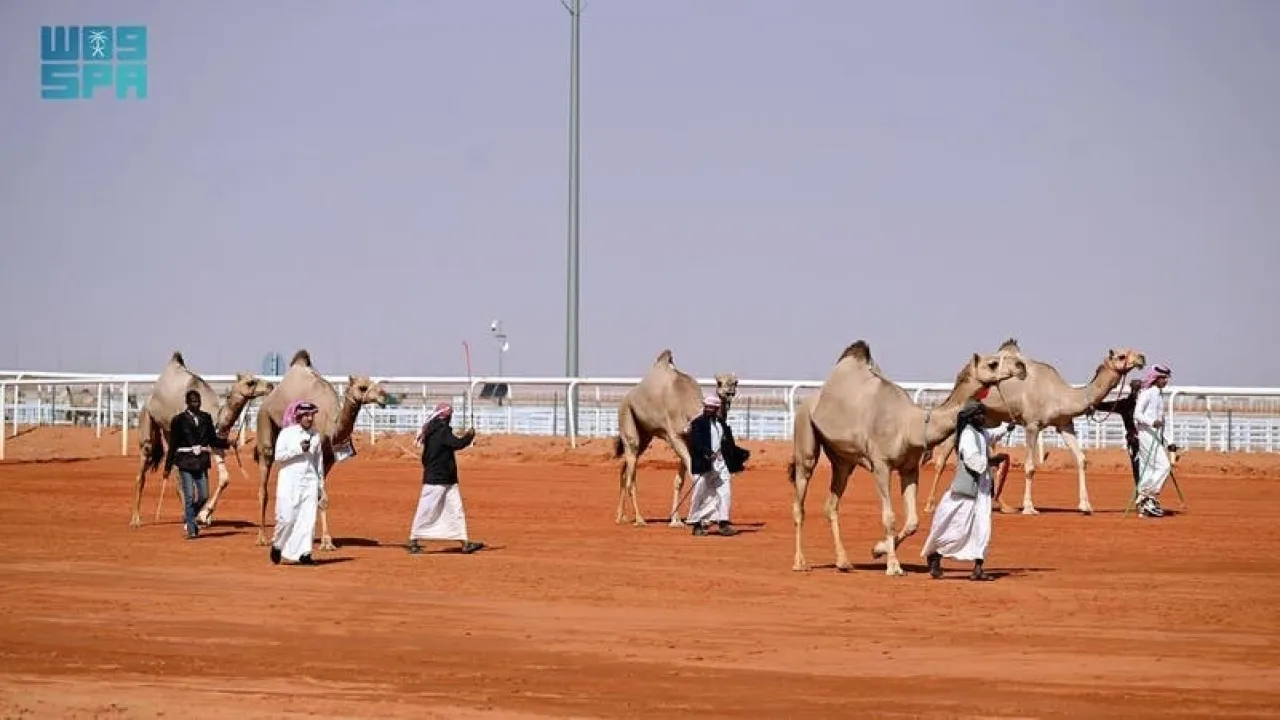
Khaberni - For the tenth consecutive year, the Kingdom of Saudi Arabia reinforces its interest in camels as ancient heritage, through the King Abdulaziz Camel Festival, which is considered the first and leading international festival in enhancing civilizational and national aspects while achieving cultural and economic returns for the community.
The Kingdom has turned this interest in heritage into part of the Saudi national identity and international discourse, and these images have become present in exhibitions and global festivals, as a story that encapsulates the Saudi personality that preserves its historical heritage while adhering to development and modernity at the same time.
The first global festival
The tenth edition of the King Abdulaziz Camel Festival was launched last November in Siyahad, northeast of the capital Riyadh. This event underscores the state's interest in camels and their cultural and historical heritage.
Symbolism of Siyahad
The region chosen for the festival's location since its inception carries historical and political symbolism, as it was a gathering point for the armies of the founding King Abdulaziz bin Abdulrahman to unify the Kingdom. The term "Siyahad" or "Sihaad," according to linguistic references, means "intense heat, disturbed mirage, and vast dry land."
Foundation of heritage
The festival also aims to root and enhance camel heritage within Saudi, Arabic, and Islamic culture, and seeks to provide a comprehensive economic system including auctions, supplies, and industries related to camels, as well as to develop its returns for the community. The festival also aims to achieve regional and global leadership, to become the most prominent international meeting point on camels, and a cultural, tourist, sports, and economic destination.
Honor to its people
The slogan of the festival for this year 2025 is "Honor to its people," which highlights the status of camels in the hearts of Arabs from ancient times until today. Arabs continue to care for camels and give them attention, as they are a timeless symbol of pure Arab heritage, and their value as a source of livelihood.
The festival "and men's sciences"
The festival hosts a number of cultural events, including the "Men's Sciences" event which highlights the Kingdom's heritage through various programs and competitions suitable for different groups. These events include: "Traditional overnight experience at the King Abdulaziz Camel Festival," "Learning about camels and falcons and how to handle them," "Arts of receiving guests and preparing Saudi coffee," "Social and cultural competitions," "Nighttime gatherings with star watching," "Mastering the Saudi dress," and "Preparing traditional Saudi dishes," among others.
Enhancing heritage
The Saudi interest in camels is not merely an emotion towards a heritage animal, but is a complex connection formed over hundreds of years, and today has turned into a cultural and economic phenomenon that reflects the depth of the Saudi identity and its evolution.
Camels and daily life
In the Arabian Peninsula, camels were the backbone of daily life, serving as the means of travel, the lever of commerce, companions on long journeys, and the key to survival in times of scarcity. They were not just an animal, but a partner in life and a fundamental component of collective memory. They carried goods on their backs, facilitated tribal movements, crafted caravan routes, and shaped relationships among people.
National consciousness
With the establishment of modern Saudi Arabia, this heritage has transitioned into national consciousness, becoming part of the modern Saudi personality. The festival embodies one of the aspects of the Saudi government's interest in this ancient heritage.
The religious and cultural dimension
Camels have a special religious dimension, as they are mentioned in the Quran and the Sunnah, which gives them a special place in the religious consciousness. This has made many people from the Arabian Peninsula regard them with esteem and respect, as a creature that embodies strength, patience, and affinity.
Culturally, camels have always been present in stories and narratives, as well as in Arabic and Nabati poetry, and in images of horsemanship and bravery.
Heritage and Vision 2030
Vision 2030 of the Kingdom considers the revival of national heritage, enabling everyone to access it through the King Abdulaziz Camel Festival, as a living witness to the ancient Saudi heritage and an active role in its presence on the map of human civilizations.
Global interest
The King Abdulaziz Camel Festival enjoys widespread interest from Western, global, and Arabic media, and a number of foreign media outlets are keen to cover it, considering it a unique heritage, cultural, and economic event, while the festival highlights the status of camels as an authentic symbol in Saudi culture, with a focus on its historical and social importance.
Huge prizes
The festival offers huge prizes with values reaching hundreds of millions of Saudi Riyals. In previous editions, the value of the prizes was about 300 million Riyals, and in other editions, it reached 200 million Riyals. These prizes are awarded to competitors in camel beauty contests (various categories and colors), camel races, and cultural contests such as "Knights of the Poem" and "The Nabati Hanging Odes." These prizes are among the largest in the world for camel races, aimed at honouring rare breeds, motivating owners, and showcasing authentic Saudi heritage.