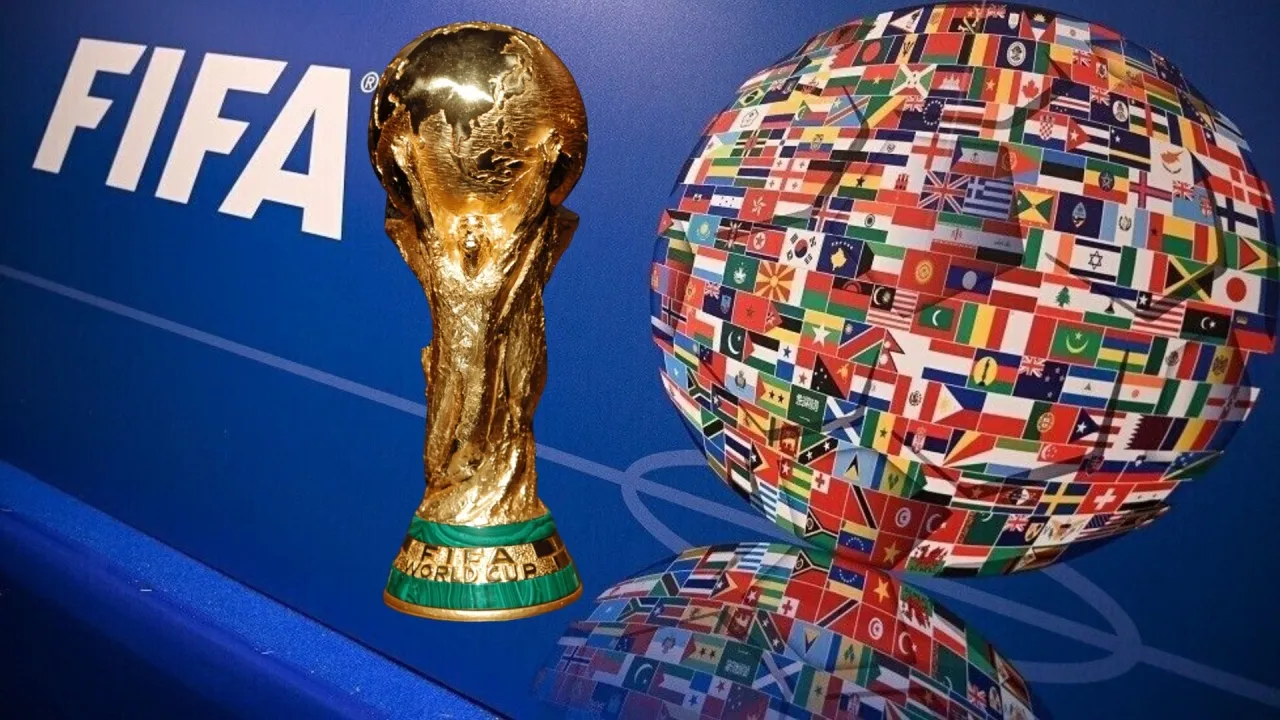
Khaberni - Approximately seven months before the start of the FIFA World Cup football tournament, all eyes will be on the American capital, Washington, which will host the draw ceremony for the largest edition in the history of the World Cup at the John Kennedy Center for Performing Arts.
The 42 qualifying teams, in addition to the six teams that will qualify from the European and global playoffs, will find out their paths in the tournament, which will be held for the first time in three countries: America, Canada, and Mexico.
16 teams participate in the European playoff, from which 4 teams will qualify, while 6 teams participate in the global playoff from which two teams will advance.
Although the tournament is still relatively far off in the football calendar, the moment of the draw marks the actual turning point that starts the technical and numerical calculations, whether for the major teams or those participating in the finals for the first time.
So far, 42 teams out of 48 have qualified for the World Cup, awaiting six teams that will qualify from the playoff in March.
The teams are distributed into four pots as follows:
Pot 1: Canada, Mexico, America, Spain, Argentina, France, England, Brazil, Portugal, Netherlands, Belgium, Germany.
Pot 2: Croatia, Morocco, Colombia, Uruguay, Switzerland, Japan, Senegal, Iran, South Korea, Ecuador, Austria, Australia.
Pot 3: Norway, Panama, Egypt, Algeria, Scotland, Paraguay, Tunisia, Côte d'Ivoire, Uzbekistan, Qatar, Saudi Arabia, South Africa.
Pot 4: Jordan, Cape Verde, Ghana, Curaçao, Haiti, New Zealand, the four teams qualifying from the European playoff, and the two teams qualifying from the global playoff.
There might be an increase in the number of Arab soccer representatives in the tournament if the Iraqi team qualifies from the global playoff, as it is 90 minutes away from participating in the World Cup, facing the winner of the Suriname vs. Bolivia match in the global playoff final.
According to the official FIFA website, the host countries America, Canada, and Mexico will be designated by differently colored balls, and when drawn, Mexico will be placed at the head of Group One (green ball), Canada at the head of Group Two (red ball), and America at the head of Group Four (blue ball), as already mentioned in the tournament schedule issued on February 4, 2024.
The remaining nine teams in Pot 1 will be assigned balls of the same color, and each will be placed at the head of the group that the draw puts it in.
To ensure competition balance, the preparation of the match schedule involved defining two paths for the semi-finals.
To balance the distribution of teams, the draw will involve special restrictions that apply to the highest-ranked teams in the global team ranking, where the top two ranked teams (Spain/first place) and (Argentina/second place) will be randomly drawn in two different paths, and the same principle will apply to (France/third place) and (England/fourth place).
This restriction will prevent the top two ranked teams from facing each other until the semi-finals if they both top their groups.
For Pots 2, 3, and 4, the position of each team in the group will be determined based on a pattern explained in a document within the draw procedures, ensuring that each team's place within its group is based on the pot it was drawn from and the group it is placed in by the draw.
Analysts believe that the new system gives more opportunities to medium and emerging teams, while putting more pressure on traditional powers to maintain discipline from the first round to avoid any setbacks that may complicate their path early on.
This time, the draw also gains an additional dimension because it will also determine the geography where each team will play, given the vast area of the host countries.
Teams playing on the East Coast of America will face different climatic conditions compared to those playing in southern Mexico or in the northern Canadian cities.
The significant time differences between hosting cities require technical staff to plan their movements carefully, especially since the tournament will require longer travels compared to previous editions.
Although the new system may relatively reduce the chances of facing a traditional "Group of Death," the possibility of a European power from the second level being matched with two experienced teams from the third level remains, potentially creating a challenging group from the start. However, experts believe that the new system tends to favor technically stable teams more than those relying on individual stars, as the expansion increases the number of matches and tests the depth of the rosters and quality of the substitutes.