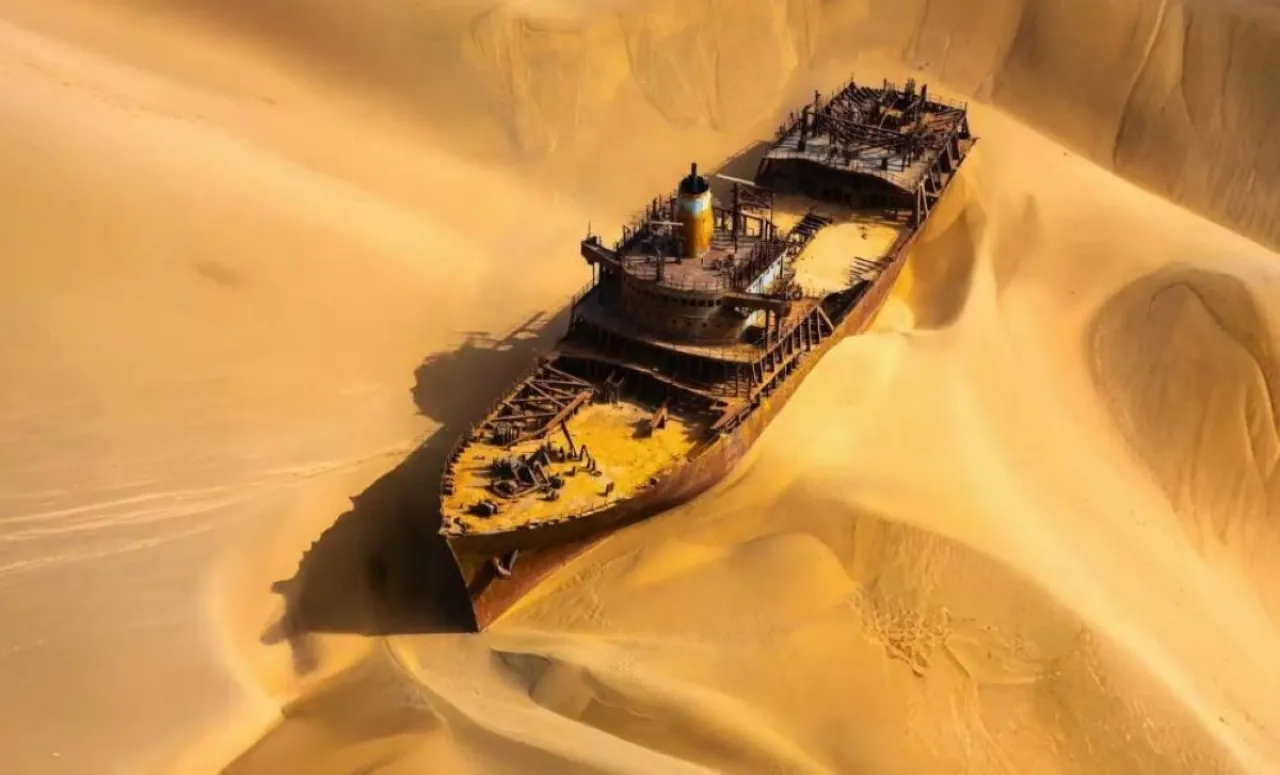
Khaberni - In an astonishing archaeological discovery, miners in the remote Sperrgebiet region in Namibia found the wreckage of a 16th century Portuguese ship buried under dry sand, loaded with gold, ivory, and copper.
The ship is known as "Bom Jesus," and had disappeared in 1533 during its journey to India, before being discovered in 2008 near Oranjemund in a heavily protected mining area.
This discovery is considered one of the most well-preserved historical maritime wrecks, as the extreme dryness and the stability of the sediments in the Namib Desert helped protect the ship from looting and degradation by water and time.
A scientific study in 2014 showed that the region's climate and coastal shape changes created an ideal environment for preserving wood, cargo, and even pieces of fabric, according to Daily Galaxy.
Onboard the ship were more than 2,000 gold coins, 22 tons of copper ingots, and dozens of tusks from West African ivory, reflecting a vast trade network connecting Europe, Africa, and Asia.
It is believed that the ship was thrown off course by a violent storm near the Cape of Good Hope before being completely buried by sand for centuries.
Dr. Bruno Werz, director of the African Institute for Marine Research and Diving, says, "This is not just a ship, but an economic time capsule from the Age of Discovery, providing tangible evidence of early globalization through the complete shipping system."
The markings on the copper ingots and rare coins indicate support from German and Spanish financiers for Portuguese voyages to the Indian Ocean, highlighting the complex Iberian financial cooperation in the 16th century.
No legal dispute arose over the ownership of the ship, as the ownership of the wreckage legally belongs to Namibia under the 2001 UNESCO Convention.
The historian Alexander Monteiro praised the conduct of the Namibian government, describing it as a model of international cooperation in managing maritime heritage.
About 300 individuals from the crew, clergy, and soldiers were aboard the ship, but only a single human bone was discovered, which suggests that some might have survived and reached land.
Dr. Dieter Noli, the lead archaeologist at the site, confirmed that the ship reaching the nearby Orange River gave the survivors a chance to endure.
This discovery reconsiders the historical narrative of early maritime exploration, proving that the European empires were operating within complex networks of financing, goods, and maritime knowledge before the advent of institutionalized colonialism.
Namibia plans to establish a maritime museum in Oranjemund to display the artifacts, affirming its role as an active narrator of African maritime history, not just a protector of lost European heritage.