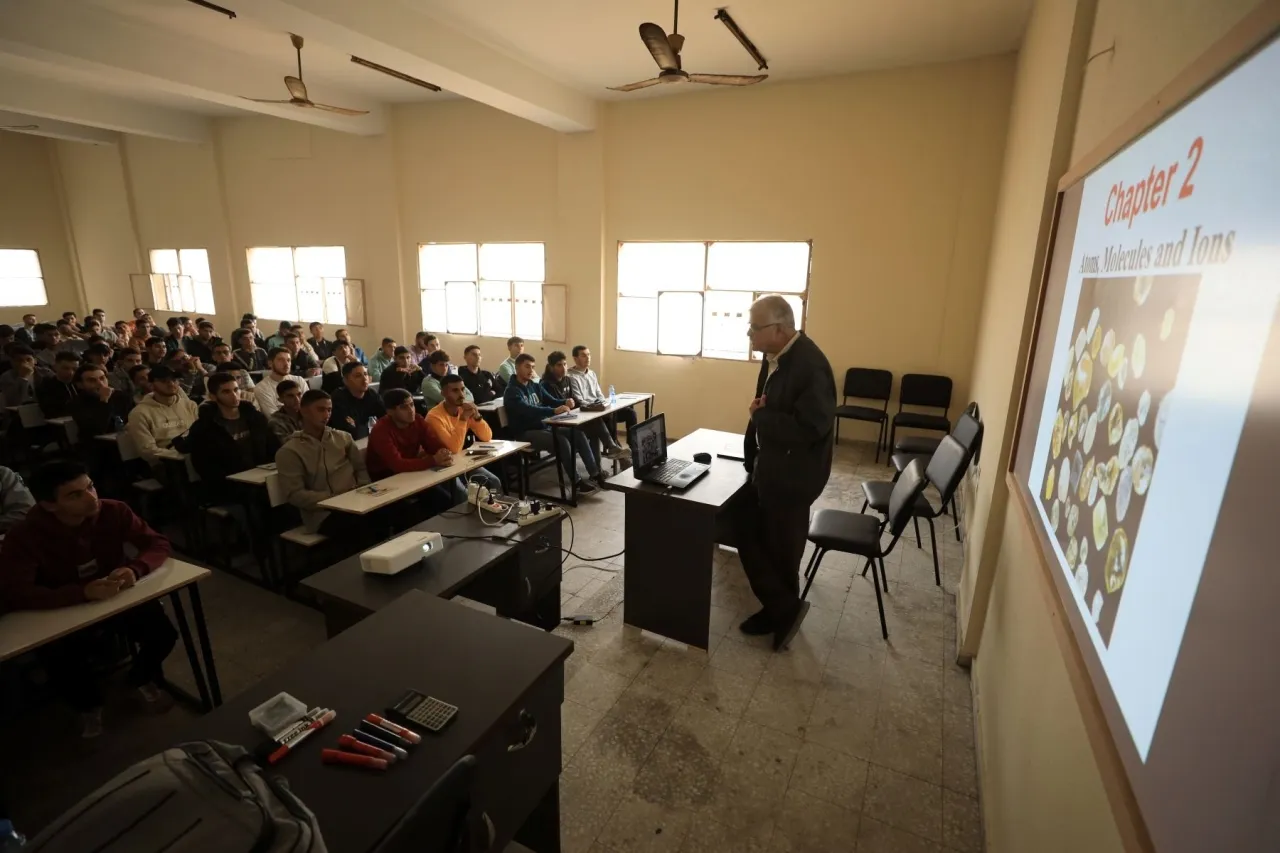
Khaberni - After two years of forced interruption from academic settings due to the genocide war that destroyed the educational infrastructure in the Gaza Strip, the "Islamic University" began its first steps towards a gradual return to face-to-face education within buildings damaged by bombing, parts of which turned into rubble.
According to the governmental media office in Gaza, the genocide war resulted in the complete destruction of 165 schools, universities, and educational institutions, while 392 educational facilities suffered partial damages, crippling the educational sector in Gaza.
Surrounded by partially restored crumbling walls, hundreds of students returned to the classrooms in a scene reflecting the Gazans' determination to regain life and education despite difficulties, obstacles, and the impacts of the war.
Parts of the university buildings also shelter hundreds of displaced families whose homes were destroyed by the genocide and who have no other refuge. This situation compelled the university administration to appeal to concerned entities for urgent solutions and providing alternative shelter for them.
Estimates from the media office indicate that the Gaza Strip needs about 300,000 tents and prefabricated housing units to meet the residents' shelter needs after the extensive damage to the infrastructure over two years of war.
A Historic Day
Describing the start of the gradual return to face-to-face education, the president of the Islamic University, Asad Youssef Asad, said in a statement carried by "Anadolu" that it was "a historic day; we return to education despite the tragedy and harshness left by the genocide war," emphasizing that "Palestinians, as it is known, love life and education," and that "large numbers of students from the faculties of medicine and health sciences returned to their classrooms today."
Asad mentioned the existence of a phased plan for the full return according to the vision of the Ministry of Education and Higher Education.
He added that the university, like other universities in the sector, suffered extensive destruction and some of its main buildings were demolished, forcing it to adopt electronic education during the war periods despite the conditions of displacement, electricity, and communication interruptions.
The president of the Islamic University noted that about 4,000 students graduated during the war through the distance learning system, and that the university today welcomes new students physically for the first time since October 2023.
Great Passion for Education
In the medical faculty halls, the student, Malak Al-Maqeid, expressed her feelings, saying in a statement to Anadolu, "I joined the medical faculty, and today we return to face-to-face classes for the first time after the war. I am happy to have reached this place, and we all feel proud and joyful about the continuity of education."
She added that "despite everything that happened, the university regained its strength and welcomed students anew, and there is a great passion for education."
Similarly, the student, Sama Radi, expressed her joy of being able to join the university again and return to face-to-face education.
She emphasized that "despite the destruction and bombing, we attend the classes, and I am proud of my country and my university that managed to rise and come back stronger than ever."