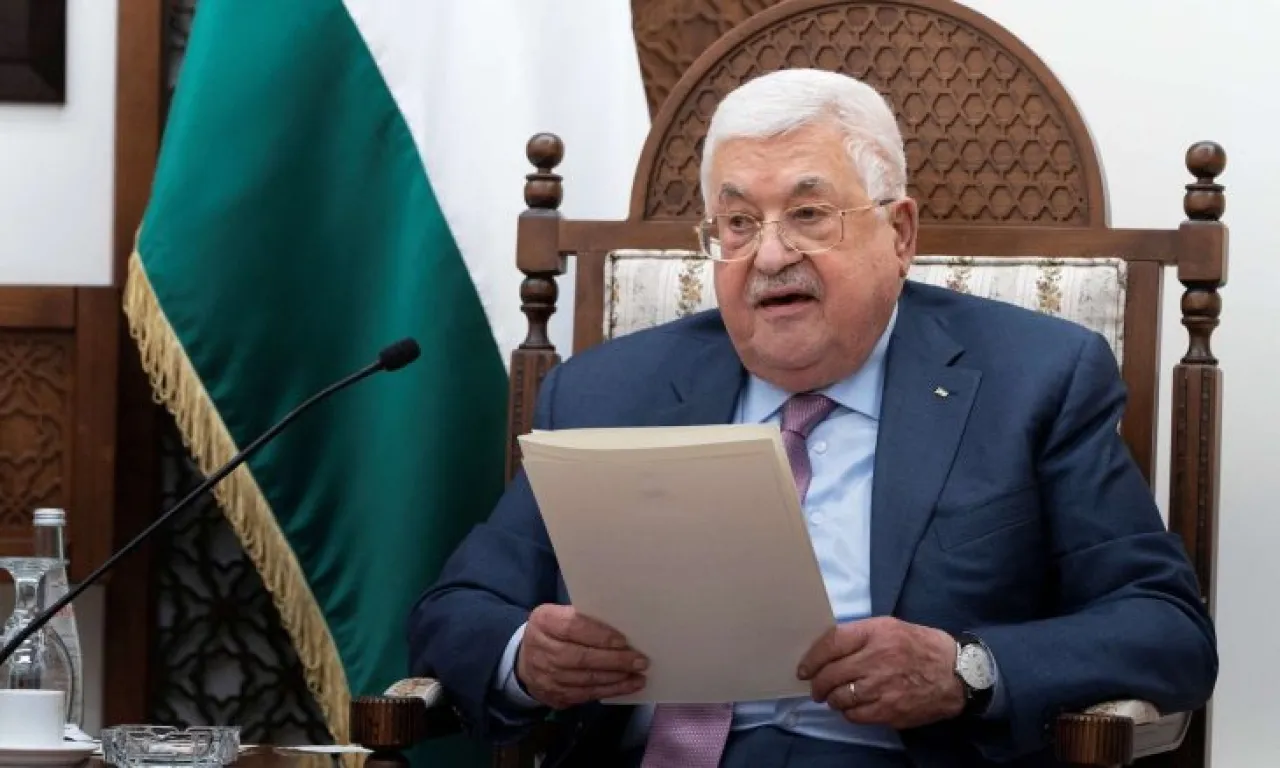
Khaberni - Mahmoud Abbas, a Palestinian politician and founding member of Fatah, was one of the 1948 refugees who were relocated to Syria. He was elected as the leader of the Palestine Liberation Organization, succeeding President Yasser Arafat who passed away on November 11, 2004.
Birth and Upbringing
Mahmoud Abbas, also known as "Abu Mazen," was born on March 26, 1935, in Safed, northern Palestine, to a family of refugees from 1948 who were displaced to Syria after the Nakba.
Education and Formation
Abbas completed his basic education through the seventh grade in Safed, Palestine before his refuge to Syria; he then paused his education for two years to work, and continued his studies from home.
After finishing preparatory school, he worked as a teacher, a profession allowed for preparatory graduates in Syria, and then he joined high school.
He earned a bachelor's degree in law from Damascus University in 1958, and a PhD in the history of Zionism from the Oriental Studies College in Moscow in 1982.
Political Experience
Abbas began his political activity in Syria and founded a secret organization with his colleagues, later working as a director of personnel affairs at the Civil Service Administration in Qatar, from where he organized Palestinian groups and connected with Fatah.
He attracted Palestinian teachers and employees from Gaza and the West Bank to work in the Ministry of Education (Education and Higher Education) in Qatar.
He participated in the first Central Committee but remained away from the center of events due to his presence in Damascus, while the PLO base was then in Beirut.
He has been a member of the Palestinian National Council since 1968, leading negotiations—with General Matityahu Peled—that resulted in the announcement of peace principles based on a two-state solution declared on January 1, 1977.
In 1978 he established the twinning project (a cooperation agreement between cities) between Palestinian and Arab cities.
Abbas held the position of member of the Economic Committee of the PLO since April 1981 and held the portfolio of the Occupied Territories after the assassination of Khalil al-Wazir (Abu Jihad).
He started secret talks with Israelis through Dutch intermediaries in 1989 and coordinated them during the Madrid Conference. He oversaw the negotiations that led to the Oslo Accords in 1993 and led the negotiations held in Cairo, known as the Gaza Jericho Agreement.
He chaired the Negotiation Affairs Department of the PLO since its inception in 1994, served as the head of international relations for the organization, and returned to Palestine in July 1995.
He was elected Secretary General of the PLO's Executive Committee in 1996, making him effectively the second in command of the Palestinian leadership hierarchy.
His repeated calls for an end to Palestinian resistance operations against the occupation and the need to reach a peace agreement with Israel stirred significant controversy among Palestinians.
The final statement of Fatah's seventh conference consolidated Abbas's positions he has defended since succeeding the late Arafat, pointing to "adherence to peace as a strategic option to establish the Palestinian state on the 1967 borders".
He was appointed as the Prime Minister in the government of the Authority, and Yasser Arafat tasked him to form a government that lasted from the end of April until the beginning of September 2003 when he presented his resignation.
He was also chosen as the president of the PLO succeeding Arafat—who died on November 11, 2004—and Fatah nominated him that same month for the presidency of the Palestinian Authority. He succeeded after obtaining 62.52% of the vote.
His presidential term constitutionally ended on January 9, 2009, but he remained in office.
Abbas was elected as the general commander of Fatah by acclamation during the seventh conference of the movement held on November 29, 2016, at the Palestinian Presidential Headquarters in Ramallah.
Positions and Responsibilities
1964: Member of the Central Committee of Fatah.
2004: President of the Fatah movement.
From 1984 to 2000: He chaired the National and International Relations Department of the Palestine Liberation Organization.
From 1979 to 1981: President of the Palestinian-Jordanian Joint Administrative Committee.
Between 1996 and 2002: He chaired the Central Elections Committee.
2004: President of the Palestine Liberation Organization.
January 19, 2005: President of the Palestinian National Authority.
October 14, 2008: President of the State of Palestine.
Publications and Achievements
Abbas authored dozens of publications including:
One-Way Travel Ticket (1982).
Palestinian Jewish Refugees (1981).
Religious and Ethnic Polarization in Israel (1998).