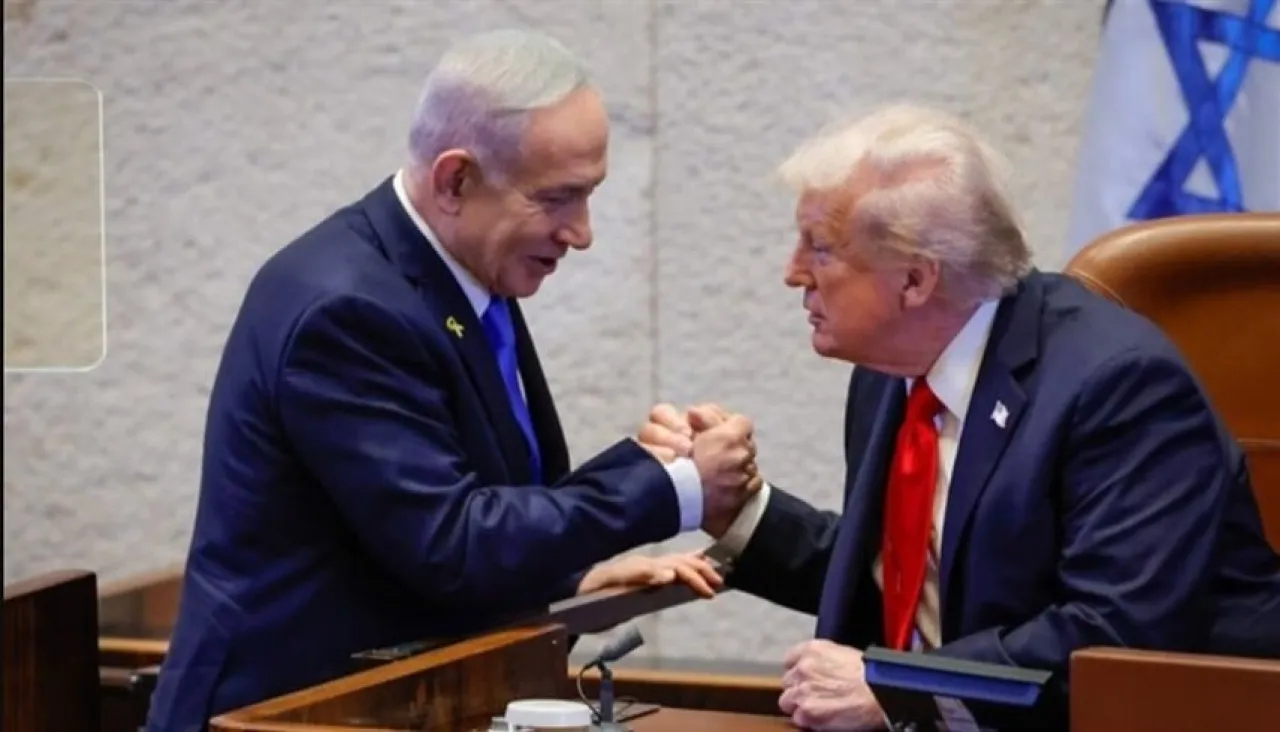
Khaberni - It appears that the paths of the American-Israeli collision were not limited to the Gaza Strip only, but it has become clear that there is anger among some Israeli circles due to President Donald Trump's intervention in the internal affairs of Tel Aviv, where "The Jerusalem Post" dedicated its editorial to criticize Trump, as he "crossed the boundaries."
"The Jerusalem Post" stated in its editorial, titled "Trump's call for a pardon for Netanyahu crosses boundaries in Israeli sovereignty," that the American president's call for a pardon for Prime Minister Benjamin Netanyahu represents "crossing the lines," and an interference in the internal affairs and judicial sovereignty of Israel, although his support for Israel is undeniable.
According to the Israeli newspaper, Trump remains one of the strongest supporters of Israel who have occupied the Oval Office, and his record speaks for itself, recognizing Jerusalem as the capital of Israel, moving the American embassy to it, recognizing Israeli sovereignty over the Golan Heights, sponsoring the Abraham Accords, and assisting in the release of remaining hostages in Gaza.
The newspaper believes that Israel owes him gratitude, but friendship, even at its deepest, does not grant the right to intervene in the internal affairs of another country.
Unprecedented intervention
The newspaper pointed out that Trump's message to Israeli President Isaac Herzog this week, which officially requested a presidential pardon for Netanyahu, crosses a line that should not be crossed, and in a move that seems unprecedented in modern American diplomacy, an American president directly urged a foreign state leader to grant mercy to his country's leader.
The editorial mentioned that the tone of the message, which urges Herzog for "full pardon for Netanyahu.. and an end to this legal warfare once and for all," reflects views previously expressed by Trump, where he described Netanyahu as "a decisive leader in a time of war," and argued that the ongoing trial "unnecessarily diverts his attention" from leading Israel through existential challenges.
Pardon not on the table
The newspaper clarified that the Israeli presidency has already made it clear that a pardon cannot currently be issued. Under the law, such a decision can only be made before the proceedings start or after a verdict is issued, neither of which applies today. Moreover, pardon procedures start with a request from the defendant, usually following an admission of guilt and expression of regret. In Netanyahu's case, he still insists on his innocence of charges of bribery, fraud, and breach of trust.
It noted that it is not the right of the American president, or any foreign leader, to call for ending this judicial process, as the judiciary in Israel, like the American system, is "independent".
Precedents of American intervention
"The Jerusalem Post" considered that there is a long pattern of intervention by American presidents in Israeli politics, where Bill Clinton openly admitted that he tried to help Prime Minister Shimon Peres defeat Likud leader Netanyahu in the 1996 election, and in 2015, the US State Department granted over $300,000 to the nonprofit organization "OneVoice," whose infrastructure funded by the United States was later used in campaign "V15" to try to overthrow Netanyahu.
However, the newspaper noted that it could not reveal any known cases of an American president formally requesting a foreign country to pardon one of its citizens, making this a unique case.
The editorial concluded by emphasizing that Israel cannot allow itself to appear as if its judicial independence could be influenced by foreign appeals, regardless of the intention.