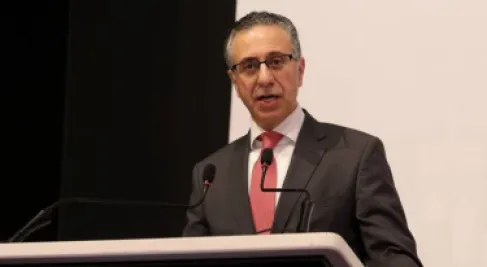
Khaberni - Moved to the mercy of God Almighty this Sunday afternoon, in the Jordanian capital, Amman, the famous Egyptian preacher Zaghloul el-Naggar, at the age of about 92 years.
His body will be buried tomorrow, Monday, in Amman.
Who is Zaghloul El-Naggar?
Zaghloul El-Naggar was an Egyptian geologist and Islamic preacher, famous for delivering lectures and seminars on the scientific miracles in the Quran and the Hadith.
He studied at the Faculty of Science, Cairo University and graduated in 1955 with honors, receiving the Dr. Mustafa Baraka Award in Earth Sciences.
He is a fellow of the Global University for Islamic Sciences and a member of its board of directors, and a founder of the Global Authority for Scientific Miracles in the Quran and Sunnah.
His Early Life
Zaghloul Ragheb Muhammad El-Naggar was born in the village of Mashal in the Basyoun district of Gharbia governorate, on Friday, the 29th of Rajab 1352 AH, corresponding to November 17, 1933 AD, to a conservative Muslim family; his grandfather was the village Imam, and his father was one of the preservers of the Holy Quran.
Zaghloul recounts that if he made a mistake while reciting the Quran, his father would correct him, even while he was asleep.
After completing the memorization of the Quran, he moved with his father to Cairo and joined one of the primary schools at the age of nine.
He completed his primary education and joined Shubra High School in 1946, where he was among the top graduates. The principal of the school asked him to participate in the Arabic language competition due to his excellence, and his teacher in the subject also participated, but Zaghloul was shy to compete against him; however, the principal insisted, so he participated and won first place, while his teacher ranked forty-second.
Later, he joined the Faculty of Science at Cairo University, where a new department of geology was opened, which he loved thanks to the German department head, and excelled in until he graduated with a bachelor's degree in science with honors.
However, after graduating, he participated in a political demonstration and was arrested for a short period, but the court acquitted him, although the political decision at the time refused to appoint him as a teaching assistant at the university due to his affiliation with the Muslim Brotherhood.
He then worked in the Sahara Petroleum Company, but was denied a work permit for political reasons, leading to his dismissal from the company, so he joined the work at the phosphate mines in the Nile Valley for two years, having a positive impact on the workers and management.
He filed a lawsuit against the university because of the refusal to appoint him, won it, and worked at Ain Shams University for one year before being dismissed again by a political decision.
He then continued to work in the coal mines in the Sinai Peninsula as part of the Five-Year Industrial Project, then was chosen to work at King Saud University in Riyadh, and applied for a master's degree at the University of Wales in Britain.
When he was ready to travel, he was prevented from leaving, but after a humorous incident with the responsible officer, who later allowed him to travel, he caught up with the ship after renting a small boat, as the ship was still in Egyptian territorial waters.
His Diplomas
• He obtained a PhD in Earth Sciences from the University of Wales in the UK in 1963, and the university granted him a post-doctoral fellowship.
• He earned the professorship (professor) in 1972.
• He obtained a Bachelor of Science degree with honors from Cairo University in 1955, being the top of his class, and received the Baraka Award for Earth Sciences.
His Jobs and Activities
El-Naggar worked in a number of companies and taught at several universities inside and outside Egypt, including:
• Ain Shams University (Cairo)
• King Saud University (Riyadh)
• University of Wales (United Kingdom)
• Kuwait University (Kuwait)
• Qatar University (Doha)
• King Fahd University of Petroleum and Minerals (Dhahran, 1978-1996)
• University of California (Los Angeles, Visiting Professor 1977-1978)
• Arab Institute for Development in Khobar, Higher Education Consultant (1996-1999)
• Al-Ahqaf University (Yemen, 1999-2000)
• Markfield Institute of Higher Education in Britain (2000-2001)
• Chairman of the Scientific Miracles of the Quran Committee at the Supreme Council for Islamic Affairs in Egypt (2001).
The last academic position he held was as a professor at the Global University for Islamic Sciences in Amman.
His Awards and Honors
He received many awards and certificates of appreciation, including:
• Robertson Research Award (University of Wales, 1963-1967).
• Fellowship of the University of Wales – Britain 1963.
• Honorary Award and the Golden Medal of Sciences, Arts, and Letters from the President of Sudan in 2005.
His Scientific Output
He has more than 150 published scientific papers and articles, and about 45 books in Arabic, English, French, and German, in addition to weekly and daily articles during Ramadan.
He also has a series of audio, visual, and CD content in various fields, most notably on the topic of Islam and science.
His Media Programs
He presented the program "The Social Miracle in the Quran and Sunnah" during Ramadan 1429 AH on Iqra TV, and participated in a number of television episodes, including his appearance on Al Jazeera in the program "Without Borders" in an episode titled "The Dangers of Earthquakes and Volcanoes to Arab Countries," broadcast on September 29, 1999, presented by the journalist Ahmed Mansour.