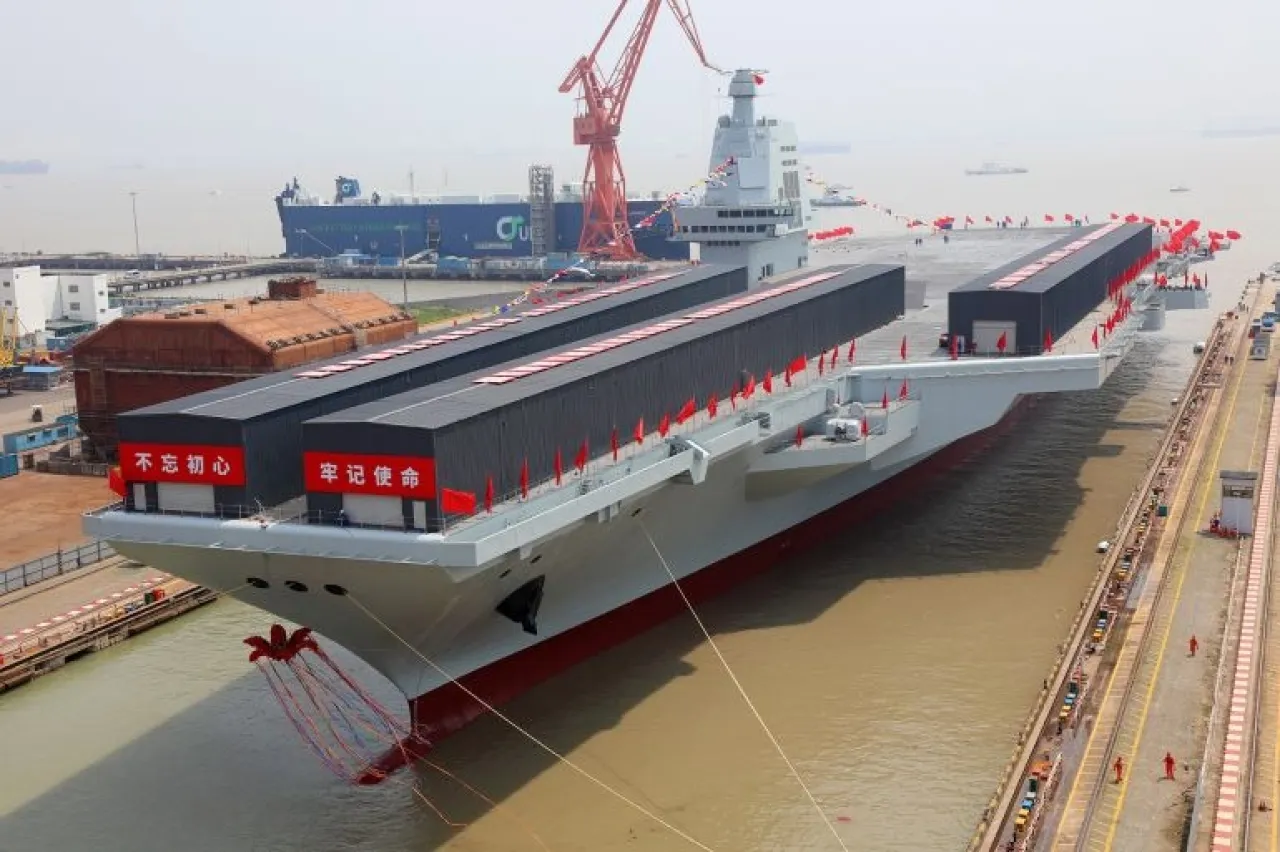
Khaberni - Chinese state media announced today, Friday, the official commissioning of China's third aircraft carrier following a ceremony held at the Sanya port in Hainan province, southern China, attended by President Xi Jinping and several senior leaders of the Communist Party and the military.
The Xinhua agency stated that the new carrier, named "Fujian", is the first aircraft carrier to be fully designed and built in China locally, marking a major milestone in Xi's plan to modernize the Chinese military and enhance its naval power amid rising tensions with Taiwan and regional disputes over sovereignty in the South China Sea.
The agency explained that President Xi boarded the Fujian carrier after the launching ceremony held the day before yesterday, Wednesday, where he reviewed the new combat systems, including the electromagnetic catapult system used for launching aircraft, which is one of the prominent modern technologies in this field, only available on the American carrier "Gerald Ford".
"Fujian" is the first carrier in China of the "CATOBAR" type, a system that relies on launching aircraft using a catapult instead of a sloped runway, similar to what the US Navy uses.
This system allows aircraft to take off fully loaded with weapons and fuel, which gives them greater range and effectiveness during combat missions, according to the French magazine Le Point.
Qualitative Leap
Military experts say that "Fujian" represents a qualitative leap in the capabilities of the Chinese navy, as its new systems allow combat aircraft to take off with larger amounts of fuel and ammunition, which expands the scope of their operations beyond territorial waters.
"Fujian" is the third carrier in the Chinese fleet after "Liaoning" and "Shandong", and represents an additional step towards closing the gap with the US Navy, which has the largest number of aircraft carriers and a global network of naval bases.
Observers believe that the launch of the new carrier reflects Beijing's ambition to expand its military influence in the Pacific and beyond, as part of Xi's plan to build a "world-class" military force by the middle of this century.
In contrast, the United States and its regional allies are following these developments with concern, considering that the growing Chinese naval power could alter the balance of power in the Asia-Pacific region, despite Beijing's repeated assurances that its goals are defensive and peaceful.