Khaberni - Minister of Political and Parliamentary Affairs Abdul Min'em Al-Odatt stated that municipal councils are the first interface of the government with the citizens and the foundation in reinforcing the concept of public participation in decision-making.
Al-Odatt added that the councils represent a true space for citizens to express their priorities and needs, and their involvement in drawing up development plans and monitoring their implementation, pointing out that developing the capabilities of municipalities and empowering them is a national priority, aimed at improving the quality of services and enhancing the trust between citizens and state institutions.
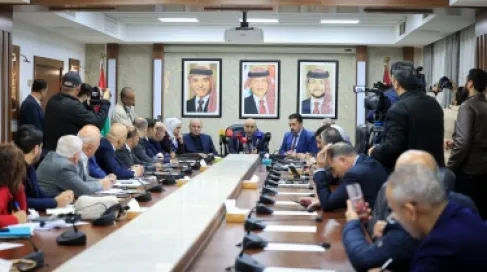
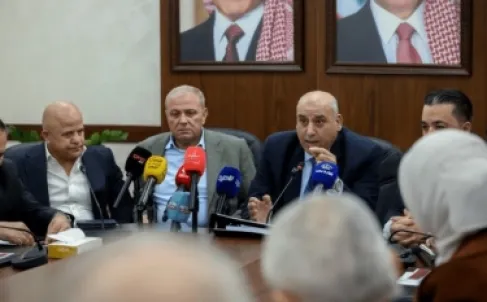
This came during the political and parliamentary affairs minister's sponsorship on Sunday of the launch of a dialogue program with political parties about the "Local Administration Law," implemented by the ministry in partnership with the Dutch Institute for Multi-party Democracy, in cooperation with the European Union mission in Jordan and the French Agency for Technical Expertise 'Expertise France', within the program (Supporting Democratic Reforms in Jordan), in the presence of the heads of parliamentary blocs and committees and several representatives of political parties in the parliament.
Al-Odatt explained that the updating project, with its three pathways, came to form a comprehensive national vision for building the modern Jordanian state capable of meeting present requirements and foreseeing the future while reinforcing the principles of participation, accountability, transparency, and the rule of law.
He confirmed that political parties are a fundamental pillar of the political updating system, playing a pivotal role in shaping realistic visions and programs for local administration, contributing to achieving balanced and inclusive development, and reinforcing public participation in local decision-making, in line with the goals of the national updating project.
Al-Odatt pointed out that reviewing and developing the Local Administration Law is a necessary step to ensure the empowerment of municipalities and governorate councils, which positively reflects on the quality of services and strengthens citizens' trust in their institutions.
He explained that effective local management relies on sound governance that enhances efficiency in performance and establishes transparency in decision-making, involving citizens in prioritizing and monitoring its implementation.
Local Administration Minister Walid Al-Masri said the outputs of political reform included a number of recommendations for developing local administration legislation, due to the deep belief of the state that true community development begins at local councils, "municipalities, and governorate councils."
He added that municipalities are partner institutions of the state responsible for urban planning and construction and providing public services, alongside the governorate councils which emerged as a true step towards achieving decentralization, and the role of local councils in both aspects develop sustainable development to serve all sections of society.
Al-Masri indicated that a draft local administration law will be developed after agreeing on the main pillars of the law intended to enhance the function of municipalities and empower governorate councils and govern them, and conduct dialogs with various civil society organizations, experts, and political parties on these pillars to refine and improve them, so that the new law aligns with the political and economic updating visions, and public sector reform.
Al-Masri outlined several important roles that fall on municipalities, including enhancing social cohesion within their jurisdiction, achieving continuous interactive democracy leading to full public oversight.
He emphasized the role of municipalities in creating a conducive investment environment for the private sector, enabling them to carry out their roles and cover their expenses, and providing job opportunities for citizens within the governorates, pointing out the importance of this program in supporting the development of the Local Administration Law concerned with daily services and improving the quality of life for citizens.
On his part, the European Union Ambassador to Jordan, Pierre Christophe Chatzisavvas, expressed his delight in launching this dialogue pathway, affirming the union's commitment to supporting Jordanian efforts in the field of political reform, and that the partnership between Jordan and the European Union embodies a model of constructive cooperation in enhancing democracy and good governance.
The representative of the Dutch Institute for Multi-party Democracy in Jordan, Bashar Al-Khatib, confirmed that the program is part of the political reform pathway, clarifying that the local administration law forms a fundamental pillar in achieving democratic decentralization and enhancing citizen participation at municipal and governorate levels.
He added that the institute, through this program, will facilitate the dialogue between parties in cooperation with the Ministry of Political and Parliamentary Affairs, to ensure inclusiveness and participatory in the reform process.
The attendees raised several topics, the most prominent being the importance of stability in laws to stimulate economic development, focusing on rebuilding the roles and powers in local councils, and emphasizing the importance of accountability and accountability to ensure the principle of the rule of law.
It is noted that the program aims to enhance constructive dialogue among Jordanian parties on the priorities of updating related to activating decentralization and local governance, and building political consensus around future national directions for local administration in Jordan.