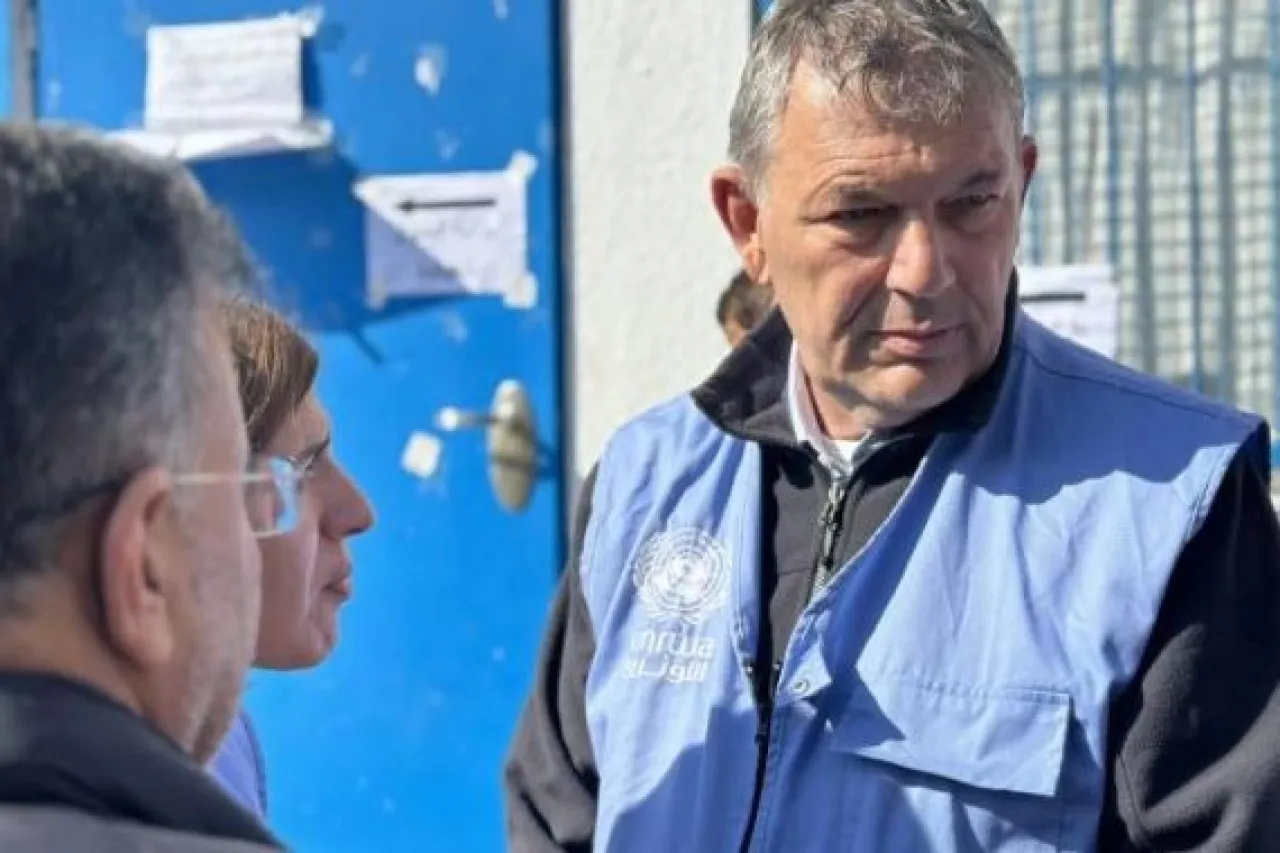
Khaberni - Parallel to the announcement of Trump's comprehensive plan to end the war in Gaza, the Israeli propaganda machine continued to spread lies and misleading claims on social media about the reality of the humanitarian situation in the besieged sector.
Just hours after the Sharm el-Sheikh ceasefire agreement, digital accounts circulated a statement attributed to Philippe Lazzarini, the Commissioner-General of the United Nations Relief and Works Agency (UNRWA), in which he stated, "There was no famine in Gaza."
Israeli official accounts widely recirculated this statement, promoting a message that "Lazzarini admitted there was no famine, and that there is enough food for everyone for 3 months, and that the real hunger is the hunger of the Israeli hostages."
Spread of the Claim
On October 12, 2025, the Israeli Foreign Ministry first published the video on its official X, Instagram, and Facebook accounts (archived) that includes the statement attributed to the UNRWA commissioner.
Official and suspicious Israeli accounts widely shared the clip accompanied by the same alleged statement.
Simultaneous Attack Against UNRWA
Soon, the video was accompanied by accusations on the "X" platform against the UNRWA, branding it as "terrorist" instead of a "humanitarian organization" and other claims that it had "falsely accused Israel of starving Gaza for years, while it had all this amount of humanitarian aid."
Meanwhile, another commented: "UNRWA would not exist without the conflict; they continue to exist by fueling hatred, spreading lies, and supporting terrorism, all funded by Western taxpayers," with others using it as a pretext to demand the closure of UNRWA forever, the same accusations that have targeted the organization since the start of the war on Gaza.
"General Commissioner of UNRWA admits that the famine campaign in Gaza was false," posted (Isaac) on the X platform.
The Reality of UNRWA's Retreat
Upon reviewing Lazzarini's statements since October 9, it appears that the Israeli official accounts deliberately twisted his statements, using them in a misleading context to deny the famine in Gaza, according to Al Jazeera.
Lazzarini mentioned in a tweet on the occasion of reaching the ceasefire agreement in Gaza and the release of hostages: "UNRWA has food, medicine, and other essential supplies ready to enter Gaza, sufficient to provide food for all residents for the next three months."
Distortion and Playing with Context
This is reinforced by what UNRWA posted on October 10, on its X platform account, which stated, "Famine can be stopped in Gaza, UNRWA has enough food for all Gaza residents for 3 months, ready outside the sector, and has an established system for safely and broadly distributing aid."
While official data from the agency revealed that the supplies available with them constitute about half of the United Nations' aid currently stored in the organization's warehouses in Egypt and Jordan, indicating that they are outside Gaza, contrary to what was promoted by Israeli accounts.
Acting UNRWA Affairs Director in Gaza, Sam Rose, recently told Channel Four UK: "We have enough food for all residents of Gaza for 3 months, blankets and tents for hundreds of thousands, and medicine to operate health clinics," adding: "All we need is the lifting of the embargo on bringing these aids."
The Humanitarian Situation in the Sector
On August 22, the United Nations and international experts formally declared for the first time a widespread famine in the Gaza Strip, the first time famine has been declared in the Middle East, and no agency or UN organization, including UNRWA, has retracted this acknowledgment after the ceasefire agreement in Gaza.
UN Secretary-General António Guterres then announced that the famine in Gaza is a man-made disaster, and in the context, UN Human Rights Commissioner Volker Turk stated that the famine in Gaza is a direct result of Israeli government actions.
In contrast to the UN affirmations of famine in Gaza, the Israeli Foreign Ministry claimed that the Integrated Food Security Phase Classification report relies on "Hamas lies", claimed that the World Health Organization report "was fabricated and designed to fit Hamas' propaganda campaigns," and denied any starvation in the sector.