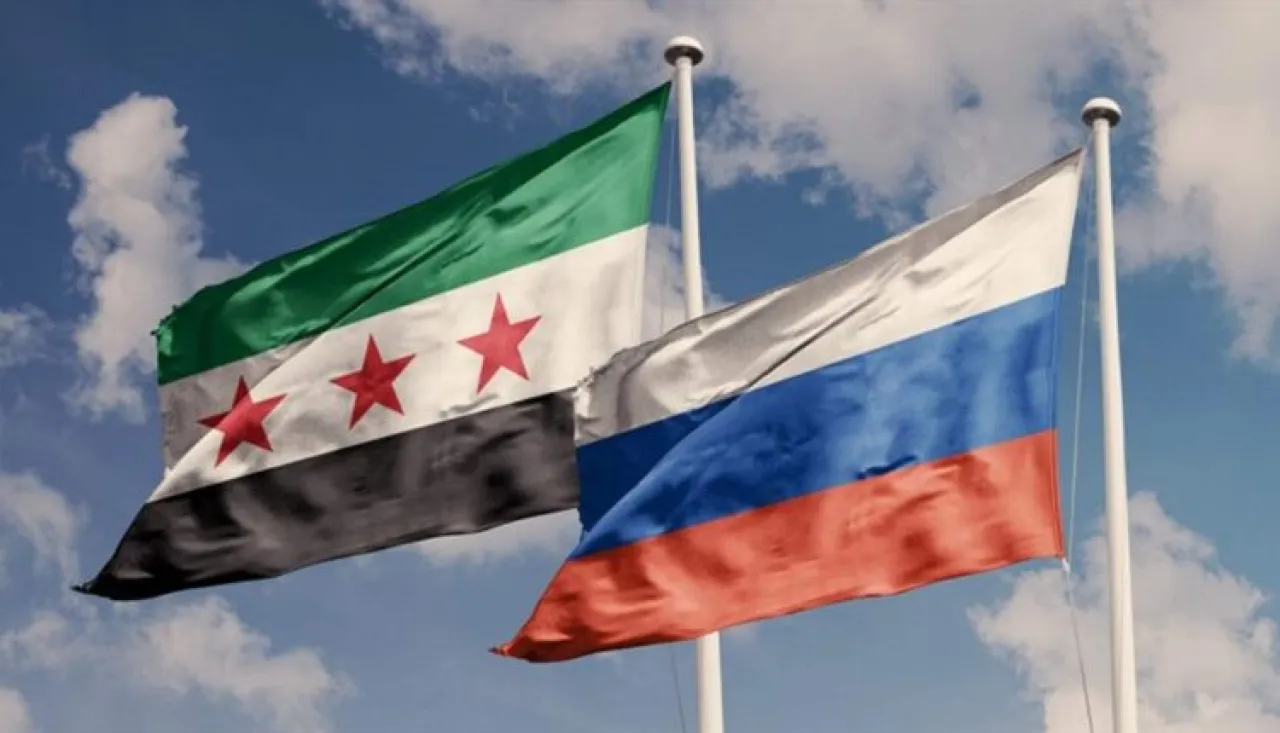
Khaberni - After the fall of Bashar al-Assad's regime, Syrian-Russian relations entered a new phase of cooperation where Damascus and Moscow seek to build a robust partnership based on foundations different from the previous stage, amid severe internal and regional challenges.
Intensive Diplomatic Visits Pave the Way for a New Phase
The months following the change in Syria saw intense diplomatic movement between the two countries, aiming to redefine their relationship on new grounds. It began in February with a phone call between Russian President Vladimir Putin and Syrian Ahmad Al-Shar', laying the groundwork for a new phase of dialogue. This was followed by a visit of Syrian Foreign Minister As'ad Al-Sheibani to Moscow in July, and then a visit by a senior Russian delegation to Damascus led by the Deputy Prime Minister, discussing comprehensive economic, security, and military files. At the beginning of this month, a visit by a high-level Syrian military delegation to Moscow aimed at developing mechanisms for military and security coordination between the two countries' defense ministries.
These accelerated visits, which will peak with an anticipated visit by Syrian President Ahmad Al-Shar' to Moscow to participate in the Russian-Arab Summit, demonstrate both parties' intent to "turn a new page" in relations, as mentioned by the Russian Deputy Prime Minister.
Syria’s Need for Russian Presence
Amidst the various challenges facing the new Syria, cooperation with Russia emerges as a strategic choice for several fundamental reasons, the most important being to counter Israeli threats. Recent events in southern Syria have shown the West's inability to act as a guarantor against Israeli interventions. Meanwhile, Russia has demonstrated a proven ability to manage tensions in the Golan Heights. Even Damascus has requested the return of Russian military police patrols to the border area, and Putin has reaffirmed his support for the unity of Syrian territory in a call with Netanyahu.
Furthermore, Russia possesses deep experience in the Syrian file and intricate relations with different parties, from the Syrian Democratic Forces "SDF" in the northeast to local components in the coast and south, allowing it to uniquely mediate internal conflicts and enhance national stability.
Russian Foreign Minister Sergey Lavrov, during a press meeting, noted that the United States is stoking the Kurdish separatist sentiment in northeastern Syria, creating significant tensions within the Syrian community.
This statement from the Russian Foreign Minister followed the U.S. Senate's approval of the National Defense Authorization Act for Fiscal Year 2026, which includes allocating $130 million from the U.S. Department of Defense budget to fund "training, equipment, and salaries" for the Syrian Democratic Forces "SDF" and the "Free Syrian Army" faction.
The Issue of Russian Bases
Lavrov clarified that Syrian authorities are interested in maintaining the two Russian military bases on their territory, namely the Hmeimim airbase in Latakia and the Tartus naval base. "The Syrian side is interested in maintaining our military bases there. As our President has repeatedly confirmed, we base our actions on the interests of the Syrian Arab Republic," ensuring that "under the new circumstances, these bases can play a different role, not just as a military site."
Experts believe this reflects a Syrian understanding of the benefits of this presence, which provides strategic cover against foreign aggression, serves as a bargaining chip in regional negotiations, and ensures training and support for the Syrian army, which relies almost entirely on Russian equipment.
The new Syrian government is now renegotiating base agreements and long-term contracts to ensure its sovereignty is respected. Syrian Foreign Minister As'ad Al-Sheibani expressed that the goal is to build a "correct relationship" based on mutual respect and guaranteeing Syrian sovereignty. The Syrian President confirmed that the relationship with Russia, adopting a pragmatic approach, is described as "solid" and "long-term," highlighting "strategic interests" shared between Damascus and Moscow.
Experts also affirm that Damascus needs an international partner to help in reconstruction and rebuilding the war-torn Syrian economy, with Russia being one of the best partners in this aspect. Additionally, Russia provides clear political support for the new Syrian administration against any foreign interventions, being a permanent member of the Security Council, a role Damascus still desperately needs.
The relationship between Damascus and Moscow is a new partnership combining the necessities of stability for Syria and Russia's pragmatic need to maintain its influence. The success in building this balanced partnership will depend on both parties' ability to overcome the legacy of the past and prioritize the interests of the Syrian people and the stability of Syria, which will positively reflect on the stability of the entire region.