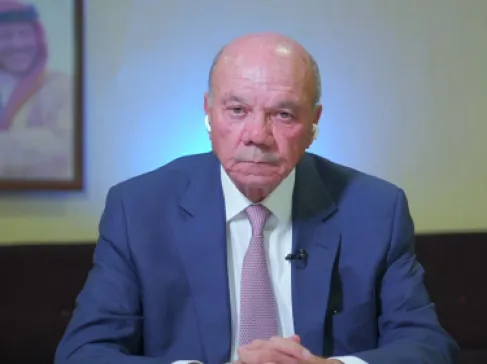
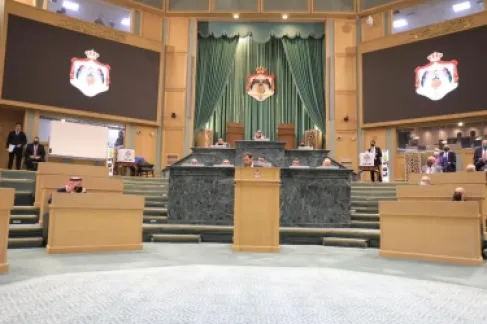
Khaberni - Speaker of the House of Representatives, Ahmed Al-Safadi, affirmed that Jordan, led by His Majesty King Abdullah II and His Highness Prince Hussein bin Abdullah II, the Crown Prince, is confidently progressing along the path of economic modernization and comprehensive reform, towards building an integrated national economy capable of competing regionally and internationally, and based on partnership and production.
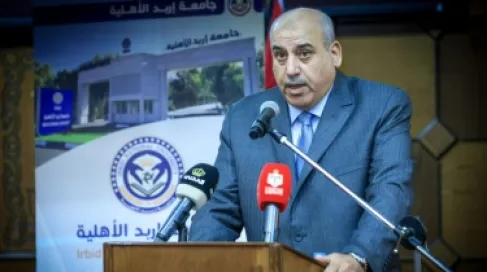
He stated, on Saturday, at the fourth national economic forum, titled "Economic Integration: Reality and Ambition," organized by Al-Yasmine Foundation, with the participation of ministers, experts, economists, and representatives of the public and private sectors, that national economic integration is not a luxury, but a strategic choice imposed by regional and economic realities, requiring doubled efforts and unified paths among various institutions.
He emphasized that the House of Representatives supports everything that serves the economy and improves citizens' lives, enhances investor confidence, and solidifies Jordan's position as a stable, attractive, and promising regional center. He explained that this meeting embodies the meaning of constructive dialogue that combines thought, practice, analysis, and decision-making.
He added, "We meet today to discuss economic integration, reality and ambition, an important topic under the delicate circumstances the region is undergoing, imposing accelerated challenges that call for doubling efforts, building partnerships, and expanding horizons for achievement and construction."
Al-Safadi mentioned that His Majesty the King, through the vision of economic modernization, has drawn a comprehensive roadmap leading Jordan in its second centenary towards comprehensive and sustainable economic transformation, through accelerating growth, improving quality of life, expanding the middle class, and providing quality opportunities for the sons and daughters of the nation, indicating that His Majesty affirmed that this vision transcends "governments and is consistent in its directions" because it is derived from a steadfast national will, and the values of the state and its institutions.
He explained that the meeting sheds light on essential axes that form bridges of economic integration, representing a space for collective thinking and reaching realistic solutions that enhance national production, support local industries, and push towards a knowledge-based economy, political will, and effective institutional cooperation.
Regarding the ongoing events in Palestine, he said, "We can only stand in reverence before the resilience of our people in Palestine who faced the brutality of war in Gaza, in one of the harshest chapters of modern history."
He added that the decision to halt the war on Gaza gives hope for a new path that restores the Palestinian human right to life and dignity, affirming pride in Jordan's steadfast and honorable role in defending the Palestinian cause through effective movements to stop the aggression, providing ongoing relief and medical support to the people of Gaza, and pushing towards a fair and comprehensive solution, based on the "two-state solution" and the establishment of an independent Palestinian state.
Meanwhile, Minister of Investment Dr. Tariq Abu Ghazaleh affirmed that economic integration represents the title of the upcoming phase and the focus of work among all state institutions, emphasizing that integration is not merely a slogan, but a work approach based on coordination, exchange of expertise, and linking efforts between the public and private sectors to achieve sustainable growth across the provinces.
Abu Ghazaleh said that the Ministry of Investment derives its economic and developmental work direction from His Majesty the King, who emphasizes that building a strong and prosperous economy is the path to achieving the aspirations of Jordanians, and from His Highness the Crown Prince, who sees youth and innovation as the primary drivers of development and change.
He mentioned that the vision of economic modernization set a clear framework for the integration approach through executive programs and specific indicators, focusing on empowering productive sectors, stimulating investment, and providing job opportunities.
He stated that the ministry operates within this system as an enabling entity, aiming to make investment projects part of the integration process, through streamlining procedures, unifying investment paths, and launching a unified digital system to facilitate the investor's journey.
He affirmed that the local investor remains at the heart of this integration, being the primary engine of the economy, as Jordanian investments make up the vast majority of projects registered in the Kingdom, reflecting confidence in the business environment and its stability.
He revealed a package of quality measures taken by the ministry during the current year, including: approving special incentives for green hydrogen and renewable energy projects, laying the foundation stone for the new Madaba Hospital, increasing the construction percentage in industrial areas, extending the exemption of IT services export profits from income tax, reducing land and electricity prices in the industrial cities of Karak and Tafilah, facilitating procedures for obtaining citizenship and investor cards to enhance confidence and clarity for investors, along with approving incentives and exemptions for power generation projects where the government is a purchasing party.
The Secretary-General of the Ministry of Transport, Fares Abu Dhieh, speaking on behalf of the Minister of Transport, emphasized the importance of the transport sector and its pivotal role in investment and economic growth, noting that the vision of economic modernization paid special attention to this sector.
He explained that transport is an integrated system that relies on comprehensive transport, asserting the sector's pursuit to keep up with everything related to modern technology.
Abu Dhieh said that in the context of discussing economic integration, the concept of integrated transport is a main title in the stages of sector development.
He explained that the relationship between integrated transport and economic integration lies within multiple basic concepts in the sector's system building, the most important of which is moving from the concept of typology in choosing, determining, and developing a specific transport mode (land, maritime, or rail) to using and developing the integrated or multimodal approach, which depends on developing logistical centers and shipping stations and land ports. He noted that using and developing the multimodal approach should be comprehensive.
Finally, the CEO of Aqaba Development Company, Hussein Al-Safadi, asserted that Aqaba represents a practical model of national and Arab economic integration and a strategic artery for transportation and trade linking Jordan to its regional depth. He mentioned that economic integration is no longer an option, but a fundamental pillar for achieving sustainable development and enhancing the competitiveness of the national economy.
He said that the company has developed an integrated system of modern transport and logistics infrastructure, including ports, airports, industrial, and logistics areas, aiming to make Aqaba a pivotal center for trade and an integrated supply chain supporting efficient import and export movements.
Al-Safadi added that the company has adopted an approach that focuses on creating an attractive investment environment, providing quality services, and innovative solutions for goods transportation and facilitating intra-trade movement, thereby enhancing Aqaba's role as a key economic gateway for Jordan to the world and a regional hub serving Arab markets.