Khaberni -UNRWA Commissioner-General Philippe Lazarini doubts the success of the new humanitarian aid plan in the Gaza Strip, while civil society organizations in Gaza confirm that no one is prepared to deal with the new mechanism.
UNRWA Commissioner-General Philippe Lazarini stated he does not believe that the new humanitarian aid plan in Gaza, proposed by Israel and supported by Washington, will succeed.
Lazarini added, "It seems that the new humanitarian aid plan in Gaza was designed with a military objective rather than a humanitarian one."
Gaza's civil organizations warn
In Gaza, civil society and civic organizations in the sector stated that there is not a single local or international Palestinian institution prepared to deal with the new American aid mechanism, which has a security nature and enshrines the concept of food in exchange for security trusteeship.
The organizations questioned the role of the American institution and those behind it, calling to halt playing a dubious role that fits in the context of serving the plan of displacing the Palestinian people, ethnic cleansing, and genocide.
They commended the ethical and legal responsible role of the United Nations, UNRWA, and all international humanitarian organizations that refuse to engage with the method of aid distribution.
Warning of falling into the trap
The Palestinian people were also warned "from falling into the trap of the American institution and being transferred to detention camps under the pretext of providing food for security and political objectives of the right-wing Israeli government."
They urged American and European partner institutions, communities, and popular activities to file global lawsuits against the American institution complicit with the occupation in the war of extermination and starvation that the people of the Gaza Strip are undergoing.
The Democratic Front for the Liberation of Palestine stated that dribbling in the introduction of aid to Gaza will not solve the hunger crisis.
They called on the international community to intensify pressure on the occupation government to open the sector's crossing points so that aid can flow in a manner that ensures its provision to all areas.
They warned of the distribution plan being discussed through American companies because it is a project to cram the sector's residents in a way that serves the army's plan to expand its operations and seize the largest area free of inhabitants.
84 days of the siege
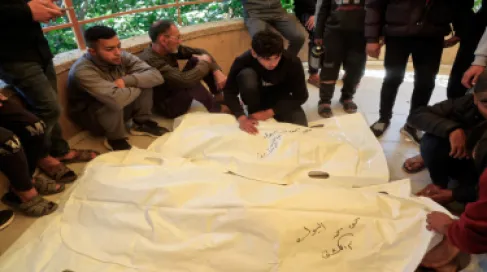
In this context, the Government Media Office in the Gaza Strip reported that the Israeli occupation authorities continue to impose a tight and severe siege on the Gaza Strip for the 84th day in a row, completely closing all crossings and implementing a systematic policy of mass starvation amounting to war crimes and crimes against humanity, according to international law, alongside the continuation of systematic genocide and daily unremitting killings.
It added that hundreds of thousands of tons of relief and humanitarian aid have accumulated abroad, spoiled and rotted due to being blocked from entry for many months, while the residents of the sector suffer from escalating famine and a very critical humanitarian situation.
They explained that, during the 84 days of total siege and closure, at least 46,200 trucks loaded with aid and fuel were supposed to enter Gaza to meet the minimum needs of the population, but only about 100 trucks actually entered, or less than 1% of the basic needs of the population.
These shipments - according to the statement of the media office - contained limited amounts of medicine and flour, which reached a limited number of bakeries, while the occupation continues to disrupt the operation of more than 90% of the sector's bakeries, clearly revealing the policy of "engineering starvation" pursued by the occupation through deliberate control over the flow and distribution of food, making the humanitarian catastrophe in which more than two million civilians in Gaza live even more complicated.
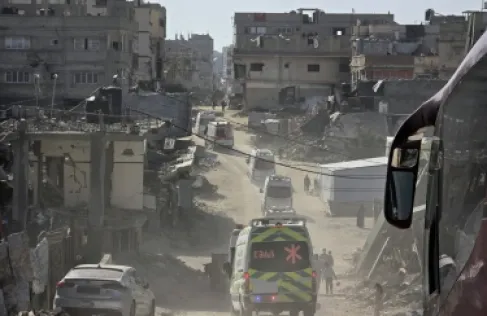
Furthermore, they explained that the occupation imposes strict restrictions on the movement of the "few trucks" that were allowed to enter in recent days, forcing them to take hazardous routes monitored by the drones it operates, facilitating their exposure to robberies by some armed groups that operate with clear neglect from the occupation.
At the same time, according to the statement, the occupation also prevents securing these trucks or providing the necessary protection for them, but rather directly targets the teams working on securing the supplies, where it recently committed a new crime by bombing 6 members of the aid security team, leading to their martyrdom during their humanitarian duty of protecting those supplies.
80 days of siege and closure of crossings also led to 58 deaths due to malnutrition, and 242 deaths due to lack of food and medicine, mostly among the elderly.
It also led to 26 kidney patients losing their lives due to lack of nutritional care and treatment, and to more than 300 miscarriages among pregnant women, due to a lack of necessary nutritional elements to sustain pregnancy.