



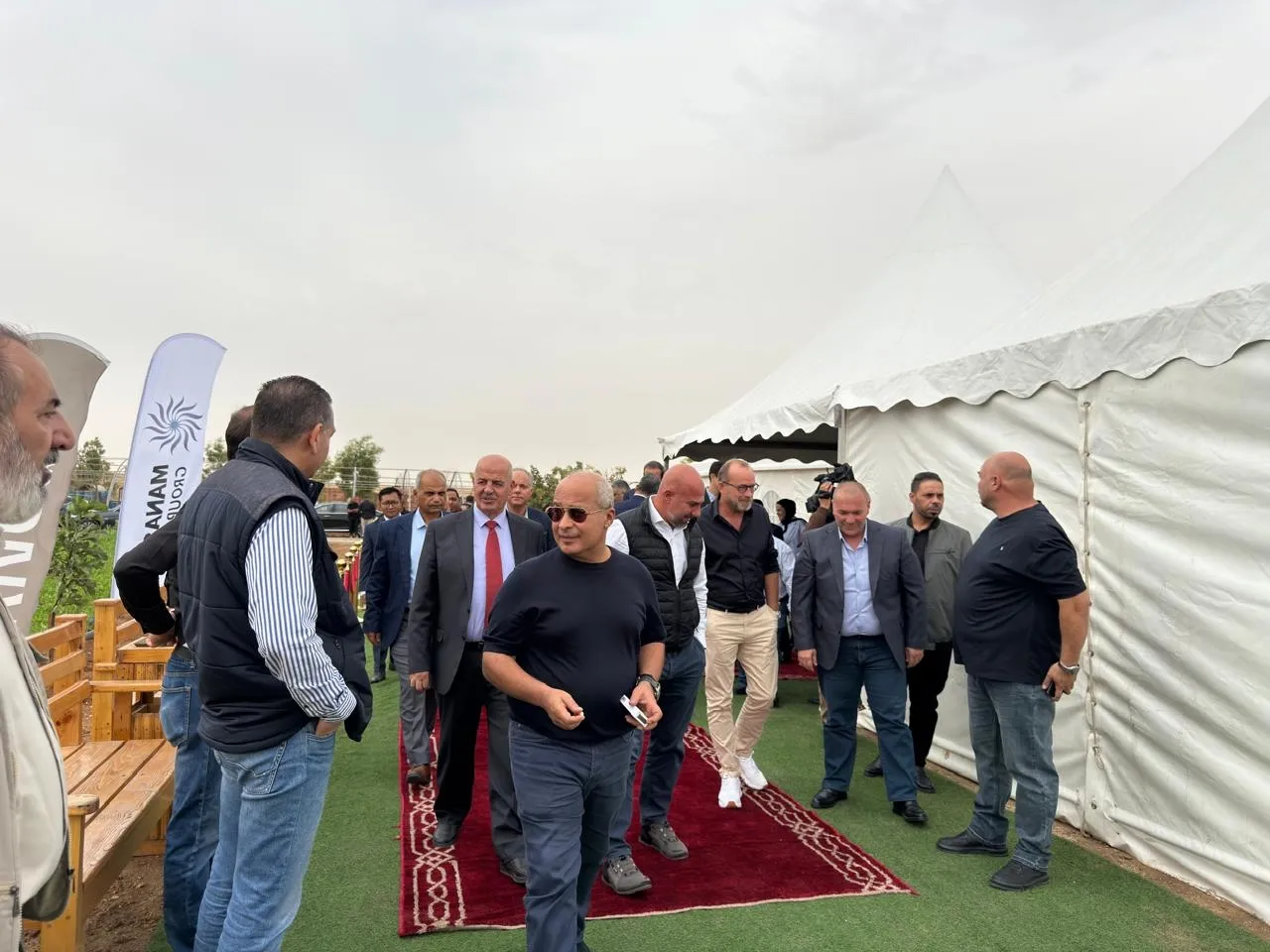
«Manaseer Group» hosts a select group of diplomats, experts, and farmers to showcase the rice farming experience under challenging agricultural conditions, making it a pivotal milestone in the journey of local natural fertilizer innovation andit opens new horizons for sustainable
Khaberni - Manaseer Group, at its industrial complex in Qatraneh, hosted a delegation consisting of ambassadors and representatives from embassies, international organizations, official institutes, academic institutes, and agricultural entities, to see firsthand a new achievement by the group, demonstrated by the successful rice farming experiment in a desert environment using fertilizers MNG innovative natural; proving its capability to support crop growth in highly challenging environments: limited water, saline soil, hot climate, and without reliance on traditional flood irrigation..
The event was chaired by the chairman of the board of the group, Engineer Ziad Al-Manaseer, attended by a number of senior officials in the group, with participation from representatives of:
- The National Center for Agricultural Research: Dr. Zakaria Muslim (Director General), Dr. Mohamed Al-Rifai (Deputy Director General for Research Center Affairs), Engineer Yahya Bani Khalaf (Director of Al-Ramtha Research Center), Dr. Sharif Al-Rawashdeh (Director of Al-Rabbe Research Center), Engineer Yancy Al-Khasawneh, and Engineer Wissam Al-Nawayseh.
- The Diplomatic Corps: Embassies of Pakistan, Turkey, Philippines, Indonesia, Spain, and Japan, including His Excellency Ambassador of the Republic of Indonesia, Mr. Adi Badmo Sarwono, and the Head of the Economic and Commercial Office of Spain, Mr. Victor Suanthes.
- Regional and International Organizations: The International Union for Conservation of Nature (IUCN), and the Arab Center for the Studies of Arid Zones and Dry Lands (ACSAD), and Advance Consulting Company,
- Official Entities:: Ministry of Agriculture (Soil and Irrigation Directorate), Ministry of Water and Irrigation, Ministry of Environment, Jordan Valley Authority, and Directorate of Qatraneh Agriculture,.
- Academic and Scientific Entities: Mutah University, Al-Balqa Applied University, and the Royal Scientific Society.
- Agricultural Sector and Civil Society: Jordan Engineers Association, General Union of Jordanian Farmers, Union of Farmers, Entrepreneurship Association, and several leading farmers.
The Rice Experiment: A Test for Farming Under the Most Difficult Conditions
Manaseer Group chose rice as a test crop due to its high sensitivity to salinity and water consumption, intending to demonstrate the effectiveness of its natural agricultural solutions under the harshest conditions. If successful here, it proves capable of succeeding elsewhere..
The experiment was conducted using locally manufactured natural products MNG by Manaseer Group, includingAquaSave, a natural water management system in the soil, free from chemicals and biodegradable, that stores water and nutrients in the root zone, enhancing their absorption efficiency and increasing plant stress tolerance, contributing to reduced water consumption in irrigation..
The experiment was carried out under challenging agricultural conditions, including:
- a hot and dry climate,.
- saline soil, reaching 5.3 deciSiemens per meter, which is above the threshold where rice usually starts losing yield,.
- irrigation with saline well water using drips instead of traditional flood irrigation,.
Results of the Experiment
Despite these conditions, the rice reached flowering and panicle formation stages on time. The treated plants, direct comparison with the same soil and water, showed stronger and denser growth, with more numerous and longer panicles,.
Natural Solutions and Jordanian Innovation naturally originated
This achievement comes within the framework of Manaseer Group's vision to develop natural solutions that contribute to building a more sustainable future for agriculture, through the use of Jordan's natural resources and turning them into innovative products with added value. And