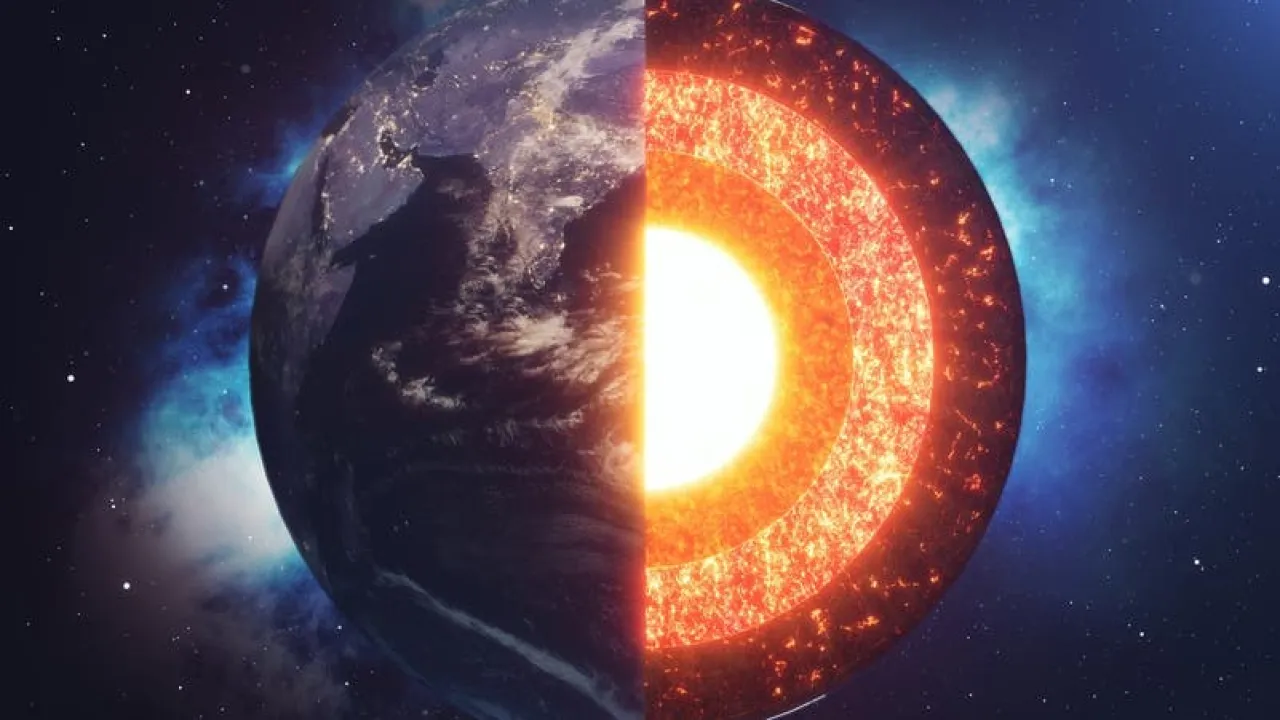
Khaberni - A new study has revealed that Earth's outer core may be more complex and active than scientists previously thought, following seismic wave analyses that showed indications of heterogeneous materials moving within the planet's core.
Nuclear Experiment Data
The study relied on an unusual source of seismic waves, data from underground nuclear experiments conducted by France decades ago, which allowed scientists to compare almost the same seismic signals across different time periods, as mentioned by the website "Science Alert".
Since the discovery of seismic waves, scientists have used their behavior to understand the internal structure of the Earth.
The changes in speed and path of these waves showed that the Earth's interior consists of different layers, including the liquid outer core and the solid inner core.
However, the new study provides additional details about the nature and movement of the outer core.
Change in Fractions of a Second
Geophysicist Ying Zhou from Virginia Tech analyzed seismic waves generated by underground nuclear tests on the island of Moruroa in French Polynesia between 1977 and 1995.
The waves traveled through the Earth's interior before being recorded by a seismic monitoring station in Kazakhstan.
Since the experiments took place at a very close location, the researcher could compare waves that traveled similar paths across the planet.
The results showed that the waves crossing the outer core did not take the same time on every occasion.
Compared to 1977, the waves were faster by about 0.1 seconds in 1982 and 1983, and by about 0.15 seconds between 1988 and 1990.
But by 1995, they became slower by about 0.15 to 0.2 seconds.
Although these differences are only fractions of a second, they carry significant importance for waves that traveled thousands of kilometers inside the Earth, indicating changes in the materials they passed through.
Materials Moving Inside the Earth's Core
The results raise the possibility that the outer core is in a state of mixing and active movement, instead of the prevailing belief that the planet's core is a homogeneous mass of molten metals.
The study estimates the existence of an abnormal region extending over more than 700 kilometers, with a thickness approaching 100 kilometers in the southern Pacific Ocean at low latitudes, which could explain the changes detected by the seismic waves.
Potential Relation to the Magnetic Field
Studying the movement of materials within the outer core may help scientists understand how Earth's magnetic field is formed and what may cause its changes.
The outer core primarily consists of liquid metals, and its movement is linked to processes that generate the magnetic field that surrounds the planet and protects it from a significant portion of charged particles coming from the sun.