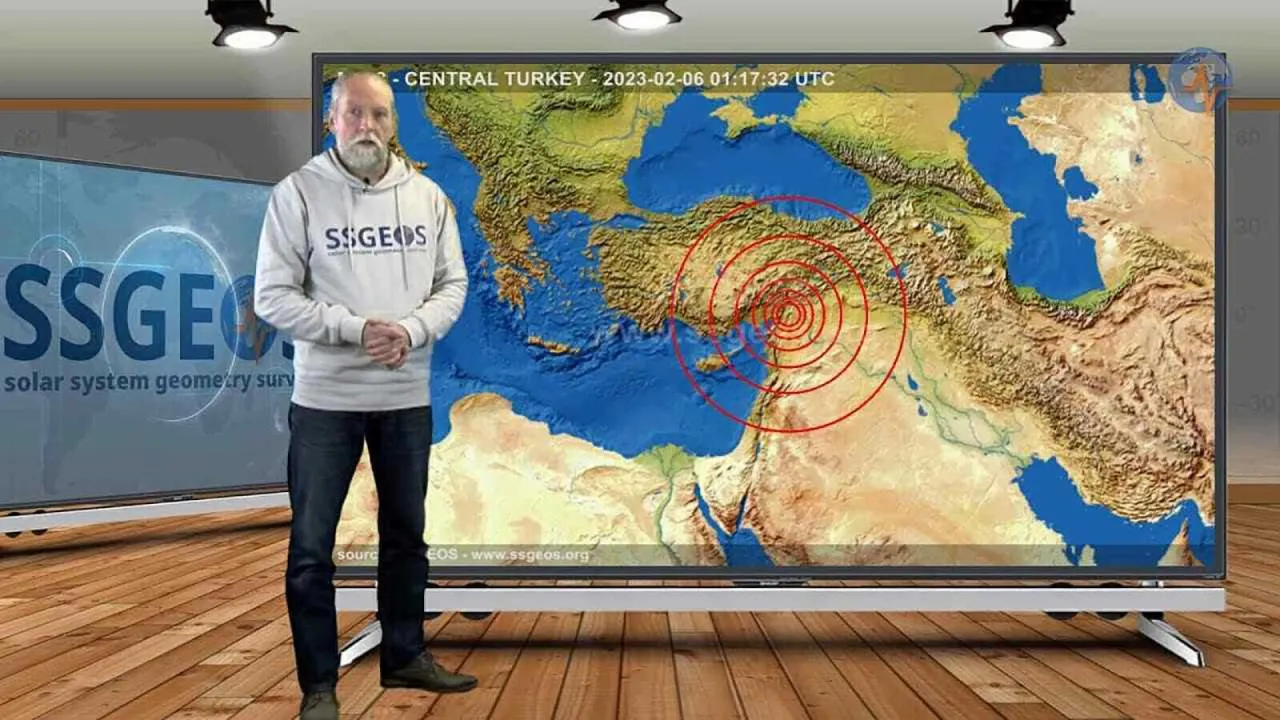
Khaberni - The Dutch seismologist, Frank Hoogerbeets, becomes present after any earthquake, where some media attempt to link his posts on his official social media pages with seismic events, as happened after the recent earthquake that hit Egypt yesterday.
Some media interpreted his cryptic posts that preceded the earthquake in Egypt as a confirmation of his theory, which links celestial bodies' movement and changes in the tectonic plates on Earth leading to earthquakes. This seems contrary to reality, confirming practically that the man who mastered "seismic astrology," as experts call it, will always find someone to cloak his posts in truth, even if they appear otherwise.
Forecast Lacking the Three Elements
The real beginning of playing this game was when Hoogerbeets wrote on his Twitter account (formerly known as X) days before the earthquake that struck Turkey and Syria on February 6, 2023: "Sooner or later, the East Anatolian fault zone will experience an earthquake," which made the man the talk of the world after the earthquake occurred, although what he said amounts to nothing scientifically.
Scientifically, anyone claiming the ability to predict earthquakes must meet three conditions in their claim: "the date and time," then "the location," and finally "the strength of the earthquake."
Hoogerbeets' most famous prediction, which preceded the earthquake in Turkey and Syria, missed two crucial elements, the timing and strength, and chance served him by picking a location that is seismically active and expected to experience an earthquake at any time.
Despite his posts that preceded the earthquake in Egypt lacking the three elements, he found those who promoted them as a prediction of the earthquake, which severely disappointed Dr. Sherif El-Hadi, head of the Earthquake Department at the National Institute for Astronomical and Geophysical Research, who, in statements to Al Jazeera Net, said: "Since the earthquake in Turkey 3 years ago, we have been emphasizing, until we are hoarse, that what Frank Hoogerbeets writes on his social media accounts is closer to seismic astrology than to science, supported by dozens of seismic events, including the recent earthquake in Egypt, yet his posts still attract a lot of attention."
What Did He Say Before the Earthquake in Egypt?
Days before the earthquake in Egypt, Hoogerbeets wrote on July 30 that "after yesterday's high lunar activity, there is a global possibility of an earthquake of 6 degrees on the Richter scale, perhaps stronger, in the next two days."
The peak lunar activity he referred to, and explained in a video he published on his YouTube channel, involves a "quadruple planetary geometry", involving a full moon in opposition with Earth intersecting with Mars and Saturn at sharp or critical angles, creating a peak in "electromagnetic/gravitational energy", which may stimulate a strong earthquake, possibly over 6 or 7 degrees on the Richter scale, in a seismically active area in the days immediately following this alignment.
After specifying the earthquake's strength, he identified the expected location for this tremor, adding "it may occur in the Mediterranean Sea, perhaps at the small Aegean Sea plate."
Ironically, the earthquake in Egypt contradicted all these predictions, as it was above average strength "5.5", and its source was not the Mediterranean Sea. It occurred in the region of the Bitter Lakes, within the northern extension of the Gulf of Suez fault system. Despite this, media outlets announced that the Dutch seismologist Frank Hoogerbeets had predicted the earthquake in Egypt.
It seems that Hoogerbeets realized that some are determined to believe him even if the facts are indubitable, so after the occurrence of the earthquake in Egypt, he reposted his prediction of an earthquake in the Mediterranean, commenting: "Seismic activity has been moderate so far in the Mediterranean region, but two areas (Italy and Egypt) have experienced a medium/destructive earthquake, not seen for years, and it remains difficult to predict their locations accurately."
Why Do People Insist on Believing Hoogerbeets?
In response to this confused post, Sherif could only say, "We are facing a man trying to prove the truth of his theory which was fatally hit by the earthquake in Egypt, yet people insist on believing him."
He finds no explanation for this other than that people wish to achieve a dream that science has not yet accomplished: precise prediction of the timing of earthquakes, and Hoogerbeets gives them false hope of achieving this.
He says that "the best that can be achieved so far is to study historical records and earth faults in seismically active areas to estimate the probabilities of earthquakes in the long term."
He explains that there are attempts to detect possible indicators preceding earthquakes, such as minor changes in the Earth's crust, electromagnetic fields, gas emissions, and groundwater levels, but none of them has proven reliable enough to allow for precise prediction.
Meanwhile, early warning systems have achieved significant success in some countries, as they can send alerts seconds or tens of seconds before the destructive seismic waves arrive after an earthquake has already begun, which was the case in the recent earthquake in Egypt.