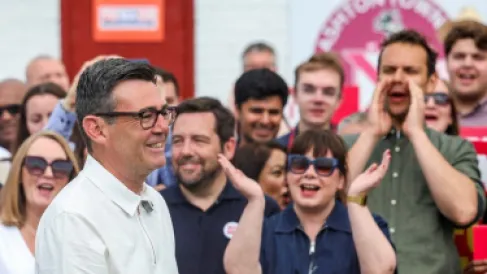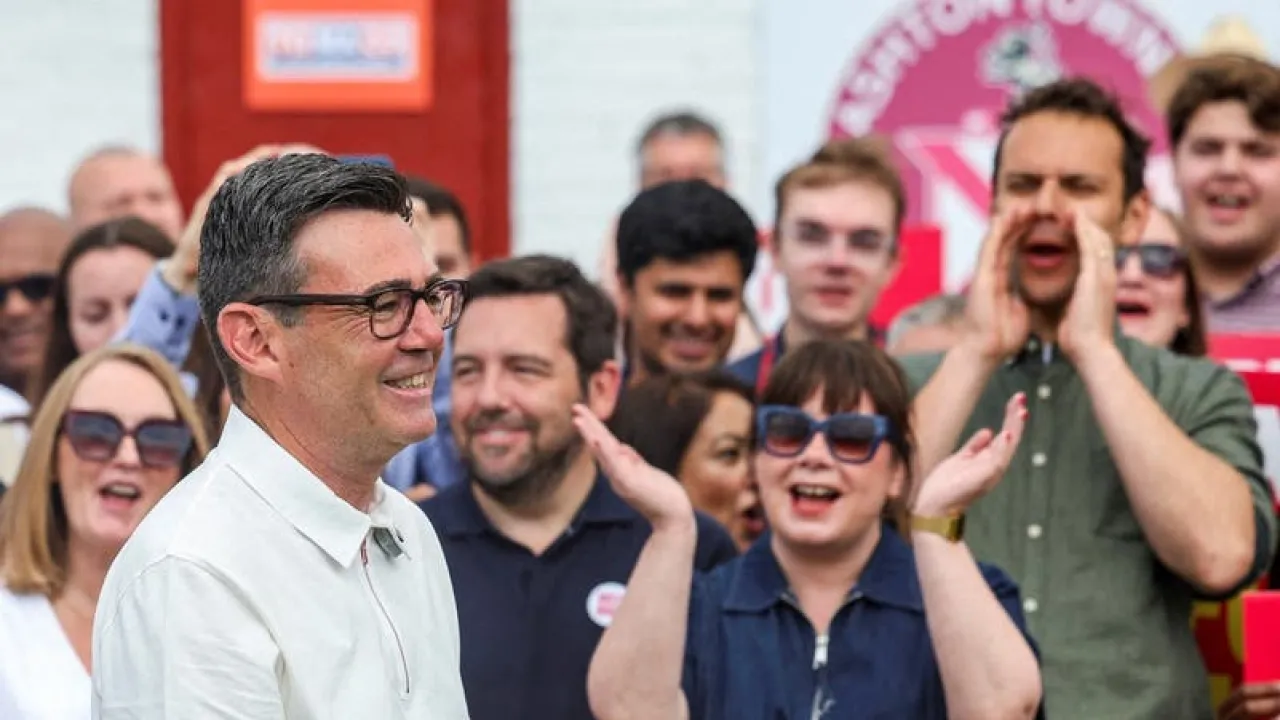
Khaberni - Hours after the British Prime Minister's resignation was announced on Monday, Labour MP Andy Burnham said he intends to run for the position of Prime Minister, succeeding Keir Starmer.
Who is Burnham?
Burnham is a British politician from the Labour Party, who came into the political spotlight through local government after being elected the first Mayor of Greater Manchester in 2017. He gained widespread popularity due to his local policies, particularly in developing public transport systems, and during the years of Conservative rule, he became one of the most prominent voices defending the interests of Northern England.
With his growing political influence, he was nicknamed "King of the North," and became one of the Labour Party's most prominent figures outside Westminster. After a parliamentary and governmental career spanning from 2001 to 2017, he returned to the House of Commons in June 2026 as MP for Makerfield, reigniting speculation about his potential future entry into the Labour Party leadership race.
Early Life and Education
Andy Burnham was born in 1970 in Northwest England, between Liverpool and Manchester, and grew up in the village of Culcheth in Cheshire near Warrington. His father was an engineer at British Telecom and his mother a receptionist at a medical clinic; both were Labour supporters, which contributed to his early interest in politics.
At the age of fourteen, Andy joined the Labour Party, influenced by the British television series "Boys from the Blackstuff" that depicted the impact of unemployment in Liverpool. Known for his sports enthusiasm since childhood, particularly in football, he has remained a loyal supporter of Everton Football Club throughout his life.
Burnham and his siblings were the first in their family to attend university, where he studied English Language at Cambridge University. After graduating, he worked in specialized journalism before starting his political career as a researcher for the late Labour MP Tessa Jowell.
Political Experience
Andy Burnham was elected as MP for Leigh in 2001 and quickly climbed the ranks in government under Prime Ministers Tony Blair and Gordon Brown.
He held positions in the Home Office, the Treasury, and the Department of Health, and served as the Minister for Culture, Media and Sport between 2008 and 2009, then as Health Minister between 2009 and 2010. During this time, he became nationally known through his involvement in the Hillsborough disaster case, where his pressure within the government led to a new inquiry into the incident that killed 97 Liverpool fans in 1989. He remained one of the strongest supporters of the justice campaign for the victims.
After Labour moved to the opposition, he held the roles of Shadow Education Minister, Shadow Health Minister, and Shadow Home Secretary. He also ran for the Labour leadership twice: the first time in 2010 after Gordon Brown's resignation, where he placed fourth behind Ed Miliband, and again in 2015, losing to Jeremy Corbyn.
In 2017, he resigned from Parliament to run for the newly-created position of Mayor of Greater Manchester, a role he won and was later re-elected in 2021 and 2024.
During his mayorship, he oversaw extensive development projects in the area, notably reorganizing the public transport network under the name "Bee Network," integrating bus services with other transport modes under unified public management, steps that received widespread acclaim.
During the COVID-19 pandemic, his popularity rose following his repeated criticisms of the Conservative government led by Boris Johnson, accusing it of focusing on London and neglecting Northern England, especially in terms of lockdown restrictions and economic support. During this period, he earned the nickname "King of the North," inspired by the "Game of Thrones" series.
In his third term as Mayor of Greater Manchester, he set a number of priorities, including completing the construction of an integrated transport system akin to the London model, resolving the housing crisis by 2038, and developing an alternate path of technical education from university education, along with launching the "Live Well" service to enhance community-based health and welfare.
In June 2026, he returned to Parliament after winning the by-election in Makerfield, a move that strengthened speculation about his potential entry into the Labour leadership race and competition with Keir Starmer for the party and government leadership, as Burnham won with 24,927 votes, while the candidate from the British Reform Party led by Nigel Farage came in second with 15,696 votes.
Political Vision
Andy Burnham is viewed as more left-leaning than Keir Starmer, which has earned him appeal among sections of the Labour Party members. He is also reputed as one of the politicians most capable of connecting with the public, having moved from a conventional political orator to a more simplistic and approachable figure.
His political vision, dubbed "Manchesterism," focuses on prioritizing people and local communities over narrow party politics, with greater attention to regions he sees as having been marginalized by successive governments in London.
During his latest election campaign, he called for expanding this experience nationally, pledging to improve vocational education, provide job opportunities for youth, reduce energy and transport bills, and end economic policies based on the "trickle-down" wealth principle, arguing that they have not delivered tangible benefits to less fortunate regions.
However, his critics argue that his proposals remain vague and lack clear details about funding sources for his promises, noting that managing a country with a population of over 70 million differs greatly from managing an area with about 3 million people.
Nevertheless, his resounding victory in the Makerfield by-election has bolstered his standing within the Labour Party, leading many to consider him one of the most likely candidates to reach 10 Downing Street, the residence of the Prime Minister.
Starmer's Resignation
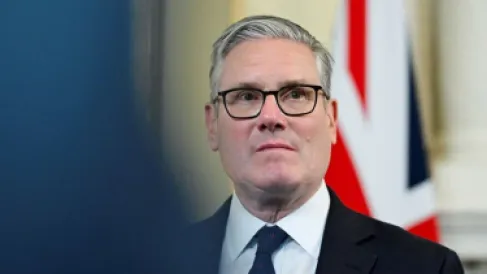
It is worth noting that Keir Starmer's political journey ended as Prime Minister of Britain today, Monday, after he announced his resignation from his office balcony, amid pressures he faced, after spending two years in his office located at 10 Downing Street in central London, as the head of the government and the Labour Party.
Starmer said he would remain Prime Minister until a new Labour leader is chosen, noting that he had informed King Charles of his decision to resign from the government leadership.
He added that he would ask the Labour Party to determine a timeline with nominations opening on July 9th.
This may pave the way for an orderly transfer of power to his competitor Andy Burnham, opening the path to Britain's seventh leader within a decade.