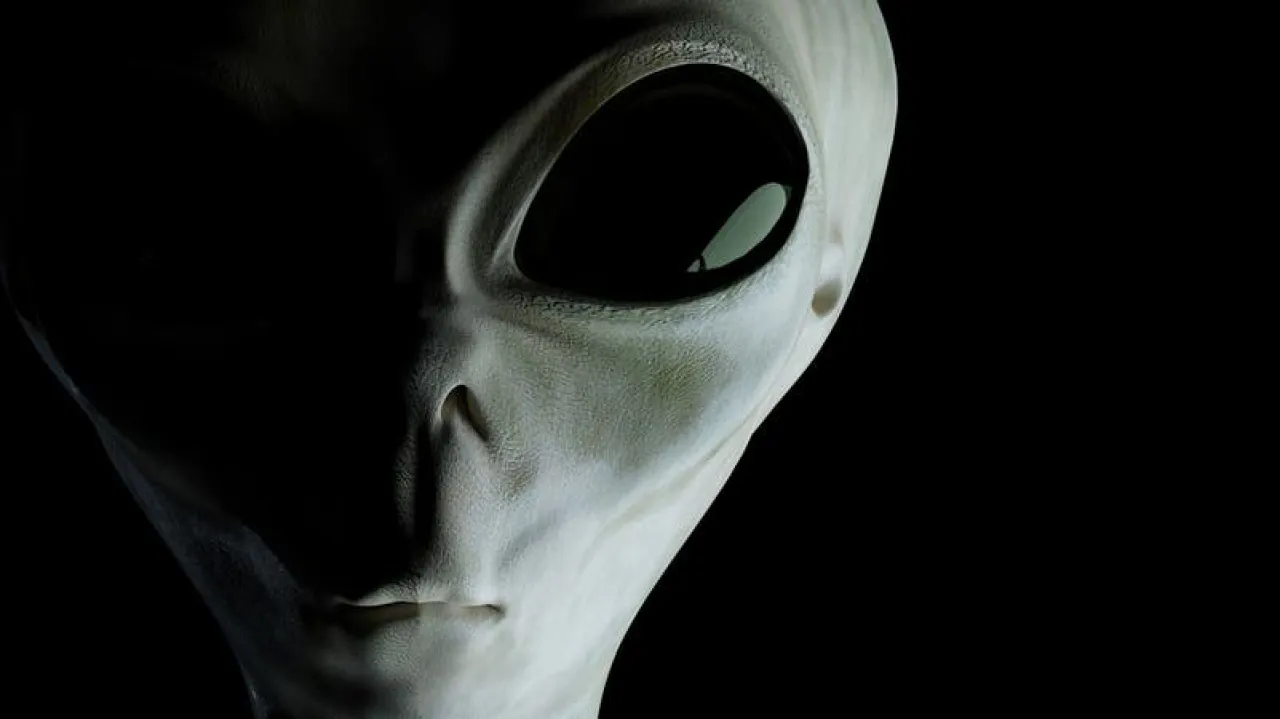
Khaberni - The recent disclosure by the US government of hundreds of previously classified unknown aerial phenomena (UAPs) has revived the idea of alien visitation to Earth.
Polls in the United States, Australia, and several other countries indicate that about one-third of the public believes in the existence of extraterrestrials, according to the website (the conversation).
Despite several indications suggesting the possibility of extraterrestrial life, there are three solid reasons that make their visit to Earth "improbable," according to a study published by (Sciencealert).
Vast Space
Space is so vast it exceeds our imagination, with the closest star to our Sun, "Proxima Centauri," approximately 40 trillion kilometers away, which is about 268 thousand times the distance between the Sun and Earth.
This distance equals 4.3 light-years, according to astronomers.
A light-year is the distance light travels in one year at a speed of 300,000 kilometers per second.
With current technologies, humans can only travel through space at a negligible speed compared to the speed of light.
Even humanity's fastest spacecraft, the "Parker Solar Probe," reaches a maximum speed of about 191 kilometers per second, equivalent to only 0.064% of the speed of light.
At this speed, it would take about 6,650 years to reach "Proxima Centauri."
Nobel Prize-winning physicist Albert Einstein demonstrated that "time is relative," meaning the flow of time is not constant everywhere in the universe.
The faster a spacecraft moves away from Earth, the slower time passes for its passengers, a phenomenon known as "time dilation."
For instance, when NASA astronaut Scott Kelly returned to Earth after a year on the International Space Station, he was younger than his identical twin by fractions of a second.
For any extraterrestrial beings, the difference could be much greater due to the necessity of "faster speeds" for a return journey from a distant star system.
Thus, the extraterrestrials would return to their home planet potentially 100 years or more older than when they left.
Immense Energy Requirements
Traveling through the stars requires "immense energy requirements," as the spacecraft's mass increases with speed, requiring an increasing amount of energy for acceleration.
At the speed of light, the spacecraft becomes massively heavy, necessitating a tremendous amount of energy, theoretically impossible to provide.
According to Mexican physicist Miguel Alcubierre, "faster-than-light travel is possible, but it involves immense challenges and energy requirements that are currently unfeasible."
Unique Biosphere
The "biosphere" is the region where living things can exist on Earth, and scientists describe it as "unique."
Oxygen is not toxic to humans, but it is highly reactive and could be harmful to extraterrestrial beings, who would need protective suits to visit harsh or toxic environments, just as humans do.
Do extraterrestrials really exist?
Scientists still lack sufficient information about the existence of extraterrestrial beings living in the vast universe. To date, around 6,200 exoplanets have been discovered in over 4,700 solar systems, but none resemble Earth or our solar system.
It is likely that most stars have at least one planet, and there are more than 100 billion stars in our galaxy alone, thus, some of these planets might be habitable.