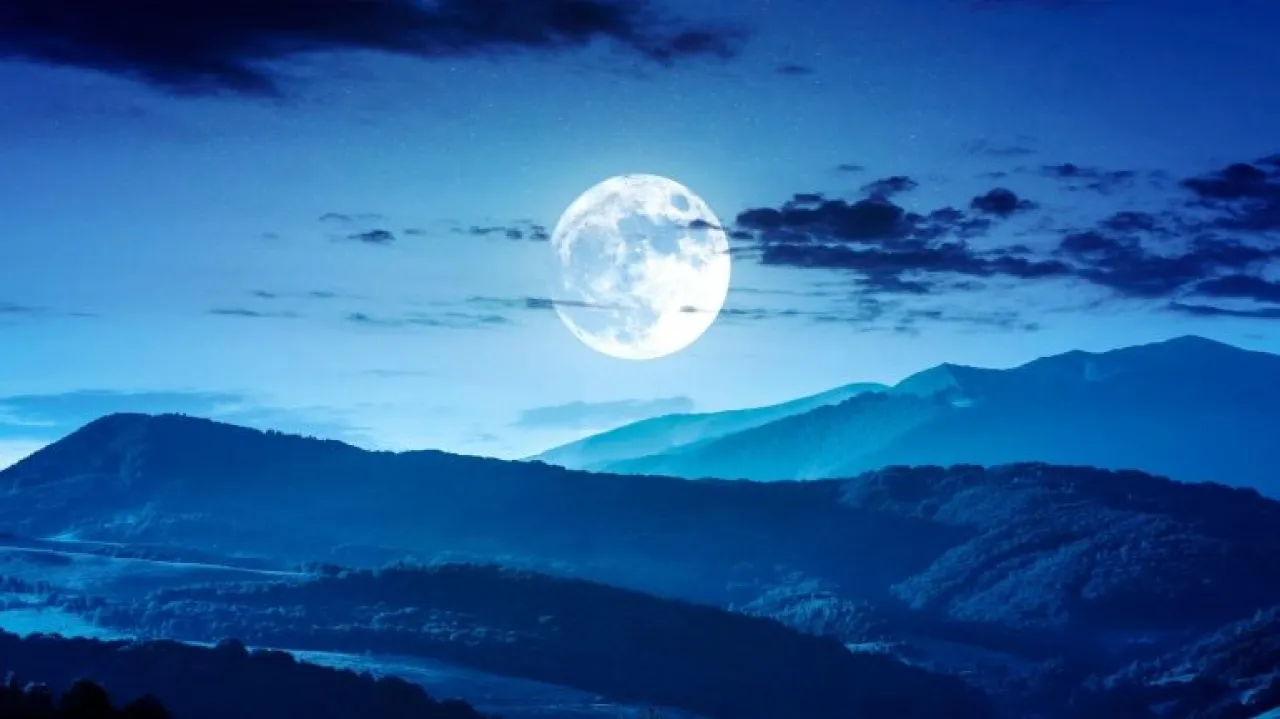
Khaberni - Precise astronomical calculations indicate that the "Blue Moon" phenomenon will occur at the end of May 2026, where the month will witness two full moons: the first on Saturday, May 1, 2026, and the second on Sunday, May 31, 2026, making the second moon the "Blue Moon".
The first will occur on Saturday, May 1, and is traditionally known as the "Flower Moon", while the second will occur on Sunday, May 31, which is dubbed the "Blue Moon" as it is the second full moon in a single calendar month.
Astronomy enthusiasts and scientists alike are preparing to witness this rare phenomenon at the end of May 2026, where the "Blue Moon" will appear in an extraordinary celestial scene that recurs approximately every two and a half years.
However, this event is not just about "lunar congestion"; it also coincides with the "Micromoon" phenomenon, giving it a dual astronomical distinction.
Despite the eye-catching name, this phenomenon does not mean a change in the color of the moon but refers to a rare temporal event in the lunar calendar that happens roughly every two and a half years.
What is the Blue Moon? A Scientific Definition Unrelated to Color
In modern astronomy, the term "Blue Moon" is used to describe two primary conditions: The monthly definition, which occurs when two full moons appear in one calendar month, and is the most media-common definition, and the seasonal definition, which is the third full moon in a season (every 3 months) containing 4 full moons instead of 3.
This phenomenon arises from the difference between the lunar cycle (29.53 days) and the length of the calendar months (30 or 31 days), which sometimes leads to "lunar congestion" resulting in an additional full moon.
"Micromoon": When the Full Moon is at its Farthest
The scientific surprise in the full moon of May 31, 2026, is that it will be the "farthest full moon of 2026," called by astronomers the "Micromoon" because it will be at the "apogee," the farthest point in its orbit from Earth.
Due to this distance, the moon will appear smaller in size by a percentage ranging between 12% and 14% compared to the "Supermoon" (the brightest full moon).
The full moon will reach its peak at exactly 11:45 AM Mecca time, and it will appear that night near the bright star "Antares" in the Scorpius constellation.
The Origin of the Term.. From a Calendrical Error to a Common Scientific Concept
The term "Blue Moon" is not a recent invention and does not go back to any single inventor, but it is a concept that has evolved over time. It was used in old English to denote "something very rare".
The modern astronomical definition spread after an explanation published in 1946 in "Sky & Telescope" magazine based on a calendrical tradition in the "Maine Farmers' Almanac." From here, the scientific and media use of the term as "the second full moon in a month" became established.
And despite this evolution, the term does not link to any real change in the color of the moon, but it is only a temporal classification.
Can the Moon Actually Appear Blue?
Although the "Blue Moon" does not describe a real color, the moon may occasionally appear tinged with blue under very rare circumstances linked to the atmosphere, such as major volcanic eruptions (like Krakatoa in 1883) and massive forest fires that release fine particles that alter light dispersion.
In these occasions, fine particles absorb and scatter red light, making the moon appear temporarily blue, without any real change in its actual color.
The Blue Moon Between Science and Human Wonder
The "Micromoon Blue Moon" experience in May 2026 will show how a single astronomical event can combine scientific precision with visual amazement. It is not just an "additional full moon", but a result of a complex interaction between lunar timing and the orbital mechanics of celestial bodies.
As celestial phenomena inspire the curiosity of scientists and sky enthusiasts, they remind us that the universe still holds its secrets and that looking at the sky is not merely observation, but a perpetual attempt to understand our place within this vast cosmic expanse.