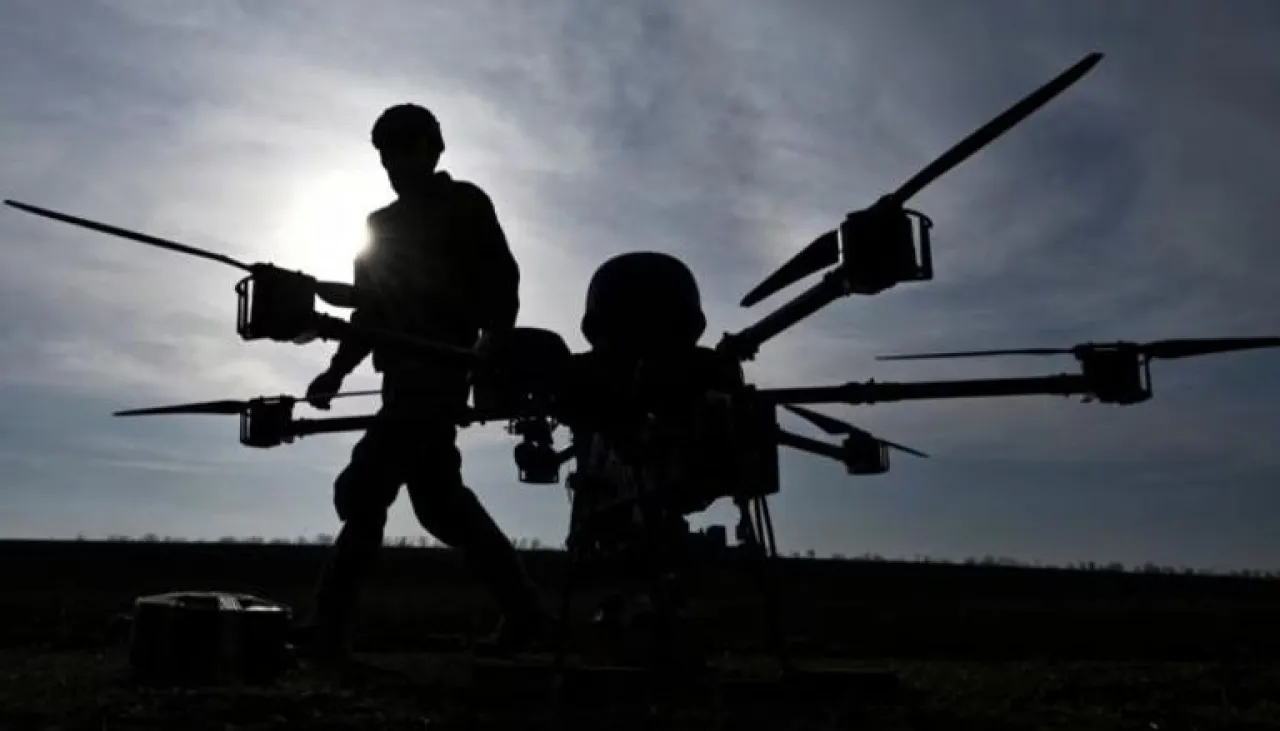
Khaberni - From logistics to data analysis, unmanned systems play a major role in combat, but they will not replace humans, rather they will prolong their survival.
A few days ago, Ukraine dismissed a military commander after relatives of soldiers from the 14th Independent Mechanized Brigade revealed that they had spent months near Kupiansk without sufficient food, water, or medicine, and posted photos of their severely emaciated condition on social media.
This tragic situation for some of the Ukrainian forces spurs a silent technological revolution now underway in Kyiv, where soldiers' use of unmanned systems such as drones and robots will not only be limited to combat but also include transporting supplies and evacuating soldiers, thus maintaining their lives long enough to continue fighting, according to what was mentioned by "Newsweek" magazine.
The magazine pointed out that Kyiv expects to contract for 25,000 unmanned ground vehicles in the first half of 2026, more than twice the total in 2025, while the Defense Minister Mykhailo Fiodorov set a goal that all logistical support operations on the frontlines be carried out by robotic systems.
President Volodymyr Zelenskyy described the unmanned systems as "advanced technology that protects the most precious asset the country has—human life," after stating that the Ukrainian forces had performed more than 22,000 unmanned missions during three months.
Some believe that robots reduce the dangers of war and this opinion reflects a liberal civilian perspective that depends on machines to do the heavy work and bear the risks, but without making critical decisions.
Human Rights Watch stated that selecting weapons and targeting without effective human control is "unacceptable," and the "Stop Killer Robots" campaign believes that states should reject the "automation of killing" and maintain effective human control over force.
Another less emotional opinion suggests that robots multiply force and a report by "Defense News" about the war machines in Ukraine quoted one of the drone leaders saying "The more drones, the higher the death toll," and another said, "We use drones... to kill, save, and liberate with them."
Indeed, Ukraine has converted 70% of the logistics services on the frontlines to automated systems where the accomplishment lies not in the machines' ability to replace humans, but in their increasing ability to perform transport operations as modern battlefields have become completely exposed to drones, making transport one of the most dangerous tasks.
The official Ukrainian figures point to this trend, and the Ukrainian Ministry of Defense reported that unmanned ground vehicles completed more than 9000 combat and logistic missions in March, compared to more than 2900 in November 2025 and over 7500 in January 2026.
During the first quarter of 2026, these vehicles completed nearly 24,500 missions in Ukraine while the number of units using them rose from 67 units in November to 167 units in March.
The new Ukrainian robot "Bizon-L" can carry up to 300 kilograms, cover a distance of up to 50 kilometers, move at a speed of up to 12 kilometers per hour, and operate in wet, snowy, icy, and rough terrains.
"Bizon-L" begins its mission with transporting supplies and ammunition and evacuating the injured, and it can also carry weapons, mining equipment, transceivers, and electronic warfare equipment, making the robot closer to a bus than a combat soldier.
This month, the US Army announced its desire to acquire an unmanned ground vehicle for resupply and evacuating the injured, due to the continuous surveillance and heavy fire making movement to and from the frontlines extremely dangerous.
The US Army wants a vehicle capable of carrying a sufficient load for a rifle platoon and company headquarters, evacuating at least two injured, operating on paved and rough roads, and working without a Global Positioning System (GPS).
An article published by the US Army in 2025 mentioned that with the decline in air superiority assurance, unmanned ground vehicles can support evacuation of the injured, logistical services, and reconnaissance operations.
The US Army's Battlefield Casualty Care Research Program is working on developing artificial intelligence, virtual health, medical robots, and autonomous systems.
The Iran war added a new data-related dimension, and Admiral Brad Cooper, commander of US Central Command (CENTCOM), confirmed the use of "a variety of advanced artificial intelligence tools" to analyze vast amounts of data and help leaders make "smarter and faster decisions than the enemy can react," reducing some operations from hours or days to seconds.
The "Maven" project, a leading artificial intelligence program under the US Department of Defense (Pentagon), uses satellite images, radar, social media, and other data sources to identify targets, accelerating the "kill chain," and one official credited this technology for moving from hitting less than 100 targets daily to 1000, and possibly up to 5000.
It can be said that the future is not an army of robots operating instead of humans, but the goal is for humans to remain in the battle thanks to a machine that brings shells and evacuates the injured, in other words, manned systems will not negate the human role in the battlefield, but will extend its scope.