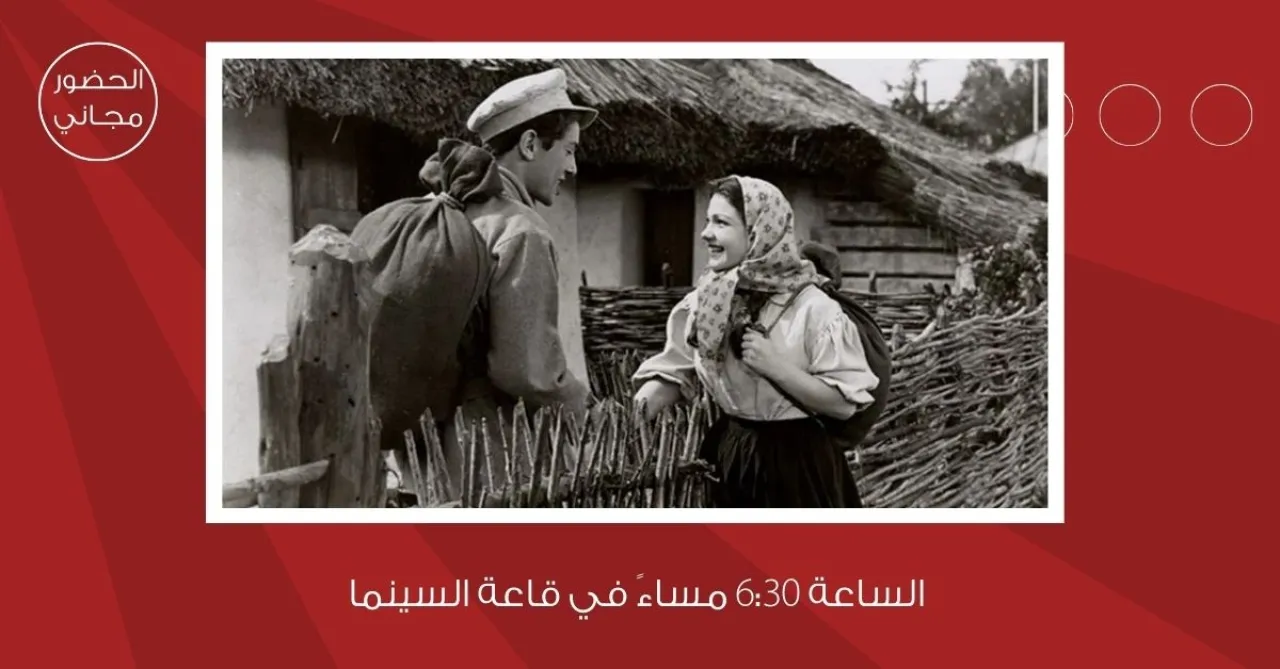
Khaberni - The Cinema Committee at the Abdul Hameed Shoman Foundation will present tomorrow, Tuesday, the classic American film "North Star" directed by Lewis Milestone, at exactly six-thirty in the evening at the foundation's headquarters in Jabal Amman.
The film, completed by director Milestone in 1943, takes place in a rural area in Ukraine, which was part of the former Soviet Union, during World War II.
The film, produced by the famous American producer Samuel Goldwyn Mayer, was commissioned by U.S. President Roosevelt as a tribute from the United States to the Soviet Union for its contributions to the victory over Nazism. Ironically, the film did not have the opportunity to be shown in America after its completion.
The film follows the conditions of a Ukrainian village enjoying peace and tranquility, where its inhabitants share relationships of affection, altruism, and cooperation in harvesting their agricultural crops. As the end of the school term nears in the village, a group of villagers decide to walk to the city of Kiev for a period of rest and recreation there. Among the villagers happens to be a pilot officer spending his vacation in the village, and they all coincidentally meet an elderly kind man who was pulling his cart, and they set off together towards the city of Kiev. Soon on their way, they face an air raid by German planes, and they find themselves having to confront the advancing Nazi occupation forces, with the simplest forms of resistance in fierce confrontations, where the old men stand together with the youth, women, and boys.
The film was characterized by stunning audio-visual scenes of the space and its exquisite compositions, appearing as a new experimental form, expressing a cinematic world through complex relationships among a number of characters during World War II, a dramatic equivalent to the resistance of the Nazi occupation, innovated by the villagers with modest capabilities and capacities.
What counts most for the film, which expressed a distinctive cinematic style and a delicate creative sense that cannot be denied, is the brilliance of its director in his realistic depiction of events, where scenes appeared almost documentary in a narrative blend, presenting intense artistic plates deep in meaning and attractiveness in a beautiful capture of the village's nature and spaces from roads and houses to agricultural areas, as well as presenting a part of an impressive song and dance performance in highly impactful segments, harmonizing with all the artistic elements of the film at the highest level, and where the director transformed the dialogues of the characters into calm speeches against the backdrop of its hot issues, far from being loud and instructive, aimed at directing the villagers towards what they should do to achieve victory over the forces of evil and violence of the enemy that was at the gates of their town, and intriguingly in the work is the director's assignment of one of the notable roles in the film to one of the most famous directors of the silent cinema era, Erich von Stroheim, in the role of a corrupt doctor collaborating with the Nazi occupation forces.
In the end, "North Star," a rare classic work in the history of world cinema, carries a generous amount of human feeling in all the details of its events and the components of its cinematographic image that came in black and white, alongside being a tightly performed aesthetic work expressing the concerns and aspirations of its diverse characters with depth and enchantment, unfortunately, after its launch in theater markets, faced a lot of rejection, prohibition, exclusion, obstacles, and assaults on its content and titling, despite its notable production and the stardom of its characters and its nomination for six Oscars, "North Star" remained boxed until the year 1976, before the permission was granted to show it completely according to the vision of its director, in an effort to rehabilitate the love of cinema and loyalty to it, and in defense of the choices and ideas and ambitions of its excellent creators.