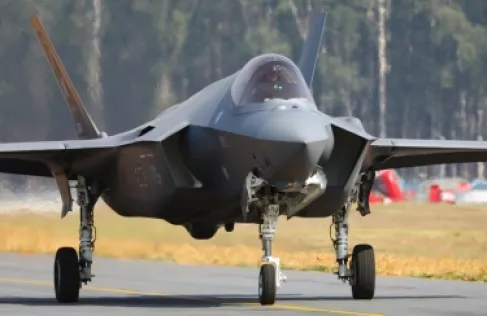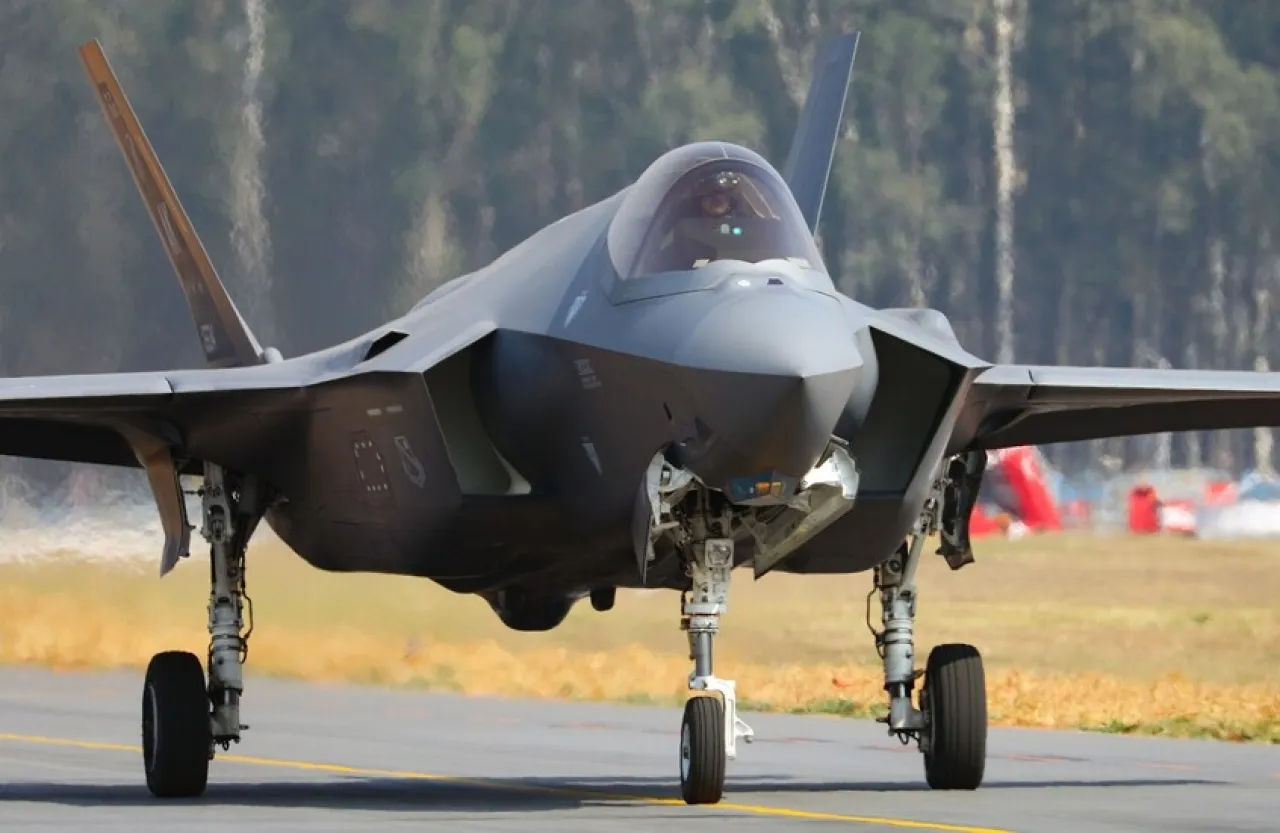
Khaberni - The F-35A (F-35A) is one of the most advanced fighters in the world and represents a key component in the fifth-generation system used by the American Air Force and a number of allies around the world. Despite its design for complex combat missions, stealth, and precise engagement in highly advanced air defense environments, its operation on long-haul flights reveals shocking figures about fuel consumption. A single hypothetical trip from the United States to China may require approximately 8,743 gallons of fuel, a number that reflects the complexity and cost involved in intercontinental missions.
This type of mission highlights an important aspect of operating modern fighter jets, namely the heavy reliance on air refueling to ensure the continuation of the journey. The greater the distance, the greater the need for precise coordination between the fighter jet and refueling aircraft, in addition to accurate calculations of range, consumption, and various flying conditions.
In this context, an important question arises about the efficiency of this aircraft in a long hypothetical journey from the United States to China, a distance that crosses the Pacific Ocean and poses a significant logistical challenge for even the most advanced aircraft. Such scenarios are not typically executed directly but rely on a series of aerial stops and ongoing support to ensure safe arrival, making them complex operations that require precise military planning at the highest level.
For an approximate calculation, one could choose a route between Eielson Air Force Base in Alaska and Shanghai Hongqiao International Airport in China. The distance between these two points is about 4,334 miles. Since this distance far exceeds the aircraft's intrinsic range, executing the trip requires reliance on several air refueling operations to ensure safe arrival. Even assuming ideal flight conditions free from wind or atmospheric disturbances, this mission remains extremely complex logistically, requiring precise planning and ongoing coordination between support aircraft and command centers to ensure the continuity of fuel supply throughout the journey.
The F-35A can carry up to 18,250 pounds of fuel as a maximum, while its practical range is about 1,350 miles. Dividing the total trip distance by this range, it turns out that the aircraft would theoretically need more than three air refueling operations, equivalent to about 3.21 times during the journey. Multiplying this number by the maximum fuel capacity, we get a total estimated consumption of about 58,582 pounds of fuel. This figure reflects the large dependence on air refueling in long-range missions, and it shows the limited intrinsic range of the aircraft when executing transoceanic and continental flights.
To convert this figure into a clearer picture, one could rely on Jet-A1 type aircraft fuel, which has a density of about 6.7 pounds per gallon. Thus, the total consumption reaches approximately 8,743 gallons of fuel for just one trip between the United States and China. This huge number reflects the amount of energy required to fly long continental distances and clearly highlights the very costly nature of operating advanced fighters in complex, long-range missions, according to the website "slashgear".
While these calculations remain estimates and are based on ideal conditions, they do not take into account many factors that could directly affect actual fuel consumption. Among these factors are flying speed, headwinds or tailwinds, atmospheric disturbances, as well as changes in altitude and flight path. All these elements can significantly increase or decrease the amount of fuel needed during the actual execution of the mission. However, these estimates clearly demonstrate that operating an advanced fighter like the F-35 in long-distance trips is a highly costly and complex process, both in terms of fuel and logistical support, making such missions rare and subject to very precise planning before execution.